Friday, June 5, 2026

This Vegan Poutine Recipe Actually Pulls Off Cheese Curds

From plantbasednews.org

Yes, the curds squeak 

Miyoko Schinner has built a career around answering one big question: how far can plant-based cheese really go? The vegan cheese pioneer, entrepreneur, and cookbook author has spent decades pushing vegan food into new territory. Now, she’s tackling a Canadian comfort food favourite with a vegan poutine recipe that swaps dairy cheese curds for something unexpected: fermented tofu.

Schinner, known for her YouTube channel The Vegan Good Life with Miyoko, recently shared a video showing viewers how to make vegan poutine with high-protein tofu cheese curds that stretch, bounce, and even squeak. The project is especially personal because Schinner admits she never tried traditional poutine before going vegan.

“You know, I went vegan when I was in my twenties and I hadn’t gone to Canada at the time, so I’d never had cheese curds,” Schinner says. “And I’ve never had poutine.”

The classic Canadian dish combines fries, cheese curds, and gravy. But Schinner wanted to do more than simply recreate it. She wanted to understand why dairy cheese curds behave the way they do and whether tofu could deliver something similar.

‘Why isn’t tofu cheese?’

Schinner’s vegan poutine swaps traditional cheese curds for fermented tofu curds that stretch, bounce, and squeak - Media Credit: YouTube / The Vegan Good Life with Miyoko

Schinner explains that tofu and cheese have more in common than people often realize.

“What do I have here?” Schinner says. “Okay, I have been wondering all my life, why isn’t tofu cheese?”

Both foods begin with coagulated proteins. Cheese comes from coagulated dairy milk. Tofu comes from coagulated soy milk. In both cases, curds form before eventually becoming the finished product.

The biggest difference comes afterward.

“With dairy cheese, not only do you coagulate the proteins, you ferment it with a bacterial culture,” Schinner says.

That fermentation process lowers acidity and changes protein and fat structures over time, helping create cheese’s flavour and texture. Standard tofu production skips fermentation entirely.

“But why not?” Schinner asks.

Instead of making conventional tofu, Schinner decided to borrow techniques from cheesemaking. Her goal was to ferment soy curds before pressing them, bringing tofu production one step closer to dairy cheese.

Creating high-protein tofu cheese curds

The vegan poutine recipe begins with soy milk. Schinner makes her own because it creates especially rich results, though she says carefully chosen store-bought versions work too.

“You can get a soy milk that doesn’t have any additives in it,” Schinner says. “Try to get one that just has soybeans water.”

She heats the soy milk to above 165 degrees Fahrenheit before adding dissolved calcium sulfate, also called food-grade gypsum. The ingredient acts as a coagulant, helping separate soy milk into curds.

Almost immediately, the transformation begins.

“See the curds already forming?” Schinner says.

Once coagulated, the mixture takes a different path than ordinary tofu. Schinner transfers the curds into a sterilized bowl and introduces fermentation culture.

“So, we are going to actually ferment this,” Schinner says.

She uses a probiotic fermentation blend but notes that probiotic capsules or yogurt could potentially help achieve a similar effect. The main objective is lowering acidity.

The curds then sit in a warm place for roughly 16 to 24 hours.

When Schinner checks the mixture the next day, she confirms it has developed noticeable tanginess.

“I tested the pH,” she says. “It’s around 4.3.”

The fermentation step moves the soy curds closer toward cheese territory.

“That’s the difference between tofu and cheese,” Schinner says. “They’re both made in a very similar process of making curds, but cheese is fermented.”

How Schinner creates squeaky vegan cheese

After fermentation, Schinner moves on to the step that transforms the tangy soy curds into something closer to cheese. Rather than pressing them firmly into tofu blocks, she drains off excess moisture while keeping the curds soft. Traditional cheese curds stay tender and springy, so she avoids compacting them too much.

The soft fermented curds go into a blender while the leftover whey-like liquid gets a second purpose. Schinner measures out half a cup and adds agar, a seaweed-derived gelling ingredient often used in vegan cooking. She heats it on the stove until fully activated before blending it into the curds.

Timing becomes important at this point. Agar begins setting quickly as it cools, so Schinner works fast. Salt goes into the mixture alongside psyllium husk powder, which helps create structure while adding something dairy cheese lacks entirely: fibre.

“This is a cheese that has the protein of tofu, but it has something that regular cheese doesn’t have,” Schinner says. “Which is fibre.”

As the blender runs, the mixture thickens dramatically. What starts as loose fermented curds turns into something dense, sticky, and noticeably more cheese-like. Schinner transfers it into a container and leaves it to chill for several hours.

Once fully set, the results surprise even her. The cheese pulls apart in strands similar to string cheese. It slices cleanly. Most importantly for this vegan poutine recipe, it develops some of the distinctive texture cheese curds are known for.

“It is a little squeaky,” she says.

She explains that the curds could become even more cheese-like with extra time in a salty brine made from leftover whey. The liquid would help deepen flavor while increasing saltiness. But for poutine, Schinner decides the cheese is ready.

Crispy fries make the foundation
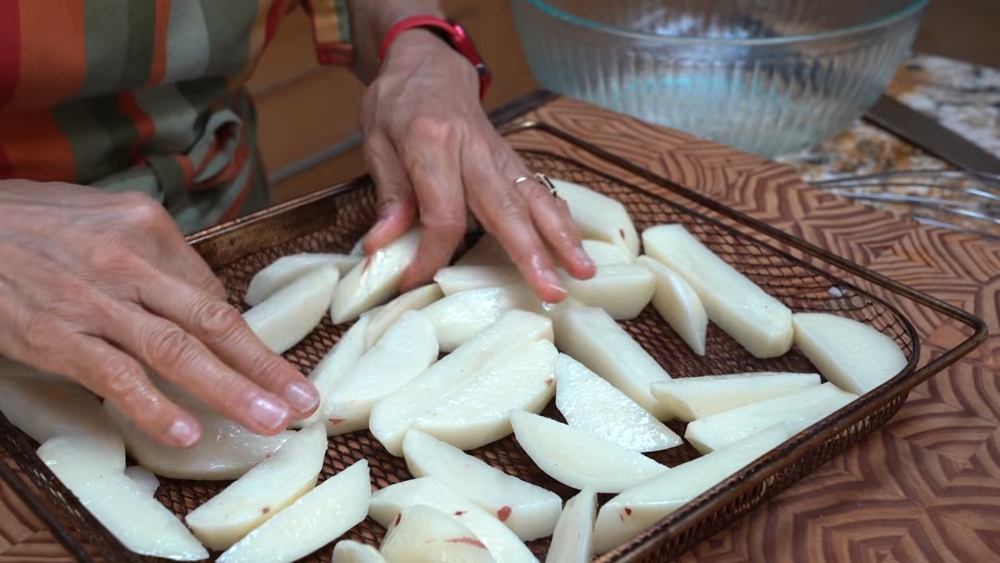
To prepare her vegan poutine recipe, Schinner places the soaked cut potatoes onto her air fryer rack
YouTube / The Vegan Good Life with MiyokoSchinner soaks the cut potatoes to remove excess starch and make them crispier and fluffier once air fried

Good poutine starts long before gravy enters the picture. Fries need enough texture to stand up to toppings without turning soft immediately. Schinner focuses heavily on preparation to make sure the potatoes stay crisp.

She cuts thick fries and immediately places them into cold water. The soaking stage matters whether the potatoes are air fried or deep fried.

“When you’re making fries, whether you’re deep frying or air frying, soak them for at least 1 hour,” Schinner says.

Her preference is soaking them overnight. The water pulls starch away from the potatoes, helping them crisp more effectively during cooking.

“It draws out a lot of that starch,” Schinner says, “and you get a fluffier, crispier fried potato that way.”

After drying the potatoes thoroughly, she coats them lightly with avocado oil and salt before moving them into the air fryer. The finished fries come out golden with crisp edges and soft centres, exactly the kind of texture needed to support gravy without collapsing underneath it.

Mushroom gravy adds savoury depth

Traditional poutine gravy often combines meat-based stock with a relatively light consistency that coats fries without overwhelming them. Schinner takes inspiration from those flavours while creating something entirely plant-based.

Instead of relying on packaged broth, she builds the gravy around her homemade mushroom bouillon base.

“We’re taking a slight departure from the traditional poutine gravy,” Schinner says. “But I guarantee you it’s going to be delicious.”

The process begins with vegan butter melting in a pan alongside a small amount of oil. Flour goes in next to create a roux, which slowly develops flavour as it cooks.

“We’re going to try to get that to brown just a little bit,” Schinner says.

As the flour darkens, nutty aromas begin building in the pan. Schinner combines hot mushroom stock separately before pouring it gradually into the roux.

“When you’re making gravy, always start with a hot stock,” Schinner says.

The technique prevents lumps and helps the gravy come together quickly. Soy sauce adds another layer of savouriness while a splash of red wine rounds out the flavour.

Unlike thicker American gravies, Schinner wants something lighter so that it coats the fries and cheese evenly.

As the gravy finishes cooking, she tastes it directly from the spoon. “I could just drink that like soup,” she says.

Miyoko Schinner tries (vegan) poutine for the first time

With every component finished, Schinner finally builds the dish she has spent years hearing Canadians talk about.

Hot fries go first. The homemade cheese curds get torn into smaller pieces and scattered across the potatoes. Then comes the gravy.

One detail matters more than complete meltability. Cheese curds in traditional poutine soften from heat without disappearing entirely. Schinner watches carefully to see how her tofu version behaves.

“The cheese curds are holding up,” she says.

The hot gravy softens them while preserving their structure. More importantly, they keep some of the springy texture she worked to create.

“They’re still a little squeaky.”

For someone trying poutine for the first time after decades of vegan cooking, the moment feels surprisingly meaningful. Schinner jokes about Canadian food traditions while taking another bite, clearly relieved that the experiment worked.

“I think that’s a winner,” she says. “I would serve this. I would eat this. This is good.”

The finished vegan poutine recipe reflects something Schinner has spent much of her career proving: plant-based cooking works best when it does more than imitate familiar foods. Sometimes understanding how ingredients behave opens entirely new possibilities.

https://plantbasednews.org/lifestyle/food/vegan-poutine-recipe/

Thursday, June 4, 2026

Subway has just added a new plant-based BBQ filling to its menu

From veganfoodandliving.com

By Rachel Smith 

Subway has unveiled a new smoky vegan BBQ Pulled Plant Protein filling for summer, bringing smoky barbecue flavours to its plant-based menu for a limited time

                                                                                    © Subway


Subway has expanded its plant-based menu with the launch of a new BBQ Pulled Plant Protein filling, available across the UK for a limited time from 3 June.

The new option features plant-based protein coated in a smoky and sweet barbecue sauce, offering a meat-free alternative for customers looking to enjoy classic BBQ flavours during the summer months.

The BBQ Pulled Plant Protein can be ordered as a Footlong or 6-inch Sub, wrap, salad or jacket potato through Subway’s Spudway range, giving customers a variety of ways to enjoy the new filling.

To mark the arrival of the new filling, Subway Rewards members can also claim 30% off any 6-inch or Footlong Sub purchased through the Subway app until 16 June.

                                                                                                                    © Subway

The BBQ Pulled Plant Protein is available now at participating Subway restaurants across the UK, as well as through the Subway app and selected delivery platforms.

The launch adds to Subway’s existing plant-based offering and provides another convenient option for customers looking to reduce their meat consumption without sacrificing flavour.

Subway’s vegan menu

Subway first entered the vegan market in 2019 with the launch of its Plant Patty, before introducing a series of meat-free products including the Meatless Meatball Marinara, T.L.C. (Tastes Like Chicken) sub, vegan Double Chocolate Cookie and Teriyaki ‘Steak’ Sandwich.

While many of these fan favourites are no longer available, the new BBQ Pulled Plant Protein gives plant-based customers something new to try this summer.

https://www.veganfoodandliving.com/news/subway-launches-new-vegan-bbq-pulled-plant-protein/


Adventures in ‘bad’ veganism: The ups and downs of a plant-based lifestyle

From eccunion.com/opinion 

By Heather Austin

I became a vegan at the beginning of summer in 2019.

Media including the 2011 film “Forks Over Knives” and 2015 book “How Not to Die” inspired my desire to lose weight and reduce my chances of cancer.

However, I struggle to be consistent in meeting my goals.

I have been making unhealthy or “bad” vegan choices since I began attending El Camino College in fall 2025, and I can no longer afford the ingredients that I initially bought when I became vegan.

I don’t have time to shop at different stores to get the lowest food prices. Before attending El Camino, I had eliminated bread and peanut butter from my diet.

My mushroom pastas turned to plain pastas with only tomatoes and seasonings quickly, especially with the closing of the 99 Cents Only Stores.

Healthy and economical vegan food options can seem about as common as vegetarians and vegans.

Roughly 6% of the U.S. population is vegetarian and about 4% is vegan, according to Statista.

The research mentions that individuals with these diets desire a healthier lifestyle, a choice more prevalent among younger consumers.

After watching “Forks Over Knives” in 2019, I lost about 10 pounds in two months by cutting meat and oil out of my diet.

Back then, I ate pasta, beans and rice, cabbage soup, and when I had time, steamed vegetables.

I used mushrooms in my pasta and drank lemon tea regularly. I read labels, avoided foods with unrecognizable ingredients, and prioritized organic foods.

I was happy with the initial weight loss, but another benefit was an improved immune system.

As a carnivore, I was frequently sick and was not keeping track of the impact that my food choices had on my health. Common colds on a carnivorous diet for me lasted up to two or three months.

I did not get sick until after Thanksgiving in 2020 with what I thought was the COVID-19 virus.

I never got tested for it, and I never went to the hospital. I treated the condition on my own with Chinese skullcap tea, which I learned about from Stephen Buhner’s 2013 book, “Herbal Antivirals.”

Each time that I got sick with what I thought was coronavirus, the symptoms became milder and milder, like a common cold.

I lost nearly 60 pounds over the course of a year during the lockdowns.

I can testify to the benefits of a vegan diet and herbal medicine, but I am not a perfect vegan. I am inconsistent in my vegan food choices due to finances, time and boredom.

                                                                                                  Illustration by Christol Nguyen

I am like many Americans, struggling to stretch a dollar for food and other necessities in an inflationary environment. 

During the fall 2025 semester, when food prices went up, I had to go back to peanut butter sandwiches to survive. This is a vegan choice; it’s just not a good one.

During the same semester, I began going to El Camino’s Warrior Pantry for more options.

I started to get bored with veganism. I used to eat cabbage soup a few days in a row. Sometimes I might cook pasta or beans and rice before rotating back into cabbage soup.

I watched my family eat cookies and cakes, while I hadn’t experienced a birthday cake for several years now.

That’s when I discovered vegan baking.

Through this new venture, I’ve baked vegan zucchini muffins, banana muffins, chocolate chip cookies and applesauce cake.

I used agave as a sweetener before prices went up and then I turned to processed sugar.

With all of my unhealthy vegan choices, I gained the weight right back.

El Camino nutrition professor Mary Lyons, a registered dietitian who has a master’s in nutrition science with an emphasis in food science from California State University, Long Beach, offered me some advice for getting back on track with my lifestyle and health goals.

Lyons provided many tips, including avoiding junk foods, candy, sodas and sweetened plant-based milks by loading up on fruits and vegetables instead.

After speaking to Lyons, I realized that our conversation was not enough.

The tips she gave me for this article is enough to get started on the path to eating well. I have looked at the nutritional science classes and I have always been curious.

Now, I really want to enrol in nutrition science in the future, so I can learn how to be a healthier vegan.

Plant-based nutrition tips
Professor and registered dietitian Mary Lyons offered tips on how people on plant-based diets can make healthier choices within their diet.
Lyons teaches nutrition science at El Camino College and California State University, Long Beach.
“You can do omnivore very well. You can do omnivore very poorly. You can do vegan well. You can do vegan very poorly,” Lyons said.
1. Avoid unhealthy food choices. Vegan junk food such as processed carbohydrates, potato chips, french fries, candies, sweetened beverages, sweetened dairy substitutes, sweetened almond or coconut milk, high fructose corn syrup, sweetened fruit juice, fake meat substitutes and soda are common culprits in plant-food diets.
2. Choose whole food options. Entire fruits, vegetables, fungi, yeast, nuts, seeds, legumes and grains or meals made from these simple ingredients are better than overly processed versions. Some items worth including in a diet are veggie burgers made of mushrooms, unsweetened dairy alternatives, olive oil, avocado oil, coconut oil, dark chocolate, coffee, tea, quinoa, buckwheat, amaranth, edamame and tempeh.
3. Buy frozen produce. Fruits and vegetables from the freezer section help reduce waste, save money and hold more nutritional value. “It’s picked at the peak of ripeness … It’s achieved optimal nutritional value, and then it gets flash frozen and it keeps its nutritional value, so when you’re ready to use it, it didn’t get lost in the freezing process,” Lyons said.
4. Batch cook healthy dishes. Prepare food on days off, then freeze some and keep the rest available in the refrigerator to grab for a quick meal.
5. Get routine check-ups. Make annual health appointments with a doctor. Bloodwork helps assess one’s vitamin levels such as B12, vitamin D and iron. Don’t take iron supplements without a doctor’s recommendation.
6. Consult guides. Check out the new food pyramid and nutritional guidelines for Americans at RealFood.gov.
7. Load up on fruits and vegetables. They contain fibre and help people feel full, which can help with weight loss. They feed the gut microbiome that helps overall mental and physical health.
8. Choose options with vitamins and minerals. For unsweetened plant-based milk substitutes, choose ones fortified with B12, iron and vitamin D.
9. Pair plant foods according to mutual supplementation. “Mutual supplementation is something that helps you achieve essential amino acids by pairing two plant-based foods together,” Lyons said. Examples include beans and rice or hummus and pita. “By pairing certain plant-based foods together, you can get all 9 essential amino acid needs met,” she said.
10. Use time-saving recipes. Find recipes based upon time to prepare on TheStingyVegan.com.
11. Look for recipes from other dietary approaches. Find recipes for the Plant-Based Whole30 Plan at Whole30.com. “I think the more variety you can add to a vegan diet, the better, because then you won’t get bored,” Lyons said.
12. Stock your pantry. “You have to build your kitchen,” Lyons said. Pantries should include spices such as curry powder, cumin, garlic powder, chili and cayenne pepper. Refrigerators can store salsa, hot sauce and sweet chili.
13. Go to farmers markets. Find nearby markets online.
14. Use salad bars. The salad bars at places like Whole Foods can help save money and eliminate waste.
15. Create a personal menu. Plan five to 10 recipes for breakfast, lunch and dinner. Creating a menu helps build a kitchen and a grocery list.
16. Explore different cuisines. Nearby international, cultural restaurants for plant-based foods with a lot of flavour such as Thai, Vietnamese, Mexican or Indian restaurants.
17. Log food intake for at least three days. This helps people assess whether their eating habits are healthy or not. Lyons likes the Cronometer app for monitoring a diet, but any logging method can work.
18. Get Omega-3 fatty acids. Consume flax seeds, chia seeds or hemp seeds to increase Omega-3 fatty acids. Algae-based foods sourced from the ocean are another source.

https://eccunion.com/opinion/2026/06/03/adventures-in-bad-veganism-the-ups-and-downs-of-a-plant-based-lifestyle/ 

Wednesday, June 3, 2026

Seitan 101: What It Is, How to Cook It, and a Look at Its Nutrition

From pcrm.org

By Xavier Toledo, MS, RD, LDN


If you’re unfamiliar, Chicken Shop Date is a popular interview series hosted by Amelia Dimoldenberg that pairs celebrity guests with playful conversations over a casual meal. During Paul McCartney’s appearance, however, one menu choice may have stood out to viewers: Instead of chicken, he opted for seitan.


For long-time plant-based eaters, that choice probably wasn’t surprising. But for others, it may have sparked a question: What exactly is seitan?

Pronounced say-tan, seitan is a protein-rich food made from wheat gluten. It has a hearty, chewy texture that makes it popular in everything from sandwiches and stir-fries to tacos and grain bowls. Even though it might feel like a modern plant-based trend to those unfamiliar with it, seitan has been enjoyed for centuries.

Whether you’re simply curious or looking for new plant-based protein options, here’s what to know.

What is seitan?

Seitan is a plant-based food made from wheat gluten, the main protein found in wheat. It’s been used for centuries in East and Southeast Asian cuisines, where it’s valued for its chewy, satisfying texture and ability to absorb flavour.

Unlike tofu or beans, seitan is especially known for its meaty bite. That texture is what makes it show up in dishes like stir-fries, sandwiches, and skewers.

Because it’s made from wheat protein, seitan is naturally more concentrated in protein than many plant foods. That’s part of why it often takes centre stage in meals rather than playing a supporting role.

How seitan is made (and how it’s used)

At its core, seitan starts with a simple process: Wheat flour is mixed with water, then washed to remove the starch. What’s left behind is the gluten—an elastic, protein-rich mass that can be shaped and cooked.

That gluten is then seasoned and simmered, baked, or steamed until it develops its familiar firm, chewy texture.

From there, seitan becomes incredibly versatile in the kitchen. It can be:

  • Sliced into sandwiches in place of deli meats
  • Stir-fried with vegetables and sauces
  • Cubed into stews or curries
  • Grilled on skewers
  • Breaded and pan-fried for a “cutlet”-style dish

One important thing to know is that how seitan is seasoned and prepared can influence its overall nutrition profile.

For example, a lightly seasoned homemade version simmered in broth will look very different nutritionally from a deeply marinated, pan-fried, or restaurant-style version that may come with added oils, sauces, or sodium-rich seasonings.

That doesn’t make one “good” and the other “bad”—it just means seitan is highly adaptable. The way it shows up on the plate often depends on what someone is prioritizing in that moment, whether that’s flavour, convenience, or specific nutrition goals.

In my opinion, that versatility is part of its appeal. Seitan can be built into a more nutrient-dense, balanced meal when paired with whole grains, vegetables, and minimally processed sauces. Or it can be prepared in a more indulgent, flavour-forward way depending on the dish. I enjoy both. That said, Temple of Seitan—the restaurant featured in the aforementioned Chicken Shop Date episode—will be seeing me next time I’m in London.

Like many ingredients, it sits on a spectrum. What you get out of it often comes down less to the food itself—and more to how it’s used.

Seitan nutrition: what to know

How much protein does seitan have?

Seitan often gets attention for one main reason: protein.

While it varies by brand and recipe, a 3-ounce serving of seitan can provide around 15–25 grams of protein, with some providing even more. For comparison, a 3-ounce serving of chicken breast provides about 25 grams of protein, while a 3-ounce serving of lean ground beef provides about 22 grams.

Among plant-based protein foods, seitan is one of the most protein-dense options available. A comparable serving of extra-firm tofu typically provides around 8–12 grams of protein, while a 3-ounce serving of tempeh provides about 15–20 grams. Beans and lentils are also excellent sources of protein, though they tend to provide less protein per ounce while contributing more fibre and carbohydrates.

That doesn’t mean seitan is “better” than these foods. Each brings something different to the table. Tofu and tempeh contain more healthy fats, while beans and lentils are especially rich in fibre. Seitan’s standout feature is simply that it packs a lot of protein into a relatively small serving.

Is seitan low in carbs?

Because seitan is made primarily from wheat gluten rather than the whole wheat grain, most of the starch is removed during production.

As a result, seitan is typically relatively low in carbohydrates, often providing around 3–8 grams per serving, depending on the recipe or brand.

This can make it appealing to people looking for a protein-rich option that is lower in carbohydrates than foods like beans, lentils, or whole grains.

Does seitan contain fat or saturated fat?

Seitan is typically low in total fat, with many varieties providing just 1–3 grams (or less) per serving.

Many seitan products also contain little to no saturated fat. That’s notable because replacing foods higher in saturated fat with foods lower in saturated fat is one dietary strategy associated with improved heart health.

Unlike foods such as tofu, tempeh, nuts, or seeds, seitan doesn’t contribute much fat to a meal. Depending on your goals, that can be either a benefit or a reason to pair it with other nutrient-rich foods.

Of course, the final nutrition profile depends on how it’s prepared. A grilled seitan skewer will look very different nutritionally from a breaded and fried seitan cutlet.

Is seitan high in sodium?

One of the biggest nutrition differences you’ll see with seitan is sodium content, especially in store-bought or pre-seasoned versions.

Some packaged products can be moderately high in sodium depending on how they’re flavoured or prepared.

If that’s something you’re watching, a few simple strategies help:

  • Check the Nutrition Facts label
  • Compare brands (they vary a lot)
  • Or opt for homemade versions if interested

  • Homemade vs store-bought

Both can absolutely fit into a balanced pattern of eating, but they offer different advantages:

Homemade seitan
  • Full control over sodium and seasoning
  • Flexible flavour profiles
  • Often more budget-friendly
Store-bought seitan
  • Convenient and ready to use
  • Consistent texture
  • Wide variety of flavours and styles


What does seitan taste like?

On its own, seitan is fairly neutral, but its strength is how well it takes on flavor.

The texture is what people notice first—chewy, firm, and hearty. It’s often described as one of the closest plant-based foods to meat in terms of bite.

From there, everything comes down to seasoning. Marinades, sauces, and cooking methods do most of the work in shaping its final taste. Garlic, soy sauce, smoked spices, barbecue sauce, or broth-based cooking can completely transform it.

Who should avoid seitan?

Seitan can be a great option for many people, but it isn’t for everyone.

Because it’s made from wheat gluten, it should be avoided by people with:

  • Celiac disease
  • Non-celiac gluten sensitivity
  • Wheat allergies
    For everyone else, it can be one of many protein options that fit into a varied eating pattern.

The bottom line

Seitan is a long-standing plant-based protein made from wheat gluten that has earned its place in a wide range of global cuisines.

It’s high in protein, low in fat and carbohydrates, and incredibly versatile in cooking. Like most foods, its value comes down to how it’s used, how it’s prepared, and how it fits into the broader pattern of your diet.

If this is your first time hearing about seitan, a good starting point can be picking up a store-bought version or trying a simple homemade recipe.

It works especially well in dishes in place of chicken, beef, or other animal proteins—think stir-fries, sandwiches, or grain bowls.

If you end up trying it, you’ll probably understand pretty quickly why it’s been around for centuries.

https://www.pcrm.org/news/seitan-101-what-it-how-cook-it-and-look-its-nutrition