Showing posts with label UK. Show all posts

Monday, November 9, 2026

Tesco’s Vegan Chocolate Orange Segments Are Here For The Holidays

From plantbasednews.org

By Liam Pritchett

Tesco rolled out the new chocolate orange segments alongside truffles and giant buttons 

Tesco has launched vegan chocolate orange segments just in time for the holidays.

The new Tesco Finest Free From Belgian Chocolate Seville Orange Segments feature loose chocolate pieces, similar to the iconic Terry’s Chocolate Orange, a year-round product that many consider an annual Christmas treat.

The chocolate orange segments are made with a combination of Belgian chocolate and Seville orange oil and are shaped to appear like individual orange slices.

Tesco's vegan chocolate orange segments in are in supermarkets now - Media Credit: Darrell Sawczuk

The new chocolate orange segments aren’t the only vegan treat Tesco has introduced for the holidays. The British supermarket has also introduced Tesco Finest Free From Cocoa Dusted Truffles and Giant Buttons with Sea Salt.

According to Tesco, the plant-based truffles feature a dark chocolate truffle filling inside a cocoa-dusted chocolate shell, while the buttons are 60 percent dark Belgian chocolate sprinkled with sea salt from Anglesey, Wales.

Tesco Finest Free From Belgian Chocolate Seville Orange Segments are available now at a price of £3.25 per 90g bag. The Cocoa Dusted Truffles and Giant Buttons with Sea Salt also cost £3.25 each.

In October, award-winning plant-based confectionary brand The Undairy Co launched a new selection box, featuring a mix of individually wrapped chocolates.

Each Icons Selection Box includes flavours like Original Creamy, a classic dairy-style chocolate; Speculoos Biscuit, a Biscoff-inspired truffle; Honeycomb, inspired by Crunchie; Gooey Cream, a take on the Creme Egg; Hazelnut Praline and Truffle, inspired by Quality Street’s Big Purple and Green Triangle, respectively; and Chocolate Orange, also inspired by Terry’s Chocolate Orange.

The Icons selection box has an RRP of £18.95 per 280g.

https://plantbasednews.org/lifestyle/food/tesco-vegan-chocolate-orange-segments-holidays/

Wednesday, November 4, 2026

UK: London’s Only Vegan Michelin Restaurant Is Almost Impossible to Book. I Found Out Why.

From vegnews.com 

By Charlotte Pointing

Green curry cappuccinos, mushroom-worshipping dances, and tick bites. Forget everything you thought you knew about fine-dining—London institution Plates is showing exactly why it’s England’s first—and only—vegan Michelin-starred restaurant

In Japan, maitake is known as the “dancing mushroom,” because according to folklore, foragers would have no choice but to literally dance with joy when they saw its signature brown ruffles nestled at the base of Mizunara oak trees. It wasn’t the apparent medicinal benefits that would force toes to tap and arms to wave, but the fungus’ flavour. Maitake bursts with umami: it’s savoury, earthy, tender—almost chicken-like, hence its nickname “hen of the woods.”

In the United Kingdom, at Plates, there aren’t any Mizunara oak trees, but there is plenty of dancing. As diners bite into meaty barbecued maitake mushrooms served on a bed of black bean mole topped with tangy kimchi, creamy aioli, and finished with a crust of crunchy puffed rice, they close their eyes, nod their heads, and sway their bodies in a display of unmistakable food-induced joy.

Safia Shakarchi

A Michelin mainstay

Plates, the UK’s first and only vegan Michelin-starred restaurant, sits in one of the most vibrant corners of Shoreditch, a trendy borough in East London. It’s lively, full of the fashion, street art, creativity, and chaos that characterize the city. Heading to Old Street, I dodge a stream of traffic and throngs of commuters spilling out from pubs after squeezing in just one more pint before descending to the Tube. It is London through and through, glorious, if not overstimulating. So stepping into Plates, full of soft, flickering candles and gentle lighting, feels almost like a mirage.

Inside the intimate, 25-seat dining room, I take in earthy, rich woods, cement walls, and natural textures. I immediately feel warm and at ease. The vibe and the aesthetic are pure hygge, which provides valuable respite from the capital’s fast pace, but also the perfect backdrop to a theatrical display of the potential of plant-based ingredients.

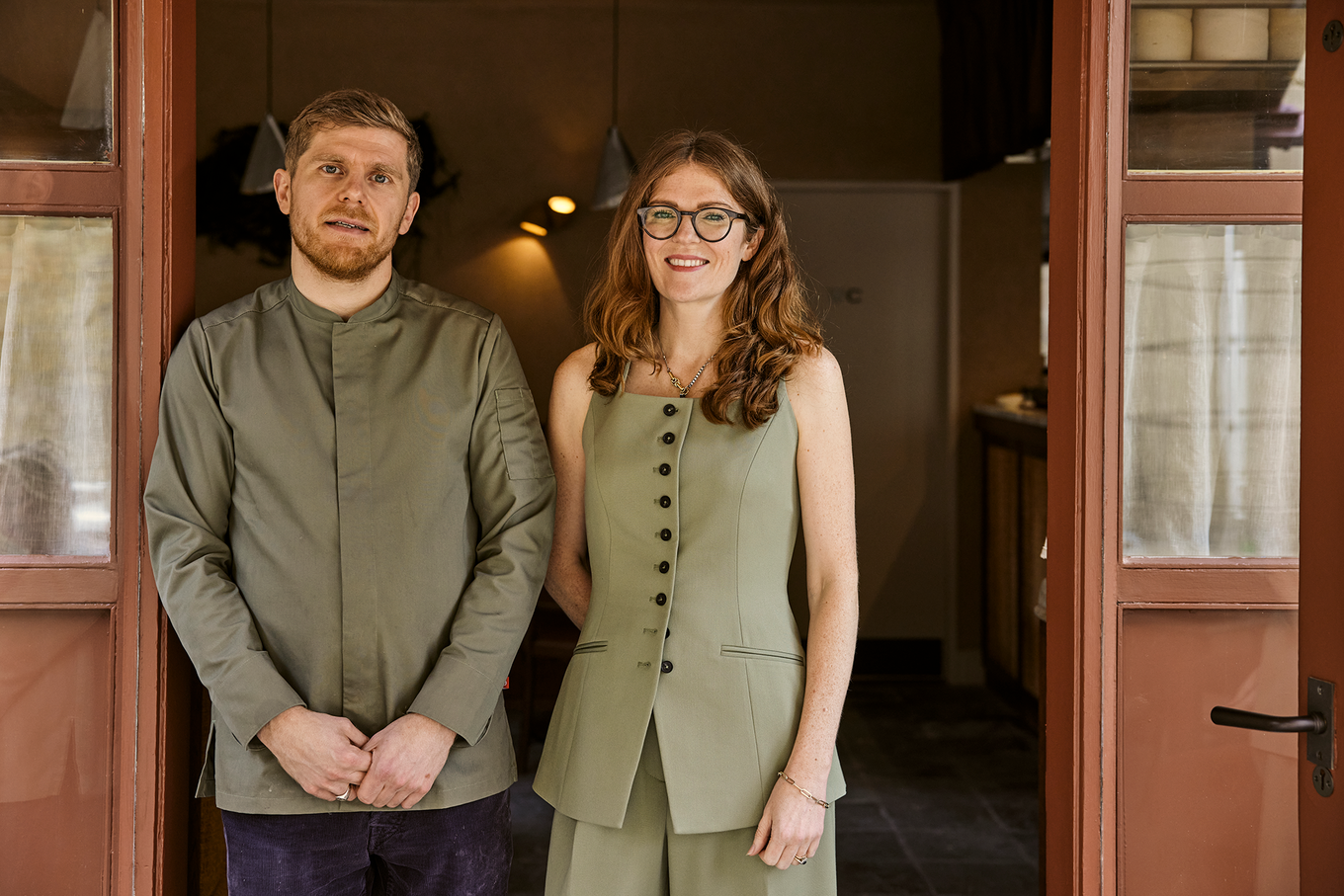
Also contributing to the overall sense of calm is the team behind it all. Much of the small kitchen is open, so diners can watch chefs quietly prepare each dish with careful precision and just the right amount of creative flair. Forget what you think you know about fine-dining culture: this isn’t The Bear. There are no Gordon Ramsay-level explosions. In fact, Kirk Haworth, head chef and co-founder, isn’t a showman at all. He comes off as quiet, considered, and softly spoken. Often, he plays the supporting role during service, standing behind servers and chefs with trays of ingredients for tableside service or cutlery as they present each meticulously crafted course to diners.

If it’s gruelling to work at Plates, no signs are evident. And make no mistake, the culture is entirely by design. “I’ve worked in kitchens where service almost feels like it’s been created to be difficult,” Haworth explains. “I try to do the opposite. The difficult part should be getting all the preparation right and getting the team organized, so that when service starts, it can feel as calm, fluid, and easy as possible.”

Plates

Creativity and cappuccinos

If the maitake dish is a dance, the next course is a chorus of seasonality. Slow-cooked English tomatoes, strawberries, and shiso leaves are sprinkled with frozen tarragon snow—innovative, but understated. As Haworth himself tells us, “sometimes the most interesting thing you can do is leave an ingredient alone and let it be exactly what it is.” Sometimes, but not always. Arguably, half the fun of running a Michelin restaurant is the creative license.

Haworth, who co-founded and runs Plates with his managing director sister Keeley Haworth, cut his teeth in some of the world’s most impressive eateries, including The French Laundry, Restaurant Sat Bains, The Square, and Sydney Harbour’s Quay. He knows how to elevate and experiment with simple ingredients and familiar flavours, and the Thai green curry cappuccino that diners are greeted with shortly after taking their seats is evidence of that. As is the sweetcorn and passionfruit cappuccino that comes halfway through Plates’ eleven-course Discovery Menu.

There is no coffee in Plates’ signature cappuccinos, but the familiar, frothy texture is all there. The flavour—that’s where the experimentation comes in. The first sip is warm, foamy corn; the final one is chilled, juicy passionfruit. An accompanying stone cube holds a delicate sweet and sour truffle. And there’s a surprise underneath it all, but I won’t say more than that.

“I think the cappuccino sits right on the edge of challenging people’s flavour perceptions while still being delicious, comforting, and nostalgic,” says Haworth. “That’s a very Plates thing to do: take something that feels familiar and turn it into something unexpected.”

If guests are still in the mood for another sip, the 12-page list of wines, cocktails, beers, non-alcoholic tipples, coffees, and teas provides ample opportunity. Highlights include the cult-status Vouette et Sorbée Champagne from the Côte des Bar region of France; Lamoresca, a classic Sicilian red wine revered for its fruitiness and notes of bitter wild herbs; and forward-thinking signature cocktails like the Blackberry & Mulberry Leaf Spritz and the Martinez with Strawberry & Mushroom Garum—a complex, sweet-and-savoury spin on the classic gin and vermouth drink.
©-Safia-Shakarchi---Plates---19.06.2024---High-Res--12Safia Shakarchi

Vegan beginnings

Haworth has had to think outside the box for much of his career. While working in Australia more than a decade ago, a tick bite changed everything for the rising culinary star. A diagnosis of late-stage Lyme disease meant transforming his lifestyle, his diet, and everything he knew about cooking. Ingredients previously thought of as staples—like meat, fish, gluten, refined sugar, and dairy—were gone. It would be enough to make some chefs flounder, but Haworth had Michelin-level training, a supportive family (his father, Nigel Haworth, is also a renowned Michelin-starred chef), and the tools to embrace a whole new world of fruit, vegetables, and fungi. Still, it wasn’t an easy ride.

“I had to unlearn everything and start again,” he explains. “I had to rethink how you create flavour and how you make dishes that feel special without relying on those traditional ‘star’ ingredients like scallops, turbot, venison, steak, and caviar. Ingredients that can naturally become the centrepiece of an incredible dish.”

In 2017, he and Keeley launched the Plates pop-up, a platform to introduce Londoners to Haworth’s new creations. “It was humbling to start again,” recalls Haworth. “But it was also incredibly interesting. In a way, it gave me a completely new fuel creatively and changed the way I think about cooking.”

The timing is significant. Plates was at the forefront of a new era; in 2017, veganism and the plant-based movement were really starting to take root in England’s capital city. Nearly 10 years later, London has evolved into a hotbed of plant-based innovation, and Plates is still leading the way.

Its current brick-and-mortar in the city’s trendy Shoreditch district came in 2024, and the coveted Michelin star followed just one year later. Now, scoring a seat at Plates requires a lot of planning and fast fingers. Once released via a newsletter, reservations sell out in minutes.

Mushroom magic

A table at Plates is worth the level of planning required. Courses of joy-inducing maitake, unexpected cappuccinos, house-made cheese, croissant-esque, house-laminated sourdough, and a choice of expert wine pairings (including options like the House Pairing, the Rare & Unique Wine Flight, and the Botanical Pairing) all build up to Plates’ staple dish and the main event: caramelized lion’s mane.

My plate featured a tender, juicy slice of this versatile mushroom with barbecued eggplant, pickled cucumber, gooseberries, and basil, but previous iterations have seen it presented alongside Tokyo turnips and salsa verde or cauliflower cream and smoked shio koji. The ingredients are always changing, but the mushroom itself is a mainstay.

Before you’re served, you’ll be presented with an untouched mushroom in its full, bright white, shaggy glory and a brief education about where it comes from. In nature, lion’s mane grows in the forests of the Northern Hemisphere, but Plates sources the ingredient from an operation in nearby Essex, where it’s cultivated in repurposed shipping containers.

Showcasing the mushroom in its raw form helps diners understand the magic of fine-dining: what a toothy fungus native to temperate hardwood forests can truly become with the right skill set behind it.

“I hope people leave Plates feeling a little more curious about what’s possible with nature,” he says. “What you can do with plants, fruit, and vegetables without needing meat or fish.”

Before my dining partner and I dragged ourselves back to the bustling streets of London, Plates closed us out with two courses of dessert. One revolved around velvety smooth chicory root ice cream and sour cherry compote, and the other featured the finest English raspberries, meadowsweet ice cream, almond praline, mochi, and shavings of black truffle.

“I want [diners] to think, at the end of the day, that the food was just delicious and that they felt completely satisfied,” he says. “But, ultimately, I want them to want to come back.”

Most, we imagine, are happy to oblige. Plates is an experience that’ll stay with you for a long time. Soon enough you might find yourself refreshing your email, waiting for news of more reservations. And when you do return, Haworth will be waiting patiently to serve you more innovation, more plants, and, most importantly, more of that maitakelevel joy.

Friday, October 30, 2026

UK: Oxford University invites 100,000 people to take part in a major study of plant-based diets

From ndph.ox.ac.uk

Researchers at Oxford Population Health have launched a major new study designed to generate the most up-to-date picture of different diets in the UK, including plant-based diets, and how they affect long-term health and wellbeing. 

All UK residents aged 18 years and over are invited to complete an online questionnaire, regardless of whether they regularly consume meat, fish, and dairy products, or follow a flexitarian or plant-based diet. Participants can also opt to receive a personalised nutrient report, contribute biological samples, and complete follow-up questionnaires. 

Funded by the Medical Research Council, part of UK Research and Innovation, the EPIC-Oxford 2 study will investigate the health effects of modern diets as dietary habits in the UK continue to evolve.  

The project builds on the original EPIC-Oxford study, one of the best-known studies of vegetarian and vegan diets, which began in the 1990s and has followed the health of around 65,000 people living throughout the UK. 

The main objective of EPIC-Oxford 2 is to establish the world's most informative resource for studying the health benefits and risks of modern plant-based diets. The EPIC-Oxford 2 team aims to involve around 100,000 people, including 80,000 new volunteers alongside participants from the original EPIC-Oxford study.

Why the study is needed 

The UK's food landscape has changed significantly since the original EPIC-Oxford study was established more than three decades ago. Previous studies of vegetarian and vegan diets were conducted before the widespread availability of today's plant-based meat and dairy alternatives, and relatively little is known about the long-term health effects of modern dietary patterns.  

EPIC-Oxford 2 aims to address this evidence gap by collecting detailed information on diet, lifestyle and health from adults across the UK. Key changes in the food landscape and dietary patterns include: 

  • An increasing number of people are following a flexitarian, pescatarian, vegetarian or vegan diet; 

  • Growing interest in reducing consumption of meat and other animal products for health, environmental and ethical reasons; 

  • Rapid expansion in the availability and consumption of plant-based food products; 

  • Increasing public debate about the health impacts of ultra-processed foods, including plant-based alternatives. 

Keren Papier, Chief Investigator and Senior Nutritional Epidemiologist at Oxford Population Health, said:

More people in the UK are experimenting with plant-based diets than ever before, but what people are eating today is very different from what they were eating when many of the studies that inform current evidence were conducted. Participants in this study will help us to address many important questions about how modern diets affect long-term health; we are very grateful for their input.

How this study contributes to health research 

The original EPIC-Oxford study revealed important differences in disease risk between people following different diets, including vegans, vegetarians, pescatarians and meat-eaters. Researchers observed differences in the risk of conditions such as heart disease, diabetes and some cancers, but many questions remain. EPIC-Oxford 2 aims to go beyond identifying patterns by combining information on diet, health, lifestyle and biomarkers.  

Keren Papier added:

With EPIC-Oxford 2, we want to go beyond describing those differences in disease risk and better understand the biological mechanisms that may explain them. By combining population-level diet research with molecular studies, we hope to build stronger evidence on how diet affects health and support better disease prevention in the future.

Take part 

EPIC-Oxford 2 is open to anyone aged 18 years or over living in the UK. Researchers are keen to hear from everyone, whatever they eat. The information gathered will support future investigations into a range of important health outcomes and may help inform dietary guidance for the public.  

People interested in taking part in the study can find out more on the EPIC-Oxford 2 webpages and complete the online survey which will take around 25 minutes.   


https://www.ndph.ox.ac.uk/news/oxford-launches-major-uk-study-of-plant-based-diets 

Thursday, October 29, 2026

Future Food Quick Bites: Burger King Royale, Vegan Chocolates & SuperYou Protein

From greenqueen.com.hk

By Anay Mridul

Our weekly column rounds up the latest sustainable food innovation news. This week, Future Food Quick Bites covers Burger King’s Vegan Royale offer, The Undairy Co.’s dairy-free chocolates, and the cost of UPF labelling.

New products and launches

As part of its ongoing partnership with The Vegetarian Butcher, fast-food chain Burger King is offering a buy-one-get-one-free deal on 250,000 Vegan Royale sandwiches to UK customers who purchase one of the former’s products in supermarkets. The purchases must be made before November 22, and shoppers can redeem the burger offer until December 31. 

Courtesy: The Undairy Co.

UK chocolate brand The Undairy Co. has launched the Icons Selection Box, a plant-based take on Mars’s Celebrations chocolate mix, featuring seven options that resemble Dairy Milk, Terry’s Chocolate Orange, Biscoff truffles, and the Cadbury Creme Egg.

Speaking of vegan chocolate, Cornwall-based Buttermilk has launched a Caramel Choc Biscuit Fingers bar in the style of Twix at Morrisons, priced at £1.50 per 50g.

Courtesy: HappyVore

HappyVore, France’s best-selling meat alternative brand, has expanded its plant-based cordon bleu range with a tomato version, after it became the “biggest launch” in the country’s vegan deli category, according to its founder.

Indian pet food brand Drools has rolled out 100% Veg Gravy, a plant-based wet food for dogs, designed to be served as a complementary food or mixed with dry kibble to add moisture, aroma and variety.

Fellow Indian start-up SuperYou, co-owned by Bollywood actor Ranveer Singh, has made its US debut, launching its fermented yeast protein powder at Walmart, and soon on Amazon.

US woman-owned wellness start-up Mujo Co. has teamed up with Rubisco protein maker Plantible Foods to launch a vanilla protein powder combining the latter’s duckweed-derived protein with yellow pea protein and coconut MCT oil. It delivers 22g of complete protein per 30g, and will begin shipping next month for $45 per 450g pack.

Meanwhile, US frozen food company Blackbird Foods‘s plant-based pepperoni pizza has landed on the shelves of select Target stores.

And New York-based Sweet Vegan has kickstarted its fifth annual Harvest Basket Giveaway, bringing together 16 brands to offer one winner a box of vegan food, desserts, beauty, wellness, fashion, dining experiences, and lifestyle products worth over $3,500.

Company and finance updates

US fermentation start-up Superbrewed Food has hired former Kerry Group and Nuritas executive Rizwan Khan as its new CEO, who will take over from co-founder Bryan Tracey (who now serves as company president). It has simultaneously announced results from a consumer trial of its Thrvia postbiotic, with 89% of participants showing improvement in their overall digestive health scores after four weeks.

Courtesy: Superbrewed Food

Californian precision fermentation start-up The Every Company has secured a new US patent covering advanced ovalbumin (the main protein in egg whites) compositions and food applications across a range of microbial strains (such as Pichia pastoris, Trichoderma reesei, and Aspergillus niger). It is the firm’s 65th granted patent globally.

Israeli precision-fermented dairy start-up Imagindairy has appointed Paul Kollesoff as its executive chairperson. He previously had senior leadership roles at Glanbia Nutritionals and Perfect Day (where he founded consumer brand The Urgent Company).

Copenhagen-based mycelium protein start-up Tempty Foods has been recognised as the Danish Food Start-up of the Year 2026 by the Danish Startup Group.

US rubisco protein startup Fudi Protein and cultivated meat media supplier Deco Labs have won the pitch competition at Bezos Earth Fund‘s second annual summit by the Bezos Center for Sustainable Protein at North Carolina State University, securing $75,000 each.

Russian dairy processor Milk Logic (formerly Danone’s subsidiary in the country) has acquired Poligrin, the parent company of the 5Yes! brand of plant-based milk, preserving the latter’s product recipes and team.

Research and policy developments

French precision fermentation start-up Verley has secured its first US patent, covering the microparticulation of its animal-free beta-lactoglobulin protein.

If the UK Parliament replaced 30% of its meat, fish and shellfish purchases with plant proteins like legumes, nuts and tofu, the government could save £216,000 a year in food procurement costs, according to analysis by Humane World for Animals.

The UK’s Alternative Proteins Association has published a best-practice guidance document for conducting novel food taste trials, drawing on insights from the Food Standards Agency‘s cultivated meat sandbox programme.

Algal oil and yeast protein have been named the top ingredients for use in alternative pet food by the Centre for Feed Innovation and the Pet Sustainability Coalition.

A large-scale study of 1,305 cats by the Griffith University School of Environment and Science in Australia has found that felines fed a vegan diet have a 34% lower chance of being assessed as overweight.

As the US government weighs up how to define ultra-processed foods (UPFs), a University of Chicago analysis suggests that mandatory UPF labelling could impact nearly three-quarters of packaged food products in the country and cost them $14.2B – and that doesn’t include an extra $1B a year in lost revenue for domestic agriculture and $7.7-8.7B in increased annual food import costs.

Finally, speaking of weight and UPFs, a study by the Physicians Committee for Responsible Medicine has revealed that eating more meat, fish, eggs, and dairy products was linked with weight gain even when they were minimally processed, while similarly processed plant-based food – like fruits, vegetables, whole grains, and beans – had the opposite effect.

https://www.greenqueen.com.hk/future-food-quick-bites-burger-king-royale-vegan-chocolates-superyou-protein/

Tuesday, October 27, 2026

Buttermilk Is Launching A Vegan Twix

From plantbasednews.org

Buttermilk's Caramel Choc Biscuit Fingers bar is coming to UK supermarkets 

Buttermilk is launching a vegan Twix.

The dairy-free chocolate brand’s new Caramel Choc Biscuit Fingers bar is thought to be the first Twix-style vegan chocolate bar to arrive at major supermarkets in the UK.

Writing on Instagram over the weekend, Buttermilk called for fans to guess what the newest plant-based chocolate bar from the company will be. Since then, Morrisons has listed Buttermilk’s Twix-style Caramel Choc Biscuit Fingers bar on its website.

According to the Morrisons listing, Buttermilk’s latest sweet treat includes two gluten-free biscuit fingers “layered with caramel” and coated in dairy-free milk chocolate.

Fans celebrated the news of a vegan Twix in Buttermilk’s comments on Instagram. One person wrote, “If it’s a Twix you can take all my money!” Another wrote, “Woohoo, a vegan Buttermilk Twix!!! Love your coconut bar and can’t wait [to] try this one.”

Buttermilk’s Caramel Choc Biscuit Fingers bar has an RRP of £1.50 per 50g.

Plant Based News (PBN) reached out to Buttermilk for more information.

Buttermilk has ‘re-imagined’ the UK’s favourite chocolate bars

Photo shows a selection of popular chocolate bars cut in half, including a Bounty, a Crunchie, a Snickers, and a Twix
Adobe StockButtermilk’s range includes vegan versions of Kit Kats, Mars Bars, and Crunchies

Buttermilk started as a small fudge shop in Padstow, Cornwall, over fifty years ago.

In 2018, the company set out to create its own plant-based chocolate, and has since “re-imagined” British favourites like the Kit Kat Chunky, Mars bar, Snickers bar, Bounty, and Crunchie with plant-based, gluten-free, and palm oil-free ingredients.

Buttermilk’s chocolate bars are available from Tesco, Asda, Sainsbury’s, Waitrose, Ocado, Morrisons, Amazon, and the Vegan Kind Supermarket.

https://plantbasednews.org/lifestyle/food/buttermilk-is-launching-a-vegan-twix/

Monday, October 26, 2026

Most People In The UK Would Cut Meat And Dairy To Improve Food Security

From plantbasednews.org

Seventy-two percent of people are concerned about UK food security, and 69 percent would eat less animal foods to bolster it 

A new survey found that most people in the UK would be willing to cut their meat and dairy consumption to improve food security.

The survey is part of “How Can Plant-Based Diets Support Global Food Security?,” a research report by The Vegan Society that analyses the topic in detail.

Attest, an AI-powered consumer survey company, carried out a nationally representative poll of 2,000 UK adults in October on behalf of The Vegan Society.

According to the poll, 72 percent of people are “somewhat” or “very” concerned about the state of UK food security, and 69 percent said that they would be open to reducing their meat and dairy consumption to make the food system more secure.

More than half (51 percent) of respondents said they were supportive of policies to help the UK food system make the transition away from livestock farming and towards plant-based proteins. Meanwhile, 82 percent agreed that securing a sustainable food supply should be a top priority for the government.

Claire Ogley, head of campaigns, policy, and research at The Vegan Society, said, “It’s encouraging to see that when presented with the facts, a significant majority of people are willing to reduce their consumption of meat and dairy to make us more food secure. But they need support from [the] Government to shift diets towards healthy plant-based foods like vegetables, pulses, legumes, fruit, nuts, seeds and wholegrains. Food policy should prioritise promoting healthy plant-based options in all settings and ensuring everyone can access, afford, and know how to cook them.”

Claire Ogley, head of campaigns, policy, and research at The Vegan Society, said, "Food policy should prioritise promoting healthy plant-based options in all settings." - Media Credit: Adobe Stock

‘Animal farming is inefficient’

According to The Vegan Society’s new research report, redirecting the large quantities of edible crops and land used to farm animals to direct human consumption could make the food system more efficient and more sustainable.

Ogley said, “Animal farming is inefficient, environmentally destructive, and reliant on imported feed and fertiliser. We have seen how that dependence exposes us this year. A transition to a plant-based food system is a big part of the answer to the interconnecting problems with global and national food security.”

The Vegan Society supports the Ten Point Plan for Plant-Rich Diets, which “proposes integrated measures to increase demand for and supply of domestically produced plant-based foods.”

https://plantbasednews.org/news/cut-meat-dairy-improve-food-security/