1 packet of Garden Gourmet Incredible Mince (200 gr)
2 tablespoons peanut oil
1 teaspoon Mae Ploy green curry paste (or to taste if using less spicy)
300 ml vegetable stock
1 large carrot, sliced
1/2 zucchini, cut into strips or cubes
1/2 red pepper, in rings
Coriander, few sprigs, chopped
Basil, few sprigs, torn
Jasmine or Pandan Rice for 2, steamed or boiled
We were already fans of the Dutch Weedburger, the Beyond Meat Burger is achieving great success, and in the supermarket the choice of meat substitutes is becoming wider and the products are getting better. No one can bury their head in the sand anymore, our kitchens are increasingly open to variety, and we were happy to try the latest brainchild of the makers of Garden Gourmet.
It's called Incredible Minced Meat, is completely plant-based, and the funny thing about this variant is that it can be kneaded like minced meat is. Unlike many plant-based minced meat substitutes, this is raw and not pre-fried, so you can use it in more directions yourself. We tasted it as balls with sriracha 'mayo' and also Mexican spiced in a taco.
Do it yourself
For my Asian recipe, I just fried it loosely in the pan. It takes some getting used to that it does turn brown on the outside but remains pink on the inside; Because it looks like raw minced meat, I got so fooled that I was really waiting for it to cook and discolour on the inside. Keep stirring quickly. I didn't season the minced meat further, because I was going to pour a lot of spicy broth of Thai curry over it. I always use Mae Ploy's green curry paste: super spicy, a teaspoon is almost always enough, so you can use it endlessly. The taste is not very salty and you can increase it yourself with soy sauce, fish sauce or just salt.
Conclusion
This was a very tasty meal! It wasn't until I took the picture that the penny really dropped, that this was not only vegetarian but even vegan. Recommended, absolutely.
This is how you make it
Heat the oil over medium heat in a frying pan.
Fry the Incredible Minced Meat while stirring with a spatula until brown and cooked, for about 8 minutes.
Remove from the pan to a deep plate and set aside.
If necessary, pour another teaspoon of oil into the frying pan and add the curry paste.
Sear for 30 seconds and add the stock while stirring gently.
Bring to the boil, add the carrot and zucchini and heat briefly.
Spoon the minced meat over the rice (divided over two deep plates), and add the vegetables from the pan.
Carefully pour the remaining stock into the plates, and garnish with the red pepper and fresh herbs.
Few things improve a warm afternoon quite like a glass of vegan Thai tea, especially when most of the work has already been done. In a video shared on his popular Yeung Man Cooking YouTube channel, Wil Yeung demonstrates how to prepare a rich, plant-based version of the iced drink in batches, leaving enough tea and homemade coconut condensed milk in the fridge to keep the drinks coming for days.
Yeung is a Hong Kong-born Canadian cookbook author, filmmaker, photographer, entrepreneur, violinist and self-taught YouTube cook. His four cookbooks draw together recipes and inspiration from his channel, which focuses entirely on plant-based food.
Yeung introduces the tea, known as “cha yen” in Thailand, as one of his favourite drinks and describes it as “so decadent, it basically is a dessert.”
That dessert-like quality begins with a homemade condensed milk made from coconut cream.
The coconut condensed milk needs patience
The marbled appearance traditionally associated with Thai iced tea can be created by adding a creamy plant-based milk - Media Credit: YouTube / Yeung Man Cooking
Yeung starts by explaining that coconut cream naturally separates into water and fat. The thick, rich portion is what gives the plant-based condensed milk its body.
He adds roughly 1 cup of coconut cream to a small saucepan, noting that canned coconut cream can also be used. Any coconut cream left over can be saved for another dish, or the quantity can be increased to produce a larger batch.
To sweeten it, Yeung adds one-third cup of cane sugar. He stirs the mixture and brings it to a boil before reducing the heat to medium-low. From there, it simmers for approximately 10 to 15 minutes.
This is not a mixture to abandon on the stove. Yeung advises stirring it occasionally so that it does not boil over. He also stresses the importance of stopping at the right moment.
“It’s important to be mindful not to overcook the condensed milk as it’ll thicken further as it cools,” Yeung says.
That warning matters because the mixture may still appear comparatively loose while it is hot. Continuing to cook it until it resembles cold condensed milk could leave it excessively thick once chilled.
The finished coconut condensed milk is transferred to a storage container and allowed to cool completely before going into the refrigerator. Yeung estimates that the batch is enough for approximately four to six drinks. He says it should remain good for a few weeks when properly chilled.
Even before it meets the tea, the mixture has plenty of appeal. “This condensed milk is so good just by itself,” Yeung says. “Imagine how it would taste in a drink.”
Choosing the tea and prepping the spices
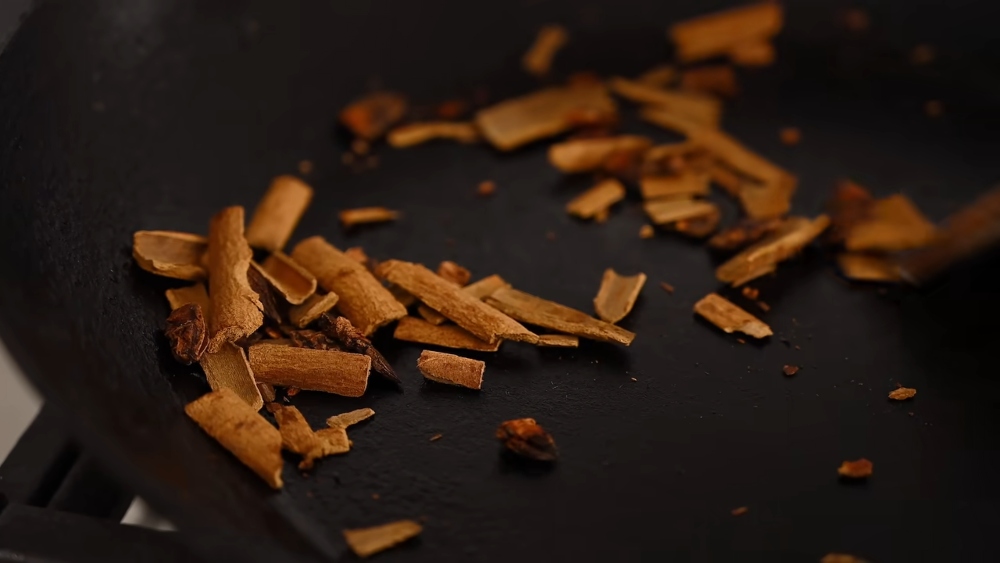
YouTube / Yeung Man CookingYeung toasts crushed cinnamon sticks and star anise in a dry pan to activate their natural oils and build aroma for his Thai tea base
Thai tea is commonly prepared using a commercial mix. Yeung shows what he describes as a popular traditional brand, but points out that the product contains more than plain tea leaves. Its ingredients include added sugar, artificial flavouring and food colouring.
For his version, he chooses black tea leaves that he already enjoys using. He emphasizes that either approach is valid and that the choice ultimately comes down to personal preference.
Yeung places 1 cup of loose black tea leaves in a large, heatproof bowl. He then turns to the spices, adding two cinnamon sticks and three pieces of star anise to a mortar. The spices are coarsely crushed with a pestle rather than ground into a fine powder.
This helps open them up before toasting. Yeung places the crushed cinnamon and star anise in a dry frying pan over medium heat, stirring them for a few minutes.
The brief toast serves a specific purpose: It activates the spices’ natural oils and gives their aroma a head start. Once fragrant, you can turn off the heat and add the toasted spices to the bowl of black tea leaves.
Steeping and storing the Thai tea base
A generous pinch of salt follows, along with approximately one-half teaspoon of vanilla extract and one-quarter cup of cane sugar. The salt is a small but useful addition in such a sweet drink, helping sharpen and balance the other flavours rather than making the tea taste salty.
Yeung then brings approximately 4 cups of water to a boil. He pours the hot water over the tea, spices, vanilla, sugar, and salt, giving everything a thorough stir.
The tea steeps for only three to five minutes. That relatively short brewing time allows the black tea to develop its bold character without sitting indefinitely and becoming unnecessarily harsh.
Once steeped, the liquid is poured through a sieve into a second bowl. The sieve catches the tea leaves, cinnamon, and star anise, leaving behind a smooth, deeply flavoured tea concentrate.
The resulting base makes around four drinks. Like the condensed milk, it can be prepared in greater quantities when a larger supply is needed.
It can also be used immediately. For make-ahead drinks, Yeung allows the tea to cool before refrigerating it and says the base should keep for up to a couple of weeks.
Turning the components into an iced drink
Once both elements are ready, assembling the drink takes little more than a minute.
Yeung combines 2 tablespoons of coconut condensed milk with 1 cup of the prepared Thai tea base. He stirs them thoroughly, transforming the dark tea into a vivid orange-caramel colour.
Then, Yeung pours the sweetened tea into a cup filled with ice. Traditional Thai iced tea is often finished with evaporated milk, but Yeung replaces it with a small amount of creamy oat milk.
As the oat milk meets the tea, it creates the marbled appearance associated with the drink: Pale, creamy ribbons move through the orange tea before the layers are stirred together.
The result is an especially rich vegan Thai tea, with bold tannins from the black tea, coconut-derived sweetness, gentle spice and two different sources of plant-based creaminess.
“This should literally be a dessert,” Yeung says after tasting the finished drink. “It is so rich and creamy and decadent.”
He describes the coconut condensed milk as bringing a subtle fruitiness and an almost honey-like sweetness. The cinnamon and star anise remain present without overpowering the tea. They provide what he calls a “playful hint” of spice.
The tea’s distinctive orange colour is more muted and natural than the brilliant hue created by some commercial mixes. However, it still develops a warm caramel appearance when blended with the coconut condensed milk.
Most importantly, the drink rewards advance preparation. Making the tea base and condensed milk requires some simmering, steeping, straining, and cooling, but neither component needs to be prepared every time a craving arrives.
Stored separately in the refrigerator, they can be combined with ice and oat milk whenever needed. As Yeung puts it, “With a little bit of prep ahead of time, you can have Thai iced tea for days.”
For more irresistible plant-based recipes from around the world, check out Wil Yeung’s YouTube channel.
In this recipe from The Vegan Asian Kitchen, WoonHeng Chia shares her tips for perfectly-coated noodles
WoonHeng Chia’s version of pad woon sen skips the meat, swaps in vegetarian oyster sauce, and is full of vegetables and tofu. It’s a dish from Chia’s new cookbook, The Vegan Asian Cookbook, that’s sure to be as satisfying as it is simple to make.
Read on for Chia’s recipe, plus her tips for getting the noodles perfectly coated in sauce, every single time.
Pad Woon Sen
(Stir-Fried Glass Noodles)
(Shein Loong Yap)
Thai-style pad woon sen—a soft tangle of glass noodles aromatic with garlic and onion and mixed with vegetables—was once a dish I was too nervous to try making at home. I used to watch the vendors making a similar glass noodle dish at char kuey teow stalls in Malaysia, stirring like their lives depended on it, making sure every noodle was coated in rich sauce, and I’d think, “How do they pull it off?”
When I finally decided to try making this in my own kitchen, I found a few tricks that made things way easier: Prep the sauce in advance and use a big pan so the noodles have plenty of surface area to absorb the sauce. Use both hands when you’re stirring, one with tongs to tease apart stubborn clumps, and one with a spatula to make sure the sauce reaches every corner. At the very end, increase to high heat for a slight sear. With these tips in your back pocket, this dish is fully achievable!
Ingredients
For the noodles
3½ ounces (100 g) dried mung bean vermicelli (bean thread)
For the sauce
2 tablespoons vegetarian oyster sauce
3 tablespoons (45 ml) Golden Mountain brand Thai seasoning sauce
½ teaspoon dark caramel soy sauce
½ teaspoon sugar
¼ teaspoon mushroom seasoning
Dash each of ground white pepper and ground black pepper
For the tofu and vegetables
2 tablespoons cooking oil
7 ounces (200 g) firm tofu, drained, pressed, and cut into 1-inch (2.5 cm) cubes
3½ ounces (100 g) fresh oyster or king oyster mushrooms, torn into bite-sized pieces
1 small onion, thinly sliced
3 garlic cloves, finely chopped
¼ cup (30 g) carrot slices
½ cup (60 g) chopped cabbage
½ cup (50 g) chopped yu choy or gai lan
1 small (60 g) tomato, cut into wedges
1 scallion, white and green parts, cut into 2-inch (5 cm) sections and julienned
For serving
1 or 2 fresh red Thai chiles, thinly sliced, in Vegan Fish Sauce
Red pepper flakes
Preparation
1. Soften the noodles: Soak the mung bean vermicelli in warm water for 10 minutes, until tender, then drain. Snip the noodles into shorter lengths with scissors for easier handling and stir-frying.
2. Prepare the sauce: In a small bowl, whisk together the vegetarian oyster sauce, Golden Mountain seasoning sauce, dark caramel soy sauce, sugar, mushroom seasoning, white pepper, black pepper, and 1/2 cup (120 ml) water.
3. Pan-fry the tofu and mushrooms: Heat 1 tablespoon of the oil in a large wok or nonstick pan over medium-high heat. Pan-fry the tofu cubes in a single layer until golden brown on both sides, 5 to 8 minutes. Transfer the tofu to a bowl.
4. In the same pan, add the mushrooms and sauté until they are fragrant and starting to sear on the edges, about 2 minutes. Transfer them to the same bowl as the tofu.
5. Sauté the vegetables: Using the same pan or wok, heat the remaining 1 tablespoon oil over medium heat. Sauté the onion, garlic, and carrot for about 2 minutes, until the onion is slightly translucent. Add the cabbage, yu choy, and tomato, then add 2 tablespoons of the sauce mixture. Stir-fry the vegetables until they are softened, about 2 minutes. Return the tofu and mushrooms to the pan, pushing everything to one side.
6. Cook the noodles: Spread the noodles evenly in the pan in a single layer. Pour the remaining sauce over the noodles and increase the heat to medium-high. Using a pair of tongs, toss and stir the vermicelli to combine with the sauce and vegetables. The noodles will gradually expand and soften. If the pan becomes dry before the noodles are fully cooked, add more water, 1 tablespoon at a time.
7. When the sauce is completely absorbed and the noodles are fully cooked, 2 to 3 minutes, fold in the scallion. Increase the heat to high and toss for another minute to combine and lightly sear.
8. Serve: Transfer to a plate and serve with Thai chiles in vegan fish sauce and red pepper flakes.
Think Veganuary means giving up bold flavours? Think again. Saiphin Moore, the culinary genius behind Rosa’s Thai, shares three vegan recipes that are as vibrant as they are satisfying
It’s Veganuary – the time of year when many of us swap out steak for seitan and discover just how versatile plants can be. But if you think going vegan means giving up bold flavours and vibrant dishes, Saiphin Moore, co-founder of Rosa’s Thai, is here to prove otherwise.
Raised in a remote village in northern Thailand, Saiphin grew up cooking with ingredients so fresh, she’d sometimes climb trees to pick them. That same approach to flavour, balance and authenticity has made Rosa’s Thai a beloved institution – and now, it’s the perfect inspiration for your plant-based kitchen.
In honour of Veganuary, Saiphin shares three stunning vegan dishes that showcase the best of Thai cooking. There’s a creamy tempeh chu chi curry, a fragrant coconut soup with oyster mushrooms and a tofu holy basil stir-fry that packs a proper punch. Each recipe is designed to make the most of simple, fresh ingredients while bringing the vibrant energy of Thailand to your plate.
Rich, creamy, and unapologetically bold – this is the kind of curry that turns a simple dinner into a culinary escape to Thailand (Saiphin Moore)
Tempeh ‘chu chi’ curry
Serves: 2
Ingredients:
3 tbsp red Thai curry paste (we make our own but shop-bought works)
300ml coconut milk
200g tempeh (we recommend Club Cultured)
2-3 lime leaves, finely sliced
1 long red chilli, sliced
1 long green chilli, sliced
Vegetable oil for frying
Steamed rice, to serve
Method:
1. Fry the tempeh in oil until golden brown then set aside.
2. In a frying pan or wok, add the curry paste and fry for 2 minutes until fragrant.
3. Add the coconut milk, mix and cook until it thickens and starts to boil, reduce the heat and simmer for about 5 minutes, then add the chillies and lime leaves.
4. Cook for 2-3 more minutes then turn off the heat.
5. Pour the hot curry sauce over the tempeh, garnish with more lime leaves and serve immediately with rice.
Coconut soup with oyster mushrooms
Light yet deeply satisfying, this northern Thai classic is like a warm hug on a chilly Veganuary evening (Louise Hagger)
Serves: 2
You can find Tom Kha all over Thailand – different versions according to location. Mine has a northern taste, as it’s based on my mum’s recipe. I still remember my dad teaching me to climb coconut trees when I was 10 years old to collect the fruits – these trees were at least 25m (80ft) high and I’d have no harness on. I had to be very picky once I reached the top, as only the mature coconuts would do for the soup.
1. Pour the coconut milk and measured water into a saucepan and bring to a boil. Add the galangal, lemongrass, lime leaves, chillies, coriander roots or stalks and salt.
2. Leave to bubble away over a medium heat for 2 minutes, until the flavours come through, then add the mushrooms and the tomatoes and cook for a further 2 minutes, until the mushrooms are cooked.
3. Remove from the heat and stir in the lime juice, soy sauce and coriander leaves. Serve immediately.
Pad kra prow taohu: tofu holy basil stir-fry
Spicy, fragrant and bursting with colour – this wok-fired wonder is proof that plant-based can still pack a punch (Louise Hagger)
Serves: 2
Pad kra prow is another national dish found on many a Thai street corner, and that includes the vegetarian version. In Thailand we use holy basil, the very pungent sister of Italian basil, which is a key ingredient in Thai cooking. You’ll notice the sudden bursts of aroma from the wok as soon as you start tossing the ingredients together over a high heat – it’s a smell that wakes up my senses every time.
Ingredients:
3 red bird’s eye chillies
3 garlic cloves
2 tbsp vegetable oil
150g (5½oz) firm tofu, cut into chunks
1 tbsp light soy sauce
½ tbsp dark soy sauce
½ tbsp sugar
Pinch of white pepper
½ onion, chopped
¼ red pepper, sliced
¼ yellow pepper, sliced
30g (1oz) yard-long beans or green beans, cut into 2cm (¾ inch) pieces
Handful of holy basil leaves
2 kaffir lime leaves, chopped
Steamed jasmine rice, to serve
Method:
1. Using either a pestle and mortar, grind the chillies and garlic to a paste.
2. Heat the oil in a wok set over a high heat. Add the chilli and garlic mixture and stir-fry for about 30 seconds, until nice and golden brown.
3. Now add the tofu chunks, both soy sauces, the palm sugar and white pepper and cook, tossing everything around in the pan, for about 1 minute, until the tofu is well coated and has taken on a little colour from the sauces.
4. Once everything is mixed well, add the onion, peppers and long beans and cook for a further 30 seconds, all the while tossing the mixture together. Throw in the basil and lime leaves and stir-fry for a further 30 seconds. Serve immediately with jasmine rice.
Recipes by Saiphin Moore, co-founder of Rosa’s Thai