Showing posts with label flexitarians. Show all posts

Sunday, May 10, 2026

Canadians Aren’t Giving Up Meat, But...

From agrifoodanalyticslab.substack.com

By Dr. Sylvain Charlebois

Up to 3.5 million adult Canadians have moved away from omnivorous diets since 2024. That is not a fad — it is a market transformation


For years, the food industry assumed Canada’s protein future would be shaped by a dramatic shift toward veganism and strict plant-based eating. That future never arrived. Instead, Canadians have chosen something far more pragmatic and far more disruptive to the market: flexibility.

The latest Canadian Food Sentiment Index from Dalhousie University’s Agri-Food Analytics Lab, supported by Caddle, shows a remarkable transformation in dietary behaviour among Canadian adults. Omnivorous diets, meaning consumers with no specific dietary restrictions, fell from 67.6% in Fall 2024 to 55% in Spring 2026. Based on Canada’s adult population, that represents approximately 2 to 3.5 million fewer adult Canadians identifying as omnivores in less than two years. Meanwhile, flexitarian diets climbed steadily from 4.6% to 9.4%, paleo also expanded significantly. Vegetarian and vegan diets, despite years of headlines suggesting explosive growth, remained relatively small and mostly stagnant. In fact, at 2.6% of respondents in Spring 2026, the data suggests that roughly 600,000 adult Canadians identify as vegan today. That figure has barely moved over the last several survey waves despite enormous media attention and billions invested globally into plant-based alternatives.
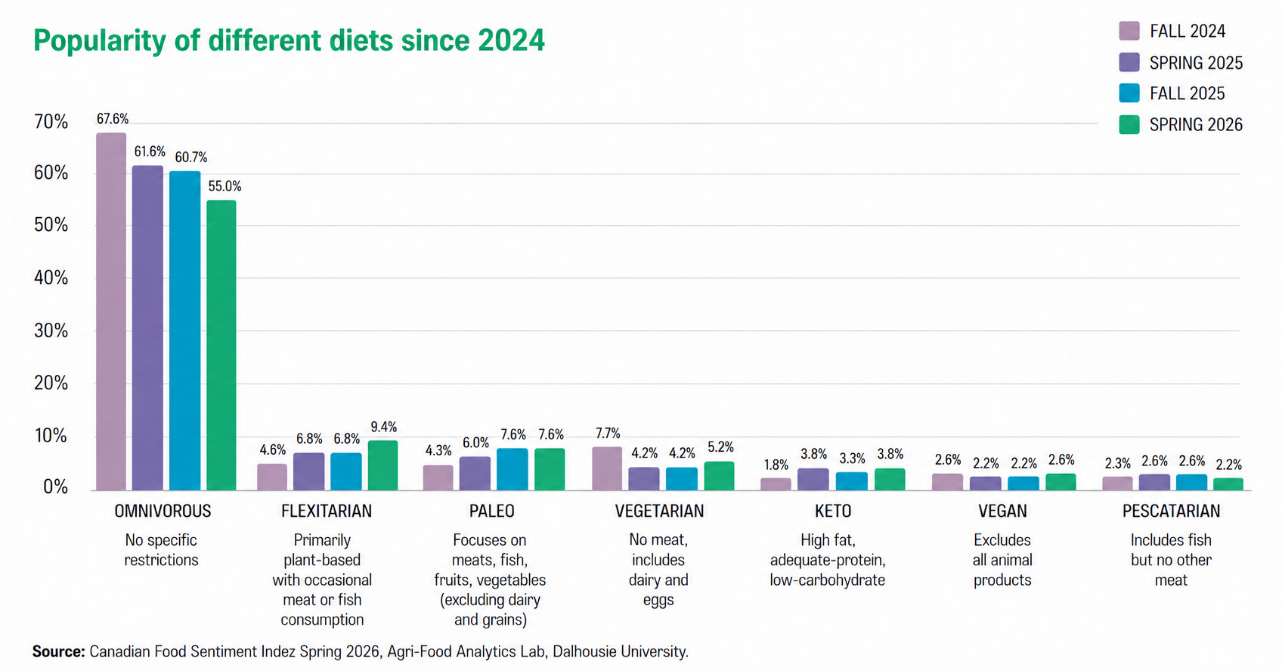
This is not a vegan revolution. It is a protein recalibration, and it is already reshaping Canada’s agri-food economy. Canadians are no longer defining themselves by strict labels like “vegetarian” or “vegan.” Instead, they are becoming opportunistic eaters, adapting their diets based on price, convenience, health goals, protein density, satiety, and increasingly, metabolic concerns tied to GLP-1 medications like Ozempic. The old assumption was binary: consumers would either eat meat or reject it. But today’s consumer wants flexibility and optionality. Someone may eat steak on Friday, Greek yogurt on Saturday, plant-based protein on Monday, and skip lunch entirely Tuesday because of appetite suppression drugs. This creates a far more volatile and fragmented protein economy.


The graph tells us something profound: Canada is not abandoning animal protein. Canadians are becoming more selective about when, how, and why they consume it. That shift is already sending shockwaves through food manufacturing and retail. Traditional meat categories are under pressure, especially premium red meat consumed at home. But value-added proteins are thriving. High-protein snacks, fortified beverages, dairy-based protein products, egg innovations, and hybrid foods are outperforming expectations. The success of protein-enhanced foods, from yogurt to beer, reflects a market obsessed not with ideology, but functionality. Consumers increasingly ask one question before buying food: “What does this do for me?” That is why cottage cheese suddenly became fashionable again. It is why protein bars now occupy entire aisles. It is why dairy is quietly winning the protein wars despite years of criticism from anti-animal-product activists.

Ironically, many plant-based food companies misunderstood consumer psychology. Canadians never truly wanted ultra-processed meat replicas as much as investors believed. They wanted moderation, affordability, and nutritional efficiency. Flexitarianism offers all three. The data also reveals the immense economic pressure Canadians remain under. Meat inflation has consistently outpaced many other food categories in recent years, while household budgets remain stretched. For many households, especially larger families, dietary adaptation is no longer philosophical. It is financial. That is why flexitarianism is growing faster than veganism. Consumers are not necessarily making ethical declarations. They are managing budgets.

The implications for agriculture are enormous. Canada’s livestock sector is unlikely to disappear despite years of predictions suggesting otherwise. But producers will face a more segmented marketplace. Premiumization, traceability, sustainability claims, animal welfare standards, and protein functionality will matter more than sheer volume growth. Meanwhile, pulse producers and ingredient manufacturers may benefit enormously from hybrid consumption patterns. Lentils, chickpeas, pea proteins, and beans are increasingly integrated into mainstream diets without consumers fully abandoning meat. Canada, one of the world’s largest pulse exporters, is uniquely positioned to capitalize on this middle ground.

For over a decade, the food conversation was dominated by activists predicting the collapse of animal agriculture and the inevitable rise of fully plant-based diets. But Canadians have chosen moderation instead of absolutism. That may frustrate ideological purists on both sides, but it reflects how real consumers actually behave during periods of economic uncertainty. People rarely eat according to political theory. They eat according to affordability, biology, convenience, and habit. The future of protein in Canada will not belong exclusively to meat, nor to plants. It will belong to flexibility.


https://agrifoodanalyticslab.substack.com/p/canadians-arent-giving-up-meat-but

Tuesday, January 13, 2026

“Plant-forward” menus to reshape eating out in 2026

From startups.co.uk/news

Hospitality operators are switching to inclusive plant-forward menus to suit changing “flexitarian” taste buds 

According to UKHospitality’s 2026 trend report, “plant-forward” dining is expected to influence a widespread shift across the industry this year. As strict vegan diets become less common, a larger group of flexitarians – diners who favour a balance of both meat and plant-based dishes – are now shaping menus.

Perhaps in quiet rebellion against the strict veganism of previous years, 2025 was defined as the year of protein. Meat-heavy menus and high-protein hacks dominated both social media and restaurant menus.

However, 2026 appears to be a little more moderate, as this data suggests the future of eating out isn’t all-or-nothing.

For hospitality businesses, this raises a practical question: what does plant-forward dining actually mean, and how should you adapt your menu to stay competitive?


What does “plant-forward” mean, and why is it trending?

Plant-forward dining doesn’t mean wiping out meat from your menus entirely. Instead, it refers to an approach where plant-based ingredients are central to menu design, rather than treated as an afterthought.

Rather than adding a token vegan option just to tick a box, food and beverage businesses are integrating vegetables, grains, and plant-based proteins into staple dishes, often in ways that feel familiar and comforting. This might look like reimagined pub classics or creative, globally inspired small plates, rather than overly health-conscious, “clean” vegan salad bowls.

Diners increasingly want food that is flavour-led, inclusive, and recognisable, not dishes that feel like a compromise or, frankly, boring. Global flavours can work seamlessly here. Korean-style sauces, Middle Eastern spices, and street food-inspired ingredients help plant-forward dishes remain indulgent and familiar, without becoming unnecessarily complex. UKHospitality’s report notes that operators are rethinking how plant-based dishes appear on menus, keeping them visible, appealing, and varied.

How to decide if your menu needs a plant-forward upgrade

For many hospitality businesses, the issue isn’t a lack of plant-based options; it’s how they’re presented on the menu.

Often, plant-based dishes are buried in a separate vegan section that offers limited choice or lacks the flavour and oomph of meatier options. Many businesses also fall into thinking that “plant-based” equals “something green”, but crucially, diners are increasingly looking for plant-forward options that appeal to a wide range of taste buds across various contexts. 

Of course, it’s worth acknowledging that many hospitality businesses are operating under increasingly tough cost pressures, facing ever-rising food prices, energy bills, and job losses

For some, a full menu overhaul may not feel like a priority as they focus on getting out of the woods. However, plant-forward dining can also work out more cost-effectively. Working with cheaper ingredients like potatoes, grains, and veggies over pricier meat and fish might work in operators’ favour, at no cost to customer appeal.

How hospitality businesses can adapt to plant-forward demand

For pubs and restaurants looking to respond to this trend, menu integration is key. Position plant-forward dishes alongside classics, rather than isolating them in a separate section.

UKHospitality notes that group dining has become a major driver, where appealing plant-based options determine where the entire group chooses to eat. By signalling that you can offer both, you’ll win over vegan-leaning customers and their friends, too.

Aside from labels, your number one focus should be flavour. Bold seasoning and globally inspired dishes will help plant-forward dishes stand out alongside meatier favourites. But this doesn’t require complexity. Building dishes around cost-effective, seasonal, and local ingredients reduces pressure on kitchens and supply chains.

If you do embark on a plant-forward menu makeover, make sure your community hears about it by highlighting your plant-forward options online, on delivery platforms, and on your physical menus.

In practice, plant-forward dining can offer flexibility on both sides of the table. For consumers, it reflects changing tastes and a desire for options without rigid dietary labels. For hospitality businesses, it can offer much-needed breathing room to adapt to cost pressures while appealing to a broader set of diners without needing to commit to all-or-nothing changes.

https://startups.co.uk/news/plant-forward-menus/

Saturday, January 3, 2026

New global report reveals top markets for plant-based innovation

From foodbev.com

A new report from The Vegan Society, unveiled today (2 January 2026) for Veganuary, offers insights into how vegan diets are shaping global culture and F&B industry innovation.


Titled Veganism Around the World, the report combines international research to build a comprehensive database offering insights into where veganism is gaining ground – and how this is impacting the food and beverage industry.


The report is based on original polling across ten countries, and detailed profiles for 21 countries around the globe.


Consumer behaviour


Polling showed that while veganism remains uncommon, ‘flexitarianism’ – whereby consumers intentionally reduce their consumption of meat and seafood, but do not eliminate completely – is now mainstream. 16-30% of consumers polled identified with this way of eating, indicating a shift toward more environmentally friendly diets.


India was highlighted as a global leader, with 14% of people identifying as vegan and 26% as vegetarian. Overall sentiment toward veganism worldwide was found to be ‘neutral to positive,’ suggesting favourable conditions for category growth, with India the most favourable and Japan the least.


Google Trends data showed that searches for ‘veganism,’ which peaked around 2020, have stabilised. However, they continue to outpace ‘vegetarianism’ and, aside from brief surges, even ‘climate change’.


Leaders in food service


Across 21 countries, New Zealand was identified as the most vegan-friendly travel destination, topping vegan-friendly dining per capita (approx. 345 per million) due to many mainstream restaurants offering vegan options.


Taiwan leads on fully vegan restaurants per capita (14.8 per million), while Iceland was the stand-out country within Europe, with 43% of restaurants offering at least one vegan dish.


Portugal followed Taiwan as the second leader globally for fully vegan restaurants per capita, despite ranking third for seafood consumption. Vietnam, Malaysia and Singapore also stood out on totals and per capita availability, with many Buddhist-influenced countries offering rich vegan and vegetarian foodservice options due to cultural norms.


The US had the most vegan restaurants in absolute terms (1,717) and now hosts the largest plant-based ecosystem overall by total company count.


Business and innovation insights


The US is home to 615 businesses producing plant-based, cultivated or blended protein products, cementing its place as leader by total business count. However, it ranked much lower per capita, with the report noting cooler domestic demand in the country, pushing producers toward exported growth.


When measured per capita, Singapore leads with 7.44 companies per million people, followed by Israel at 6.66 and the Netherlands at 5.03, all supported by robust science and food-tech industries.


The Netherlands also leads Europe on per capita spend for plant-based meat, and alongside the UK and Germany, combines deep company bases with strong retail sales.


Asia is also seeing surging demand, with consumers in India and China nearly twice as likely as those in the US to say they are ‘very or extremely likely’ to buy plant-based meat. This suggests major growth potential for exporters and local innovators.


However, The Vegan Society acknowledges that innovation density does not automatically reduce animal product consumption. Israel, despite being a leader in the alt-protein industry, still ranks among the highest per capita consumers of poultry and beef.


Veganism: Moving into the mainstream?


The Vegan Society, a UK charity founded in 1944, said its findings show veganism is ‘increasingly understood and adopted worldwide’. The report will inform the organisation’s Vegan Trademark programme, which is now carried by over 70,000 products globally, helping consumers to identify products that have been certified as free from animal-derived ingredients.


Claire Ogley, head of campaigns, policy and research at The Vegan Society, said: “This report is the first comprehensive investigation into the growth of veganism around the world. The data shows that veganism is no longer a niche movement but is gaining traction cross-culturally with restaurants, businesses and consumers driving its growth globally.”


She noted that though the word ‘vegan’ was only coined 80 years ago, it is “widely understood” and used globally.


“It’s also promising to see that despite stereotypes, people’s feelings towards veganism are mostly neutral, and actually lean positive in many cases,” she added. “This surge in interest is reflected in search trends and the rapid expansion of vegan dining options and product innovation worldwide – signs of veganism moving into the mainstream.”
https://www.foodbev.com/news/new-global-report-reveals-top-markets-for-plant-based-innovation