Showing posts with label students. Show all posts

Tuesday, February 17, 2026

Student Life: Surviving on Soy Lattes and Tofu

From bluedotliving.com

By Anna Popnikolova

I challenged myself to eat vegan for one week while away for college. Here’s what I learned


Growing up in a family of meat lovers, I never even considered going vegan. Just proposing vegetarianism would have elicited a big laugh from everyone at my dinner table, where we regularly gathered over traditional Bulgarian meals that often involve several kinds of meat. My family’s favourite meal is a spread of grilled chicken, pork, and beef patties called “Мешена Скара” or “mixed grill.” A dinner without meat simply doesn’t exist in our home.

Still, I have always been curious about a life without meat. Since I left home for college and have had regular access to vegetarian meals and ingredients like tofu (something that never breached the threshold of my childhood home), I’ve started eating more plants and fewer animals.

When I’m at school, I eat chicken almost every day and red meat maybe twice a week. I try to keep my red meat consumption to a minimum — it’s one of the best lifestyle changes we can make to reduce our carbon footprint and a great move for heart health and cholesterol. As for dairy, I don’t drink cow’s milk, but I do enjoy cheese and dairy yogurt. 

As a little challenge, the week before Thanksgiving break, I decided to try to keep a strictly vegan diet for one week. I wanted to learn how difficult it is to eat vegan on my college campus, find some fun new substitutes for my regular animal-based meals, and just see how my body felt after a diet change.

I kept some journal entries from my first few days and took pictures of all my meals. 

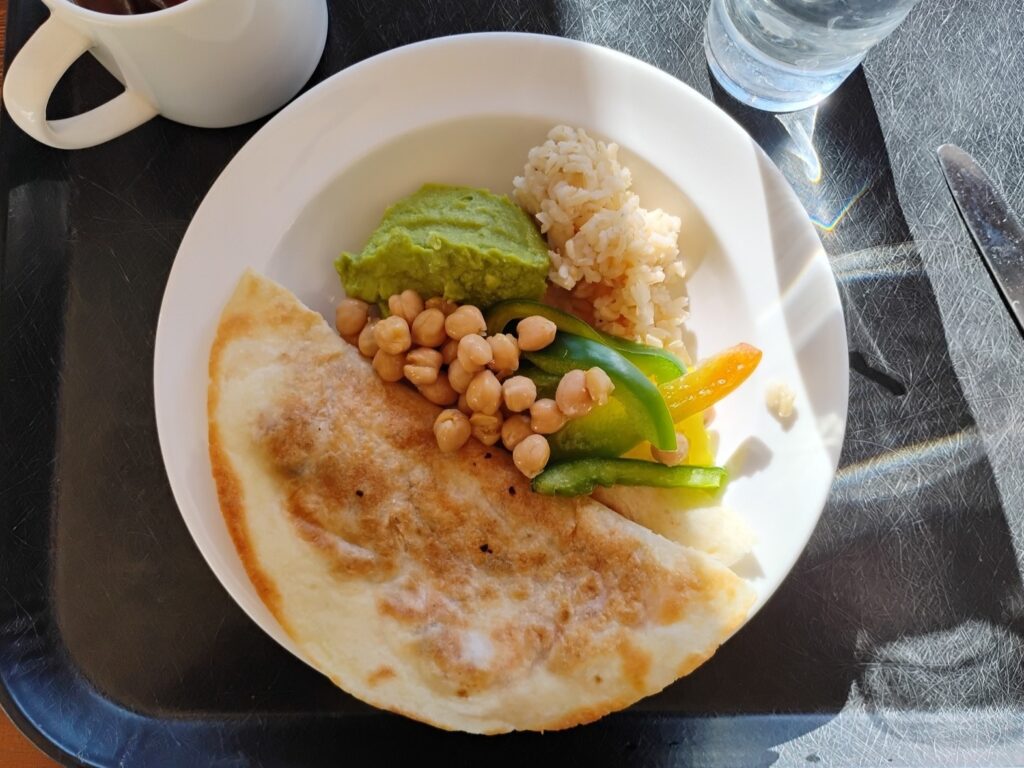
Vegan chorizo quesadilla, with brown rice, chickpeas, mashed avocado, and bell peppers. – Photo by Anna Popnikolova

Breakfast

Surprisingly, many things I was already eating were vegan — and I didn’t even know! Here’s what I wrote in my diary on Day 1: 

Some days, I woke up early enough to visit the dining hall before class. I was surprised to find that all the bagels there are vegan. I had to walk past my usual butter and cream cheese and opt for jam or avocado spread, but the substitution wasn’t too difficult to make.

When I didn’t have time to get a dining hall breakfast, or when getting coffee with a friend, I frequented two on-campus cafes: Clover and Flour. Flour has always been one of my favourites, and I practically live for their low-fat vegan chocolate muffins. Even after my challenge was over, I found myself peering through the window at their pastry case to see whether they had them in stock. I’ve found a dupe recipe for them online, and I am excited to give it a try next time I go home. 

                     A filling vegan breakfast: bagel with jam, mixed seeds, and tea.    Photo by Anna Popnikolova

Coffee wasn’t a problem for me at all! I’ve been an oat milk drinker for about three or four years now and have recently started shifting over to soy, for the added protein. I like the texture of soy a little better, as I find it less oily. So, I kept getting oat and soy milk as usual.

Beyond missing out on cafe pastries, I missed eating eggs in the morning. And yogurt! I lamented in my diary:

Lunch

I learned throughout the week that the dining hall has a lot of really great vegan options. Every entrée option typically comes with a vegan/vegetarian alternative — often, one that I prefer anyway — and they are actually well-thought out and delicious. A few days into the challenge, I wrote:

Clover became one of my go-to lunch spots when I knew I’d miss dining hall hours. Their falafel sandwich on pita with tahini sauce was a very affordable and filling lunch option, especially between classes.  

Snacks

I found some great snacks to keep myself full between classes. My fall semester schedule wasn’t great for meals — I had classes practically back to back from 9 a.m. to 4 p.m., often with no time to eat breakfast or lunch. So snacks kept me going. 

I continued popping the Nature’s Bakery bars into my bag, along with dried apricots and dates, which were a great sugar boost for my classes and meetings in the afternoon. I also found myself opting for more nutritious options:

         Clover's falafel sandwich on pita with tahini sauce is affordable and filling!   Photo by Anna Popnikolova

A lot of crackers and chips I was already snacking on were vegan-friendly. I discovered some great roasted chickpeas that I added to the crunch rotation during homework hours. 

Dinner

I found myself eating a lot more beans than were previously in my diet to make sure I was getting enough protein. Cannellini white beans, hard-boiled adzuki beans, butter beans, and chickpeas became everyday additions to my salads. I ate tofu every day, sometimes several times a day. And then there was soup:

I have been a die-hard lentil soup fan since I started eating with my school’s dining services and have also become a fan of their carrot-ginger soup. I missed having chicken noodle soup and chili, but sometimes the dining hall serves a sweet potato and quinoa chili, which is just as delicious. 

At the end of the week, I headed home for break. 

When I was home, I found myself drinking a lot of tea and eating lots of fruits and vegetables, avoiding too much cheese and even yogurt, in exchange for bananas and citrus. My mother always fills the fridge with berries when I come home, because she knows berries are hard to come by on campus. 

Ultimately, I found this challenge really enlightening — I felt great in my body and not tired at all, as I worried I might be. In fact, I think it helps with my energy levels and mental clarity, much more so than loading up on ground beef, bacon, or pork.  

In the time since completing the challenge, I’ve found myself cutting meat even more from my diet and opting for plant-based options instead. I’ve been reaching for the soy meatballs on spaghetti and meatball night at the dining hall and tofu over grilled chicken more and more often. Yogurt, however, I won’t give up — there has to be a better alternative for vegans than the runny, cardboard-like soy, coconut, or oat yogurt. Until I find it, the dairy yogurt must stay.

A lot of vegan creators online say people tell them, “I would totally go vegan, but … cheese.” Their response?  “OK — go vegan but cheese!” If having a bowl of yogurt for breakfast or a slice of cheese on your sandwich makes all the difference, do it. It’s better to try to eat a more plant-based diet, even if you don’t do it perfectly!

https://bluedotliving.com/vegan-challenge-college-meals/

Friday, August 1, 2025

Vegan teens exercise more often than meat-eating peers, study finds

From news-medical.net

While health is the top dietary motive for all students, new research reveals vegan teens are significantly more active and consume more fruits and vegetables, raising important questions for school health policies 

In a recent study published in the journal Current Developments in Nutrition, researchers examined health behaviours and motivations of secondary school students following vegetarian, vegan, and omnivorous diets.

Plant-based eating is on the rise, but what’s driving the shift?

In Europe, 10% of people eat vegetarian or vegan diets. The omnivorous diet is currently the most common, with about 91% of the global population being omnivorous. Nevertheless, 51% of Europeans, 59% of Germans, and 51% of Austrians have reduced meat intake, with Germany doubling the number of vegetarians and vegans during the coronavirus disease 2019 (COVID-19) pandemic.

The massive change in dietary preference toward plant-based diets, particularly by younger people, could be related to health, well-being, animal welfare, ethics, and environmental protection.

Health-related lifestyle and behaviours often solidify in childhood and adolescence and persist into adulthood, with limited possibility of learning healthy behaviours in adulthood. As such, schools represent an excellent environment for health behaviour interventions.

The authors also note that recent Austrian school policy reforms now require that vegan meal options be made available in schools, reflecting broader support for plant-based diets in educational settings.

About the study

In the present study, researchers analysed the motives and health behaviours of secondary school students following vegetarian, vegan, and omnivorous diets in Austria. They employed a multi-level cluster sampling strategy following a cross-sectional design. A standardized survey was available for nationwide participation by secondary school students.

The survey could be completed at any time using a computer, tablet, or smartphone under the supervision of parents or school personnel. It was based on individual characteristics, physical activity (PA), exercise, sports, diet, nutrition, and health. Control questions were included throughout the survey to determine conflicts and illegitimate responses.

The survey collected information on age, nationality, sex, residence, anthropometrics, diet type (vegan, vegetarian, or omnivorous), dietary motives (e.g., animal welfare, health, tradition, environmental protection), lifestyle interests, and dietary behaviour (vegetable and fruit intake, fluid intake).

Students were categorized as vegan, omnivore, or vegetarian based on survey responses. Analysis of variance (ANOVA) and chi-squared tests were used for statistical analyses. The authors acknowledge certain limitations, such as the data being self-reported and the sample sizes for the diet groups being unbalanced.

The cross-sectional nature of the study also means that causality cannot be established.

Who’s eating what? Diet trends, gender, and age

In total, 8,799 students were included. On average, they were aged 15.1 years and had a normal body weight. Most students were female (63%), rural residents (68%), and followed an omnivorous diet (92%). Only 7.2% of students followed plant-predominant diets, with 1.6% vegan and 5.6% vegetarian. More males followed an omnivorous diet, while more females followed a vegan or vegetarian diet.

The paper suggests this could be due to several factors, including parental habits and the socio-cultural association of meat-centred diets with masculinity.

Motivations revealed: What makes students choose their diet?

Vegan and omnivorous diets were more common in middle-school students, whereas vegetarian diets were more common among high school students. There was a significantly higher prevalence of underweight among vegetarian pupils compared to omnivorous pupils. Animal welfare was the most common motive for vegetarian pupils, followed by health.

Conversely, health was the most popular motive for students following an omnivorous or vegan diet, followed by sports performance for vegans and taste for omnivores. The lifestyle of a specific sport and engaging in sports, exercise, and PA were most commonly considered cool across the sample. Meanwhile, 1.4% and 6.1% of students considered smoking and alcohol intake as cool, respectively.

While a vegan lifestyle was seen as cool by some, the authors note that this doesn't yet match findings from other countries, such as a UK study where young people described a vegan lifestyle as “cooler than smoking.”

Lifestyle choices: Activity, diet, and “coolness” in adolescence

Notably, more males reported eating meat as cool than females, while females mentioned a vegetarian lifestyle and diet more often. Most participants (82%) regularly engaged in leisure-time sports.

The prevalence of leisure-time activity was higher among vegan pupils (86%), though participation in more organized club sports did not differ significantly between the groups. It is also important to note that despite these differences, the average activity level for all groups fell short of the daily 60-minute recommendation for adolescents.

Further, most students reported daily intake of fruits (66%) and vegetables (64%).

Daily habits: Fruits, veggies, and what students are drinking

Across dietary subgroups, daily fruit intake was significantly more prevalent among vegan pupils than among omnivores or vegetarians. Meanwhile, daily vegetable intake was significantly more prevalent among vegetarian and vegan students compared to omnivores. Fluid intake level was comparable across dietary subgroups.

Water was the most common drink, followed by syrup, fruit juices, and soft drinks.

More vegetarians reported water as their most common drink (84%) than vegans (75%) and omnivores (72%). Conversely, syrup and fruit juice were the most common drinks among omnivores, and tea was the most common drink for vegans. Around 47% of students consumed alcohol, and 9.3% were smokers.

Alcohol intake was significantly higher among vegetarians (55%) compared to omnivores (46.5%) or vegans (38.0%).

The paper's authors note that this could be linked to the vegetarian group being significantly older on average (15.9 years), placing more of them at or near Austria's legal drinking age of 16 for beer and wine.

What does this mean for schools and student health?

In sum, health remains the top motive for dietary choice, with sports engagement and lifestyle being the top reasons for lifestyle preference. While the omnivorous diet was the predominant dietary choice, students on a vegan diet were the most active in their leisure time.

The findings support the idea that plant-predominant diets are linked to healthier activity levels, which could be a major factor in addressing the global obesity epidemic.

The authors emphasize that these results highlight the potential for schools to become crucial environments for public health intervention. They advocate for a dual “Healthy Eating and Active Living” (HEAL) approach within the school curriculum and suggest that improving the availability and quality of plant-predominant meal options in schools could improve not only dietary habits but also physical activity levels among students.

While these findings are most directly relevant to Austria, the authors note that they may also apply to culturally similar countries.

Journal reference:
  • Wirnitzer KC, Tanous DR, Drenowatz C, et al. (2025). Difference in Motives and Basic Health Behavior of 8,799 Children and Adolescents Aged 10–19 Years Following a Vegan, Vegetarian, or Omnivorous Diet. Current Developments in Nutrition, 9(7). DOI: 10.1016/j.cdnut.2025.107498 https://cdn.nutrition.org/article/S2475-2991(25)02959-2/fulltext

Tuesday, January 28, 2025

Trial and Error: Learning to Love Veganuary

From varsity.co.uk/lifestyle

Edie Castell reflects on the highs and lows of the Veganuary experience 

The first time I attempted veganism was when I was 12 years old. It was the summer of yellow ochre, mom jeans, and those ‘we should all be feminists’ tees: in other words, the perfect environment for half-hearted teenage activism. I didn’t particularly know why I was suddenly avoiding animal products past a general concern for their welfare, nor did I have the perseverance to sustain my new diet longer than a few weeks. The problem wasn’t a lack of passion, but rather one fatal flaw that I’ve yet to relinquish: I am incredibly lazy in the kitchen. Especially at university, nothing beats the comfort of a bowl of pesto pasta.

This month, however, I decided to work against my nature, and what better way to do so than to commit to a national movement (and an article) to hold myself accountable? Veganuary, for the unacquainted, is exactly what you’d presume it to be: a month-long commitment to a vegan diet. Since its conception in 2014, the movement has only attracted more fanfare – it feels like half of my friends have given it a go at one point or another.

This month I decided to work against my nature, and what better way to do so than to commit to Veganuary?   Natasha Larsen for Varsity

There’s no arguing that the case for a vegan diet is compelling. Not only has it been linked to certain health benefits, like a lower blood pressure and cholesterol, but cutting out meat has a genuine environmental impact. It’s common knowledge that a reduction in our meat intake would lead to a better carbon footprint. These factors considered, I spent the better part of my New Year’s Eve excitedly sharing my new endeavour: to go into 2025 completely plant-based.

As the new year dawned, I was admittedly over-confident about the ease with which I would take to this shift in my diet. As a passionate butter-hater and plant milk connoisseur, I felt like I was already halfway to veganism. What I hadn’t accounted for was waking up on New Year’s Day exhausted (mildly hungover) in the midst of a rain storm. My early morning supermarket plans foiled, I opted to make do with what I could find in my cupboards. A simple tomato and lentil pasta seemed like my easiest bet, and the dish came together smoothly. However, after struggling through half a bowl of tomato pasta sans cheese, I realised it was lacking the umami taste I craved.

Going vegan, I was quick to note, eliminated many of my go-to embellishments for simple meals. Gone were the days where I could just chuck a load of cheddar over a mediocre dish and call it a day. All hope was not lost, however, and to prevent you from succumbing to a similar fate, I have compiled a (tried and true) list of easy food embellishments:

  • Absolutely anything pickled or fermented: gherkins, olives, onions, jalapenos, kimchi – take your pick.

  • Seeds and nuts: peanuts and sesame seeds were wins for me, though I can also envision cashews or pistachios complimenting a pasta dish or curry.

  • Crunchy veg: Finely chopping up some celery, chillies, or bell peppers allows for a more diverse array of textures.

  • Liberal seasoning: even if you fail to venture past salt and pepper, being slightly more generous with your food-to-seasoning ratio can make all the difference.

  • It didn’t take too long to adjust more fully to my new lifestyle (achieved by sitting down and writing out a proper meal plan). Among the highlights of my meals were colourful finely chopped salads and even ready-meal vegan curries from the supermarket. My attempt at veganism also gave me a chance to finally settle my long-held grudge against tofu. In the past, I have been victim to it at its least seasoned, and it took accepting a couple hours of marination to truly obtain the flavour I’d been searching for. I let the cubes sit in a mix of sriracha and tahini, before popping them in the oven at 180 degrees celsius for half an hour. My biggest win was my discovery that hummus is, in fact, vegan, which widened the potential for out-of-meal-time snacking.

  • Eating out whilst vegan can be, in better situations, limiting, and at worst, entirely fruitless. Whilst the pubs, restaurant, and markets of London, and indeed Cambridge, boast a plethora of vegan options, a local pub in Grays lacked the same menu. The sole vegan option, a faux-chicken burger (counterintuitively served with a saucer of mayo), was clearly not a bestseller. “There’s no meat in that. You know that, right?”, the waitress clarified, in a tone that suggested I was making a grave error with my order. She wouldn’t have been all that incorrect – it was by no means fine dining. I can appreciate a pack of Linda McCartney veggie sausages with the best of them, but I’ve found over the course of this experience that meat mock-ups tend to pale in comparison to whole foods that just so happen to be vegan. In my eyes, a portobello mushroom serves as a much better burger filling than a Quorn patty.

  • So, will I continue my veganism into February? The jury is still out on that one: whilst I’ve enjoyed the challenge of straying from my comfort zone with my cooking, I haven’t been sold on going entirely plant-based just yet. However, whatever I end up deciding, this experience has certainly pushed me to be more mindful about what I consume. Putting extra consideration into the food I choose to buy and cook has shifted eating into a more deliberate practice, rather than just a functional one. I anticipate many trips to Mill Road (the heart of vegan cuisine) this Lent term.

  • https://www.varsity.co.uk/lifestyle/28925

Sunday, May 5, 2024

UK: Durham announced as the fifth best city to be vegan in the north of England

From thetab.com

It’s been revealed Durham is the fifth best university city in the north of England to be a vegan.

Student accommodation specialists, StuRents, conducted a survey to discover which university city is most accommodating for students following a plant-based diet.

Using the QS World University Rankings, they analysed the top five university cities in the North of England using HappyCow, a website that lists vegan and vegan-friendly restaurants.

For each city, StuRents calculated the number of vegan restaurants, the square mileage, the number of vegan restaurants per square mile, and the average star rating of these vegan restaurants. In line with these findings, the cities were then ranked from one to five.

Sheffield comes out on top. Although it doesn’t have the most vegan restaurants, its average star rating (3.70) was the highest.

Newcastle-Upon-Tyne places second with the city boasting 75 vegan restaurants. Moreover, Leeds and Manchester are third and fourth respectively.

Durham lands in fifth place with only 21 vegan restaurants, around 50 less than the other contenders. However, its average star rating of 3.47 suggests Durham may be going for quality over quantity.


StuRents highlights The Nook and Head of Steam as some of the most popular vegan options in the city. Additionally, with Durham being only a 10-minute train ride from Newcastle, the options for vegan students vastly increase.

A statement from Michael Rainsford, co-founder of StuRents, reads: “It’s becoming clear that students today aren’t just looking for a place to live and study, they’re also searching for communities that align with their ethical and dietary preferences. It’s not just all about the prestige of the university anymore.

According to The Vegan Society, 4.1 per cent of students are now vegan and a further 10 per cent are planning to adopt a plant-based lifestyle. They list reasons for going vegan as concern for animal welfare and the environment, or for the health benefits.

https://thetab.com/uk/durham/2024/05/05/durham-announced-as-the-fifth-best-city-to-be-vegan-in-the-north-of-england-54913 

Sunday, April 28, 2024

How to be a vegan – and an Oxford student

From cherwell.org

By Thaejus Ilango

I have a disturbing secret to admit, which might cause people to think I’m crazy, and Katie Hopkins to think I’m smelly: I’m vegan.

I have been vegan for over four years, and I can honestly say I have never found it difficult. Choosing a path of compassion and non-violence feels much easier to me than the alternative, and I firmly believe a vegan lifestyle makes positive contributions towards one’s mental and physical health, both human and non-human welfare, and the environment. What’s more is that one does not need to consume animal products in order to live a healthy life.

I am often reminded how fortunate I am to come from a household that supports my dietary choices, and to have been raised on South Indian cuisine, which can be so effortlessly veganised. I have come to realise this is not the case for my peers from different backgrounds – but university can be the perfect opportunity to assert your independence and choose your own lifestyle.

                                                                          Image credit: Robin Stott / CC-BY-SA 2.0 via Geograph

Despite Oxford being a fairly small city, it has a surprising number of vegan-friendly places. Some recommendations from a certified vegan are: The Coconut Tree, Chick Pea, Delhish Vegan Kitchen, Dosa Park, and of course, Najar’s (they have vegan mayo, ask for it!). A special mention goes to the banana bread French toast at the Handle Bar and the vegan doughnuts at Crosstown. However, I always wish there were more options, especially affordable ones, which perhaps only Najar’s gets points for. 

But what about students who want more than falafel and hummus? Cooking for yourself as a vegan is not nearly as expensive and difficult as people will tell you it is. While realistic meat alternatives can be pretty pricey, many staple sources of protein for vegans, such as beans and lentils, are in fact cheaper than their animal counterparts. Once you’ve secured said affordable vegan goods, a quick google search for ‘easy student vegan recipes’ will show you that you are almost definitely capable of executing a simple dhal or chilli. In fact, there are many cuisines around the world which are not centred around animal products. Ethiopian, Indian, and Mediterranean cuisines, among others, have largely vegan foundations, showing that the idea that one cannot live on a diet that is simultaneously sustainable, nutritious, and tasty, is entirely unfounded.

When it comes to college cuisine, I am privileged to be at St John’s, where hall food is incredibly affordable, and – for the most part – quite nice, with rare (devastatingly bad) exceptions (including a harrowing tempeh dish I still have nightmares about). A special shout-out goes out to the college café, at which the ratio of plant-based to non-vegan options is 2:1, not to mention the fact that there is always at least one vegan cake to choose from. By contrast, although I have generally had good experiences at formals, I have consistently been disappointed by my dessert. I just want to consume a meal that doesn’t inflict pain and suffering on others, whilst still having a sweet treat that looks like what’s in front of everyone sitting around me – is that too much to ask? Apparently so, considering the number of delicately plated fruit platters I’ve reluctantly eaten at the end of a John’s formal. 

My friends make fun of me, I am persistently asked “where on earth do you get your protein from?” and I will, tragically, never have a post-club night kebab. But I will always prefer it to the alternative, and I am proud to be happy, healthy, and 100% plant based.

https://cherwell.org/2024/04/28/veganism-oxford-student/

Saturday, February 10, 2024

Being Vegan Isn’t Just For January

From trillmag.com

By Michal Lewis

Veganism is spreading across the globe, with more people deciding to make sustainable choices regarding their food consumption. As Veganuary 2024 is coming to an end, I decided to share my reasons for choosing a vegan lifestyle. Plus, some tips for newcomers.

There has been a fast and sharp rise in numbers of people turning to veganism. This has not been much of a surprise. More people are becoming aware of the harms which animal produce industries cause, deciding to make change in their personal life.

Veganuary has been going on for ten years now since it started in 2014. For a whole month, hundred of thousands of people around the world give veganism a go for a whole month. People sign up for the challenge for one whole month for no charge, and daily support via emails. They are given recipes and tips on how to keep going and develop their ability to maintain a vegan lifestyle. 

My journey for adopting a plant-based diet started when I became vegetarian at 16, and went on to becoming vegan a few years later. Eight years of abstaining from eating meat and eventually animal products, gave me some insights regarding starting your way with veganism. And with the help of our friends on social media- here are a few tips for everyone thinking of giving it a go.

Figure Out Your “Why”

For some, it is their dismay of consuming meat, or products which came from animals. Others are influenced more by ideologies regarding climate change and animal rights, whilst at times it is just the love of animals which drives people to change their consumption behaviours.

There are many reasons why you may want to commit to a vegan diet, but each person has one or two reasons which are at the core of their choice. What made you make the choice of switching to a vegan lifestyle?

Ease Into It

In the beginning, I cut off meat during weekdays, and on weekends still ate meat. By the second weekend, meat wasn’t appealing to me anymore. I continued to slowly took off dairy products, eggs, and everything else.

For most people, making such a big change could be quite overwhelming. That way, your body and mind will get used to your new diet one step at a time. This will make for an easier transition.

Make the transition gradual. This will also help you learn how to provide all the needed nutrition to your body with a vegan diet.

Find The Best, Cheapest Vegan Options Around You For Dining Out

As a student, I am often in university from morning until evening. The best option, in my opinion, is to bring my own lunch with me. But it also happens that I forget, or that I am too busy to make my lunch box.

Use Google and apps such as HappyCow to find the best vegan options around you. Find out where you can buy your coffee, what nice treats there are around you, and where are there proper lunches as well.

Familiarizing yourself with the options around your area will guarantee that you are not stuck looking for food when hungry.

Cut Yourself Some Slack

                                                    No Feeling Guilty- Be Conscious Instead! Credit: Shutterstock/Ariwasabi


This may not be a popular opinion amongst vegans but sometimes, we slip.

Maybe your grandma just made your favourite, non-vegan cookies. Or maybe, you are sitting with friends in a restaurant and just can’t resist trying their food.

While there are replacements for most things, it could be difficult to abstain from what you know. Not being to harsh on yourself is important in the sense that it will allow you to bounce back quicker.

You will not feel as if you have failed, and maybe next time- you’ll know how to resist better. You could even look for ways to make or get the things you like! There are vegan alternatives for nearly everything by now!

Use Social Media!

Many food influencers have already turned to TikTok and Instagram to share easy, cheap, approachable recipes. It is no different with veganism!

You honestly do not have to look very hard. Just put “veganuary” into your search engine, or “easy vegan recipes” and so many results will come up!

So Now That Veganuary is Over- Why Should You Stay Vegan?

As said before, there is no one right answer. Being vegan is one of the most valuable ways in which you can minimise your carbon footprint as an individual. There are multiple health benefits, and moral benefits such as reducing harms to animals and the environment.

It is not an easy transition. But there are huge communities on Facebook and free challenges such as Veganuary, all guaranteed to help you in your journey.

https://www.trillmag.com/life/food-drink/being-vegan-isnt-just-for-january-heres-why-i-chose-a-vegan-lifestyle-and-some-tips-for-newcomers/

Tuesday, January 2, 2024

Veganuary Tips for Students

From studentnews.manchester.ac.uk

By Daisy Coggin

If you’re thinking about trying Veganuary but worried about the feasibility whilst being a student, then look no further. This January will be my fifth year of being vegan and it all started with Veganuary 2019, when I was in my first year of uni. Being vegan is second nature to me now, but it wasn’t always this easy. In 2018, I tried and tragically failed Veganuary, within the first two weeks I caved into a chicken mayo sandwich because I was sick to death of eating falafel every day. So, from a self-proclaimed Veganuary veteran, here are my tips for having a successful Veganuary as a student. 

Don’t rely on fake meat and dairy products.

The market for vegan food is drastically improving every year, and in some of the higher end supermarkets you can find every kind of fake meat, cheese and dairy product your heart could desire (Tesco’s I’m looking at you). Whilst they are fun to indulge in every now and then, trust me when I say that relying on expensive fake meats and cheeses for all your meals will simply bankrupt you. Stick to having them as treats.

Shop at budget stores

It’s hardly a secret that Aldi and Lidl have some of the best bargains for your food shop. Not only do these shops offer cheap tins of any kind of bean you’re after, but both sell cheap own-brand vegan staples such as tofu and falafels. Aldi’s frozen plant menu selection is also one of my favourite supermarket vegan brands and they are always adding new products to the range. 

Stock up on sauces and seasoning 

The key to good vegan cooking is seasoning and sauce. If your spice rack is lacking, I highly recommend building up your collection in preparation for Veganuary. For example, I tend to eat a lot of stir fries, so I make sure to always have five spice, ground ginger, soy sauce and plenty of garlic in the cupboard. I also love the bottles of hoisin and sweet chilli sauce you can get in Aldi. 

Experiment and work out what you enjoy.  

Veganuary is all about experimenting with new recipes and finding out what you like. Figure out what protein sources you enjoy, be it tofu, tempeh, chickpeas, or lentils, and look for recipes that use them. @bosh.tv are a great Instagram account to follow if you want to get some recipe ideas but you can pretty much “veganise” any food you enjoy now! Just google the vegan version of the recipe and try some out. 

Buddy up 

If you can convince someone to try Veganuary with you then I recommend doing so! You can share recipes and tips, it’s also good to have someone to push you to keep going if you’re struggling, think of it like having a gym buddy holding you accountable. 

Don’t give up if you slip up

My biggest mistake was giving up completely when I slipped up my first Veganuary. Being vegan isn’t about being perfect, it’s about making a lifestyle change for a bigger purpose.  Remember every time you swap out animal products from your meal, you’re making a difference to+ the environment and for animals everywhere. Stick to it and trust in the process. I’ve also included some links below for a bit of Veganuary inspiration. Best of luck and happy Veganuary! 

https://studentnews.manchester.ac.uk/2024/01/01/veganuary-tips-for-students/ 

Wednesday, September 6, 2023

UK students interested in adopting a vegan diet report affordability as the main barrier

From politics.co.uk

Veganism is popular among students, with 4.1% saying they are already vegan — more than double that of the general population — and a further 10% reporting that they plan to adopt a vegan diet soon.

Whilst interest in veganism is strong, considerations around affordability remain at the forefront for students, with Vegan Society research finding that 28% of students believe a vegan diet is too expensive for them. In response to this, The Vegan Society have released new, student focussed resources as part of their Live Vegan For Less Campaign, as well as making membership to the society free for those under 26 years old. 


Rapidly increasing bills for essentials such as food and utilities have been affecting the UK public since 2021 and students are no exception to this ongoing issue. The Office for National Statistics reported that 92% of students felt that their cost-of-living had increased compared to last year, whilst research by The Sutton Trust has found that two thirds have said that they’re spending less money on food and essentials as a result of the crisis. Spending money wisely has become more imperative than ever for young people.

 Last year, The Vegan Society’s Live Vegan For Less research found that a third of shoppers were cutting down on products such as meat and dairy in response to the cost-of-living crisis. Despite the shift in reducing spend on animal products, students are still concerned that plant-based options are too costly for their budgets with 28% reporting that they feel a vegan diet is too expensive for them.

 The perception that veganism is expensive is largely unfounded. Previous cost-comparison research has shown that vegan sources of protein – such as lentils, peanut butter and beans – are actually some of the cheapest food options. Eating vegan on campus needn’t break the bank for students either, with nearly half of vegan students saying that they felt the affordability of vegan catering options on campus were good or very good and 32% believing that they were fairly priced. The affordability of vegan food will be of interest to money conscious students, with 87% of those interested in veganism reporting that they would consider adopting a vegan diet if it was proven to be more affordable than a non-vegan diet.

The Vegan Society are aiming to tackle the perception that veganism is costly head-on – in addition to recently making membership to the society free for those who are under 26, they have created a number of resources that illustrate how affordable the lifestyle can be. They are hoping these resources will inspire even more students to explore a vegan diet which, with access to a wealth of discounts from the society’s Trademark holders as a member, will help to keep costs down.

Campaigns Manager for The Vegan Society, Hannah Coyne, says: “It’s encouraging that so many young people are interested in trying a vegan diet if it’s proven to be cheaper than a non-vegan one. We understand that a shift in lifestyle and purchasing habits might seem daunting – especially for those under financial strain – but the evidence from our Live Vegan For Less research suggests that a plant-based diet can be affordable and can often be much cheaper than a non-vegan one.

“We have a variety of resources to help those who are on a budget and looking to make a change. Our Live Vegan For Less student basket takes the guess work out of food shopping, whilst our recipes and student menu illustrate how straightforward, tasty and nutritious vegan cooking can be!”

 https://www.politics.co.uk/opinion-former/press-release/2023/09/05/amid-concerns-around-the-cost-of-living-students-interested-in-adopting-a-vegan-diet-report-affordability-as-the-main-barrier-vegan-society-research-finds/ 

Friday, October 2, 2020

Being Vegan at University

From seren.bangor.ac.uk

According to the Vegan Society, the number of vegans in Great Britain quadrupled between 2014 and 2019. The rise of veganism is showing no sign of slowing down either, as there are more vegans now than ever, and it’s estimated vegans and vegetarians will make up a quarter of the British population in 2025!

This year, I have set myself the goal of making the majority of my meals plant-based, and also only using vegan beauty products on my hair, body and skin. My main reason for making this change is to help me live my happiest, healthiest and most sustainable life.

To find out more about being a vegan whilst at university, and to get some tips on how I can stick to my own vegan goals, I spoke to third year Psychology student Arta Crossman, who’s been a vegan since she was 11 years old…

When did you start being vegan, and why?

I’ve been a vegetarian since birth, but became vegan when I was around 11 years old. I became vegan due to my love for animals and also for the health benefits a vegan lifestyle provides. I had come to the realisation that I wasn’t doing everything I could to help the animals, and that dairy and eggs aren’t actually that healthy anyway.

Why would you encourage other students to become vegan, or make more vegan/ vegetarian choices?

I would encourage all students to consider veganism. Firstly, we need our brains to work as well as they can during our studies, and vegan food tends to be much healthier than the meat or vegetarian equivalents – I’d recommend watching Game Changers for more information about the positive health benefits of a vegan diet.

Secondly, researchers at Oxford University found that by eating a vegan diet you can reduce your carbon footprint from food up to 73%! With the current global challenges we are facing I think it’s important we all do what we can. If we all went vegan, the world’s food-related emissions would drop by 70% by 2050, according to a recent report on food and climate in the Proceedings of National Academy of Sciences journal. So, while it might not seem like simply swapping meat, dairy and eggs for alternatives will do much, it really does make an astronomical difference when you look at the bigger picture.

Thirdly, I would encourage all students to consider being vegan not only for your health and the environment, but also for all the animals. We are living in a caring and compassionate society that is increasingly vocal about the rights of oppressed people, and consequently a lot of us consider ourselves ‘animal lovers’. The best way to protect our furry friends from a life of pain, is to live a vegan lifestyle.

What misconceptions do you think people have about veganism?

There are a lot of misconceptions about veganism, and most commonly you will hear that having a vegan diet is unhealthy, difficult, and expensive. Most of us have been brought up being told that meat, dairy and eggs are healthy for us, but historically, people also used to believe smoking was healthy! More research is coming to light about why we should avoid these products, and links are being made between health issues and the consumption of non-vegan food.

Veganism is not expensive, unless you buy expensive products (same as with anything really). Supermarkets all have their own brand vegan alternatives which are about the same price as meat, dairy and eggs. I usually spend approx. £10-£20 on food a week, depending on whether I go out for a meal or not. As I’ve been vegan for a relatively long time, I’ve seen quite a lot of changes over the years in the availability of vegan alternatives in shops and supermarkets, and I’d say it’s definitely not difficult to be vegan in 2020. There’s a whole abundance of yummy vegan food out there I promise!

Where do you find your vegan recipes?

I’m quite creative, (especially when it comes to food) so I don’t often follow recipes, although sometimes I will search for one online. However, if I were to recommend a recipe book it would 100% be the Bosh Cookbook which is available now on Amazon.

There are also a lot of vegan bloggers and influencers who post recipes and ideas on Instagram.

What social groups/activities are there for vegans in Bangor?

If you’re looking to meet people with similar interests then the Bangor University Vegan and Vegetarian society is a great place to start, as they have regular meet-ups and try lots of different vegan food, which can help you when it comes to things like picking a plant-based milk that you’d love in coffee.

Other Societies that I think you’re likely to meet vegans and people with a similar love of the world are the environmental societies, such as the Conservation Society. There is also a Cube of Truth in Bangor which you can get involved in!

Where are your favourite vegan restaurants and cafes in/around Bangor?

Bangor has lots of vegan cafes and restaurants to pick from. I love them all equally as it’s so lovely to go somewhere and be able to pick anything off the menu! Voltaire is Bangor’s oldest vegan restaurant which serves really nice meals, puddings and drinks so that’s perfect for when your family comes to visit. I’d also recommend Green Olive Vegan in Menai Bridge, and Coco Vanille – our new Vegan Donut parlour. Viridian is awesome for hot drinks too!

Where do you do most of your food shopping in Bangor, and what are the best shops for vegan options?

As a student, I tailor my shopping to the cheapest places – so usually Lidl and Aldi. Aldi is amazing for vegan options, and they have a whole frozen range with vegan sausage rolls, vegan steak bakes, vegan pizzas, vegan ice-creams, vegan yogurts, and loads of fridge foods like vegan coleslaw, vegan potato salad (controversial I know!), vegan yogurt, plant based milks, and snacks, along with lots of accidentally vegan foods! But I also shop at Asda and Lidl equally, as there are really good options at all of them, depending on what types of vegan alternatives you want.

There’s also a wholefoods shop in Upper Bangor called Dimensions that is really good for more sustainable toiletries and things like washing up liquid, and they also sell unusual vegan finds that you can’t buy in supermarkets. Holland & Barrett are brilliant too for the occasional treat, or vegan supplements if you want to get a vegan B12 supplement, (although your body stores B12 for a long time and it’s in most fortified foods!).

Arta’s top tips for being a vegan at university … 

  1. Find a friend whose vegan too – It’s much easier to have a lifestyle change when you have a friend doing it with you to share vegan finds, ideas and just help you feel like you’re not on your own.
  2. Join vegan groups on social media – These groups are a great place to find out about new vegan products, find the best vegan discounts, and in general they are very inclusive and provide lots of support. They’re perfect if you’re looking to change your lifestyle but aren’t sure how.
  3. Drink vegan – If you’re out drinking and socialising with friends, vodka and gin based drinks are good go-to’s as they are vegan.
  4. Invest in a vegan cookbook – Being a student away from home means you’re having to buy your own food and cook your own meals (possibly for the first time). It’s tempting to live off chips and noodles, but try and refrain from doing this! If you’re not very good at cooking, buy a vegan cookbook for some guidance. The Works in Bangor often has lots of cheap ones on sale.
  5. Make sure to treat yourself every now and again – It’s easy to get carried away with only eating healthy foods, but let yourself try vegan chocolate, sweets and junk food every now and again or you’ll feel like you’re missing out on things due to your vegan diet.
  6. Use up whatever non-vegan toiletries and makeup you have before buying new ones – As students we can’t always afford to replace our drugstore products before they’re finished, but when you can, consider buying environmentally friendly alternatives like shampoo bars, bamboo toothbrushes, toothpaste tablets and flannels.
  7. Don’t feel like being vegan or being environmentally friendly is weird or something to be embarrassed of – Bangor University is full of vegans, so be yourself and you’ll attract the type of friends that you’ll keep for life.
  8. Buy a reusable tote bag and water bottle and take them with you wherever you go – Bangor is full of hills which can make you thirsty, and it’s super important to keep hydrated! Plus, you never know when you’ll need a bag, and it will save you on having to buy a plastic one.
  9. If you suffer with any health related issues, that doesn’t mean you can’t be vegan, but perhaps check with a doctor or dietician to see whether you’ll need to supplement your new vegan lifestyle.
  10. Lastly, check out Challenge 22 for help, guidance and support! They have dieticians on hand and can help you with your transition to veganism.