Showing posts with label croissant. Show all posts

Sunday, April 19, 2026

10 classic French patisserie recipes made entirely vegan, and impossible to tell the difference

From eluxemagazine.com

You know what’s funny? The most traditional French pastry chefs would probably faint at the thought of vegan croissants, yet some of the best pastries I’ve tasted recently contained zero butter, eggs, or cream.

I discovered this during a recent trip to Paris, where I stumbled into a small patisserie near Montmartre. The owner, a third-generation baker, had started experimenting with plant-based versions after his daughter developed severe allergies. Watching customers unable to distinguish between his classic and vegan offerings was like watching people discover they’d been speaking in prose their whole lives without knowing it.


1. The perfect croissant that breaks all the rules

Let me tell you about croissants that shatter into a thousand buttery flakes without containing a single gram of dairy. The secret lies in using high-quality vegan butter with at least 82% fat content. Keep everything arctic cold, work faster than you think necessary, and trust the process.

For that golden shine, mix plant milk with a splash of apple cider vinegar instead of egg wash. The lamination follows the exact same rhythm as traditional croissants: fold, roll, chill, repeat. You’ll create 81 delicate layers that crack and flutter exactly as they should. I’ve served these to French friends who grew up in Lyon, and they had no idea.

2. Pain au chocolat worth waking up for

Using that same croissant dough, you can create pain au chocolat that would make any Parisian café proud. Wrap two batons of quality dark chocolate (most dark chocolate is naturally vegan anyway) in the dough before the final proof.

Brush with maple syrup mixed with plant milk for that bakery-window shine. When you bite through, the chocolate melts into perfect rivers while the pastry maintains its honeycomb structure. The contrast between crisp exterior and soft, chocolatey interior remains absolutely intact.

3. Crème brûlée that cracks just right

Who says you need cream for crème brûlée? Silken tofu blended with cashew cream creates a custard so silky, you’ll question everything you thought you knew about desserts. A pinch of turmeric gives that classic pale gold colour, while real vanilla bean provides the authentic flavour that makes this dessert legendary.

Set it with agar powder and add cornstarch for that signature wobble when you tap the ramekin. The sugar topping caramelizes exactly the same way, creating that satisfying crack when you tap it with a spoon. Use a kitchen torch and watch the magic happen.

4. Madeleines that would make Proust weep

Remember reading about Proust’s madeleines in literature class? These shell-shaped beauties trigger memories just as powerfully when made vegan. Aquafaba (that liquid from canned chickpeas you usually throw away) whips into peaks that rival any meringue.

Combine with almond flour, all-purpose flour, and a touch of baking powder. Add lemon zest and vanilla extract for that classic flavour that transports you straight to a French grandmother’s kitchen. The signature hump forms naturally during baking, just like it should. Brush your moulds with vegan butter and dust with flour, and they’ll pop out perfectly every time.

5. Éclairs that defy expectations

Choux pastry without eggs sounds impossible, right? Wrong. Aquafaba strikes again, combined with plant milk, vegan butter, and flour to create shells that puff up golden and hollow. Pipe them long and straight, bake until they’re sturdy enough to hold their filling.

Fill with vanilla custard made from coconut cream thickened with cornstarch. The chocolate glaze uses dark chocolate melted with coconut oil for that perfect sheen. The shells stay crisp, the filling stays creamy, and nobody questions what’s missing.

6. Tarte Tatin that caramelizes dreams

This upside-down apple tart becomes even more incredible when you realize how simple the swap is. The pâte brisée uses vegan butter cut into flour, bound with ice water. Same technique, same flaky result.

Caramelize sugar directly in your cast iron pan until it’s amber perfection. Arrange apple slices in overlapping circles, cover with pastry, and bake. The inversion moment reveals glossy caramelized fruit that could grace any Michelin-starred menu. Serve warm with coconut whipped cream and watch sceptics become believers.

7. Macarons with perfect feet

These temperamental cookies become slightly less intimidating when you use aquafaba. Reduce it by half through simmering, then whip to stiff peaks with cream of tartar. The macaronage technique remains crucial: fold in almond flour and powdered sugar until the batter flows like lava.

Pipe uniform circles, tap the tray to release bubbles, let them rest until they develop a skin, then bake. They’ll develop proper feet and smooth, shiny tops. Fill with ganache made from dark chocolate and coconut cream. The texture rivals any traditional macaron from Ladurée.

8. Mille-feuille in a thousand perfect layers

Whether you make your own puff pastry with vegan butter or buy it ready-made, the technique stays consistent. Bake between two sheet pans for ruler-straight layers. The pastry cream uses cornstarch, plant milk, and vanilla to achieve that perfect consistency.

Layer with fresh raspberries or strawberries for brightness. Top with fondant made from powdered sugar and plant milk, then create chocolate feathering with a toothpick. Each forkful delivers the perfect ratio of crisp pastry to smooth cream.

9. Profiteroles that melt hearts

Same choux pastry as éclairs, just piped smaller and rounder. Bake until they’re golden spheres with hollow centres. Cool completely, then slice horizontally and fill with premium dairy-free vanilla ice cream.

Drizzle with warm chocolate sauce made from dark chocolate and coconut cream. Serve immediately while the ice cream is firm and the sauce is warm. The temperature contrast and textural variety make these absolutely irresistible.

10. Opera cake that sings

This showstopper proves vegan baking can handle complexity. Joconde sponge made with aquafaba and almond flour creates delicate, flexible layers. Soak each with coffee syrup for moisture and flavour.

Alternate chocolate ganache (coconut cream and dark chocolate) with coffee buttercream (vegan butter whipped with espresso). The final chocolate glaze creates a mirror finish worthy of any patisserie window. Each bite delivers coffee and chocolate in perfect harmony.

Final thoughts

After years of helping people navigate change and transformation, I’ve learned that the most profound shifts often come from questioning assumptions we never knew we had. These recipes prove that excellence doesn’t require traditional ingredients, just understanding, technique, and quality substitutes.

The best part? You can serve these to anyone, regardless of dietary restrictions, and watch their faces light up with pure enjoyment. No disclaimers needed, no apologies required. Just beautiful pastries that happen to be vegan.

Try one recipe this weekend. Start with croissants if you’re ambitious, or madeleines if you want something quicker. Once you experience that moment when plant-based butter creates the same magical flakiness as dairy, you’ll understand why this isn’t about restriction or compromise. It’s about possibility.

https://eluxemagazine.com/recipes/l-bt-10-classic-french-patisserie-recipes-made-entirely-vegan-and-impossible-to-tell-the-difference/ 

Sunday, May 5, 2024

Why France is finding vegan croissants hard to stomach

From bbc.co.uk

There it sits, in all its flaky glory, with a crust the colour of autumn leaves, and two plump claws almost begging to be torn off and devoured. Light as air and as French as the guillotine.

One impeccable croissant.

But this particular pastry - among dozens crowding a display shelf in an unremarkable looking boulangerie in central Paris - is no ordinary offering. Far from it. For this is a butter-free croissant, a crisp swerve away from more than a century of devout culinary tradition and a nod towards larger forces seeking to reshape French food and agriculture.


                                         These croissants are for sale in a dairy-free bakery in Paris

Sacrilege has rarely looked so seductive.

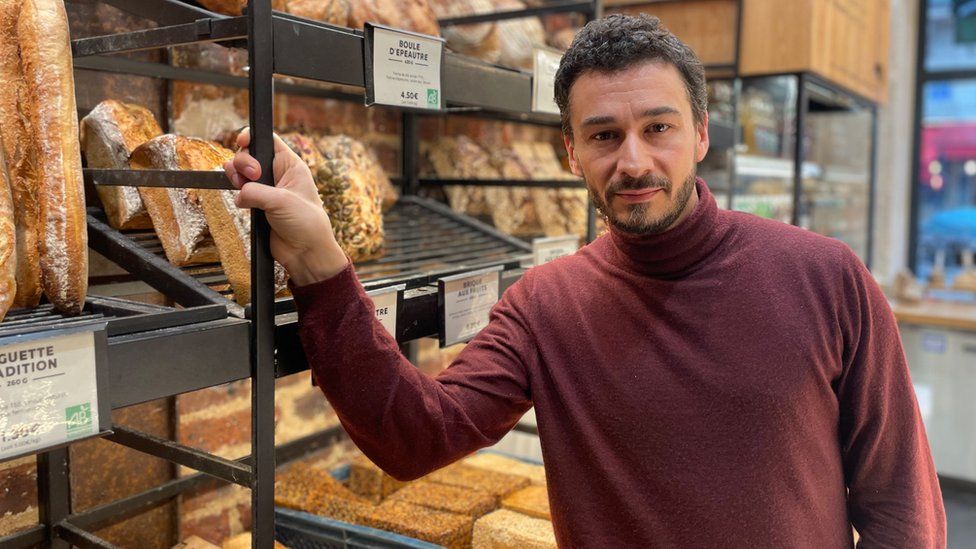
"I'm changing the world," grinned Rodolphe Landemaine, between mouthfuls of a lovingly laminated, butter-free, pain au chocolat.

Landemaine, a baker, now owns five busy boulangeries in Paris, with more on the way in other French cities, all serving entirely dairy-free products to a mostly local clientele.

Not that he advertises the absence of butter, or eggs, or cows' milk, in his shops. Indeed, the word "vegan" never crosses his lips.

"It's not an easy word for French people to get used to. It's very difficult for them to give up on butter and eggs," he acknowledged, explaining that the idea of veganism is considered too "militant" for many.

Instead, Landemaine, a vegan with an interest in animal welfare and climate change, has adopted a stealthier approach, hoping customers will fall in love with his croissants, madeleines, quiches, sandwiches, flans and pains au raisins before they realise, too late, that butter has been replaced with a secret blend of plant-based products.

Rodolphe Landemaine
Image caption,
Baker Rodolphe Landemaine is a vegan and exploring dairy-free alternatives to traditional ingredients

And if he can persuade conservative French taste buds to tolerate croissants "sans beurre" then perhaps, the argument goes, anything is possible.

As if on cue, a young boy walked past us, clutching the remains of a flaky claw, which he loudly declared to be délicieux.

"It tastes lighter," said a musician named Anne, 42, nibbling the end of her croissant.

"It's really good. I don't think I would recognise the difference," said Marta, a visitor from Poland, of her pain au chocolat. She's not a vegan but noted that she often got a scathing look from French waiters if she ordered oat milk with her coffee.

"I see the judgement in their eyes because it's just not part of their culture," she added.

For a country grappling with all sorts of new influences, such as challenges to its long-standing policy of state secularism, or le wokisme of imported "Anglo-Saxon" culture wars, a few unusual pastries can hardly be considered a major threat.

And yet the issue brushes some raw nerves here, from French people's deep but evolving relationship with the terroir or land, to the escalating farmers' protests across Europe, to the upheavals brought on by climate change commitments, to France's almost religious devotion to certain culinary customs. And all this in the shadow of June's European Parliament elections, which look likely to usher in big gains for far-right parties in France and beyond.

"Not for me, no way," said Thierry Loussakoueno, with mild indignation, appalled by the very idea of a butter-free croissant.

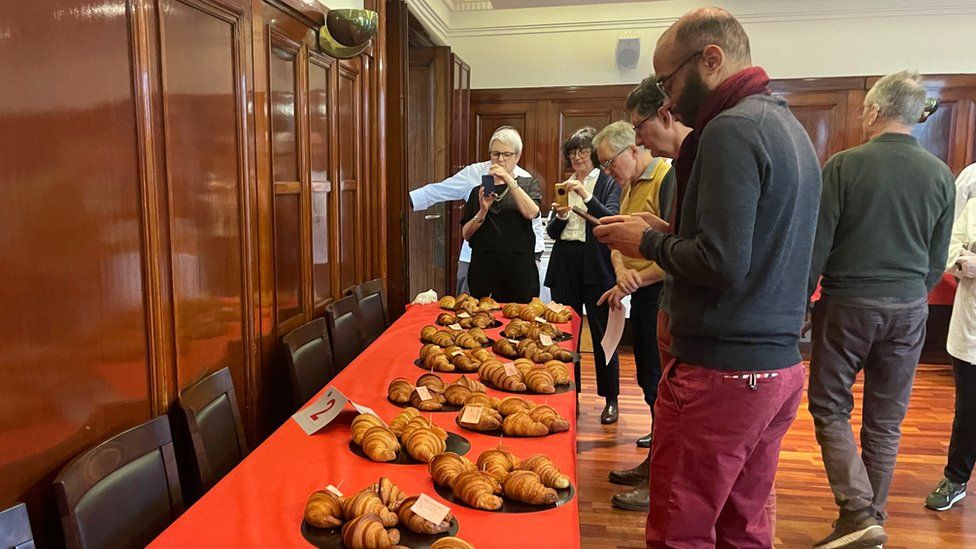
Croissants laid out on a table at a competition with judge Thierry Loussakoueno
Image caption,
Thierry Loussakoueno was among the judges at a recent croissant competition

Loussakoueno was busy, one recent morning, judging a traditional croissant competition in a wood-panelled conference room close to the River Seine in central Paris. The event, one among dozens, was organised by the Paris office of the French Union of Bakers and Pastry Makers and sponsored by a group of dairy farmers from south-west France. The French food industry has a collective reputation for being highly organised, conservative, and quick to self-defend.

"I don't understand these vegan pastries. I can understand people who don't eat meat for whatever reason, and I respect this completely. But dairy products and butter are just too important in the taste of food and not using them is just too bad and a pity," said Loussakoueno, a Parisian civil servant.

Other judges and competitors, sniffing and prodding a succession of crescent-shaped creations, spoke of the need to protect French farmers.

"It's difficult for me to even talk about making a croissant without butter. There's a whole family who are behind this - lots of people involved in the process," said Olivier Boudot, a cookery teacher.

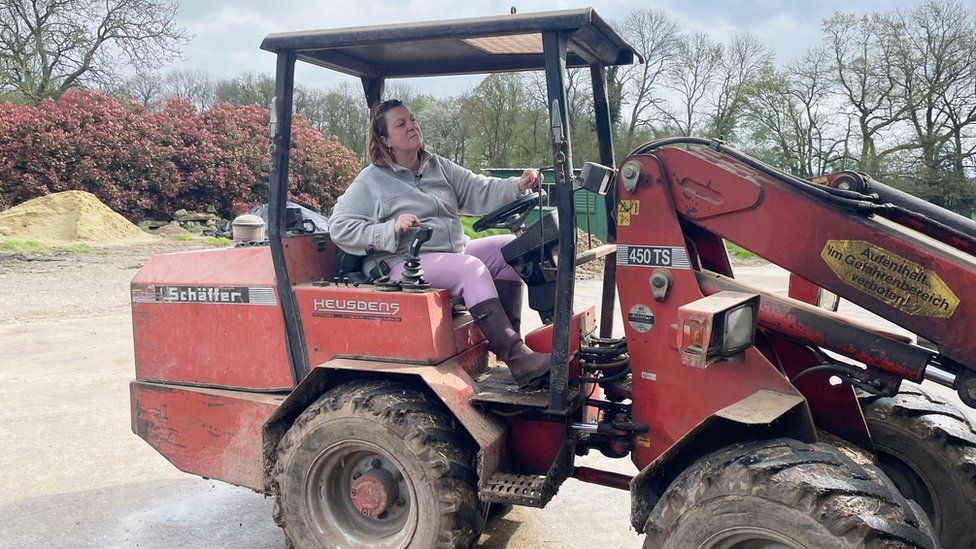
An hour's drive northwest of Paris, near Amiens, in a large barn surrounded by gentle green hills, a muscular, 700kg Holstein cow manoeuvred herself into an automated milking enclosure, watched by her owner, Sophie Lenaerts.

"Amazing machines," said Lenaerts, as a mechanical arm swung four suction cups beneath the cow, who was casually relieved of a dozen litres of milk, destined for a nearby butter factory.

Sophie Lenaerts driving an agricultural vehicle on her farm
Image caption,
Sophie Lenaerts keeps a herd of Holstein dairy cows

Lenaerts, 57, has more pressing concerns than the perceived threat of vegan croissants sold to metropolitan consumers. And yet the issue rankles.

Like many small farmers in France and beyond, she has spent much of the past few months angrily organising protests against a European Union-wide agricultural system which she feels is destroying her industry. She's planning another trip to Brussels this month to help block roads near the European Union's headquarters.

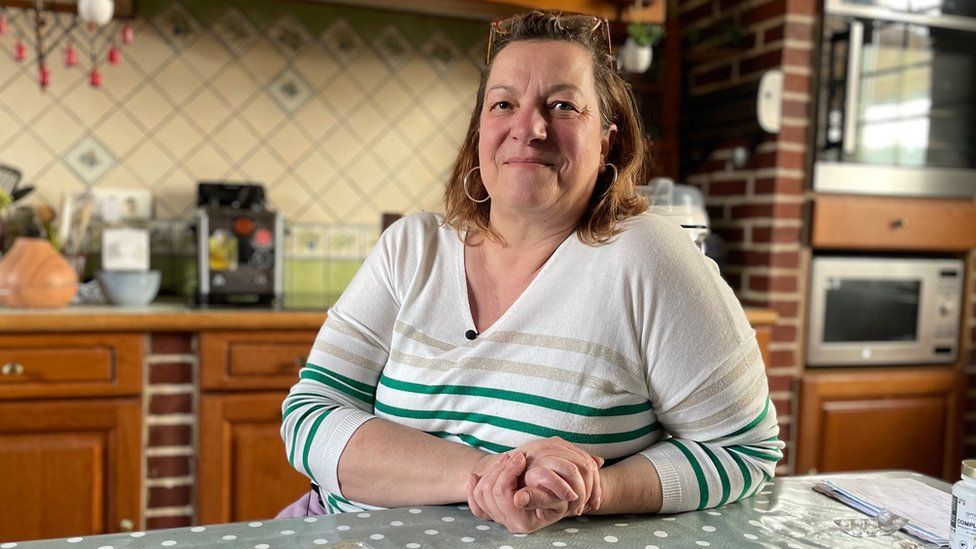
Sitting later in her snug farm kitchen, Lenaerts railed against imports of cheaper, sub-standard foreign food goods, against the huge mark-ups that distributors and middlemen impose on her produce, and against the sense that farmers are too often left as scapegoats for all climate-related issues.

"I have grandchildren. I want the best planet for everyone. But it's always the farmer that gets the blame," she said.

Vegan croissants were, for her, merely an indicator of the broader "industrial madness" that involves shipping unusual foods around the globe in order for "certain food companies" to make a profit. A combination of cynicism and virtue-signalling.

Sophie Lenaerts in her kitchen
Image caption,
Lenaerts suggests everyone make a small effort to eat well

Lenaerts looked through a rain-speckled window towards her fields. Ninety-eight percent of her cows' food is produced on the farm. Almost all the food her family eats is bought from her neighbours, just a cycle-ride away. Surely, she explained, this is the way to tackle climate change, and a host of other challenges. Instead, this "virtuous circle" is already on the brink of extinction.

"The fear of losing French agriculture is the fear of losing our heritage, our land. It's the farmers that maintain our landscape and make France a country for tourism. When no farmers are left, when no cows are left, it will be much worse. (But) I think we're at a turning point in terms of awareness," Lenaerts continued, pointing to strong public support for the recent farmers' protests.

"If everyone makes a small effort to eat well, to pay attention to what they're buying, things should go in the right direction."

There are some encouraging signs of that.

Manon Fleury in her restaurant alongside team members preparing food
Image caption,
The team at Datil, which has been awarded a Michelin star

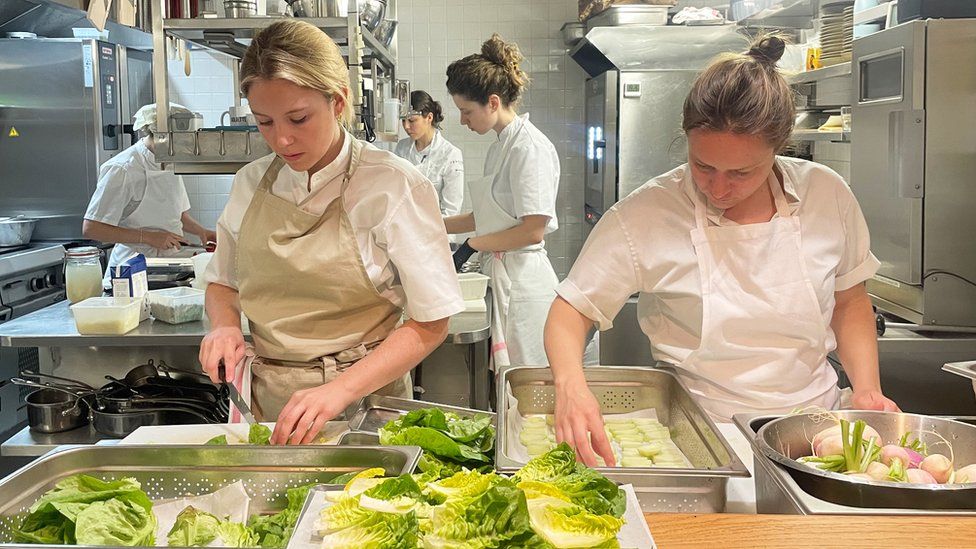
Off a narrow street in the fashionable Marais district of Paris, six women stood, in solemn concentration, in a gleaming restaurant kitchen, carving up the morning's delivery of plump asparagus spears, salad heads, kumquats, and radishes.

Gliding between them, the owner and chef, Manon Fleury, was still basking in the delight of being awarded a first Michelin star for her restaurant, Datil, in March. Fleury, once a junior fencing champion, has received a lot of attention in France for her energetic attempts to challenge a male-dominated restaurant industry, but her cooking - with a focus on "mostly vegan, poetic" recipes - is also seeking to nudge French food culture in a new direction.

Hers is by no means the only restaurant of its kind in Paris, but visitors - including the millions soon to descend on the city for the Olympic Games in July - may notice the extent to which meat and dairy-loving France lags far behind London, for example, in offering even the barest nod towards vegetarian options.

"The French tradition is quite heavy," Fleury admitted.

She acknowledged the cost involved in trying to break away from larger suppliers and sticking to a smaller network of trusted organic farmers.

"There is more and more interest in this kind of cuisine, but it has to be in harmony and balance," Fleury said, trying to sound both reassuring and radical at the same time.

"Sometimes you have to be radical to change the world," she said.

A little revolution?

"Yes, kind of. But with a lot of kindness."

Back at the bakery, perhaps 15 minutes by bicycle from Fleury's restaurant, the morning rush of customers was slowing down. One last, lonely, croissant sat waiting behind glass. Landemaine, the owner, said his business was growing fast, with new outlets opening soon in Bordeaux, Lyon and Rennes, with strong interest from the UK, Dubai and elsewhere.

But perhaps more significant was the notice that he said other French food companies were taking in his success.

"They sense the market is changing. One reason (for their interest) is that butter has been so expensive for several years," he said.

Still, Landemaine acknowledged that the road ahead remained steep.

"It's changing. But not so quickly," he said, as one of his bakers emerged from the basement kitchen, carrying a tray laden with dark, light-as-air, butter-free, chocolate tarts.

https://www.bbc.co.uk/news/world-europe-68944117