Vegan mayo sales are surging worldwide as health and sustainability drive demand. Could condiments be the future of plant-based growth?
Plant-based meat might be struggling right now, but the global vegan mayonnaise market is looking promising, according to a new report from Future Market Insights. The analysis projects the industry’s value could nearly double over the next decade, reaching $9.1 billion by 2035.
There are several key reasons behind this growth. More consumers are choosing plant-based foods for sustainable and ethical reasons, but health is also a major motivator.
Vegan mayonnaise is often seen as a healthier alternative, since it is lower in fat and cholesterol than traditional, egg-based versions. For example, one tablespoon of Hellmann’s Real Mayonnaise contains 8 percent of the recommended daily saturated fat intake, while its Plant Based Mayo Spread contains just 3 percent.
Vegenaise
As well as Hellmann’s, other brands offering popular egg-free mayonnaise options include Follow Your Heart, Eat Just, Chosen Foods, and Sir Kensington’s. For even more vegan mayo options, check out our guide here.
The report notes particularly strong demand in Japan, but sales are also rising across Europe, the UK, and the US. “The growth is further bolstered by supportive government initiatives and consumer advocacy promoting sustainable food production and animal welfare,” the firm notes. “Regulations encouraging plant-based food adoption and health guidelines for reduced fat and cholesterol intake are collectively driving innovation and expansion across the globe.”
A similar trend is emerging in the dairy alternatives market. According to the IMARC Group, the vegan yogurt market is expected to surpass $12.2 billion by 2033, while Grand View Research projects the plant-based milk market could reach more than $32.3 billion by 2030.
So, why is plant-based meat struggling?
By contrast, the plant-based meat sector is facing headwinds. Shares in Beyond Meat, one of the category’s leading brands, have fallen by 37 percent. Rising costs and consumer hesitancy around ultra-processed foods remain major obstacles.
“There is a market for fake meat, but consumers are broadly sceptical of the category as it is not seen as particularly natural and is viewed as being highly processed,” Neil Saunders, managing director at GlobalData, told The Daily Mail. “This means demand is sluggish and that, along with competition, has weighed down on Beyond Meat’s performance and valuation.”
Beyond Meat
Plant-based mayo, on the other hand, while also processed, carries a stronger health halo. It is also rarely the centrepiece of a meal, and is usually spread or mixed with other ingredients, likely making it an easier swap. Condiments also lack the deep cultural and emotional ties of meat, which may make them simpler to replace for many individuals.
Still, there is hope for plant-based meat. Brands are adapting to consumer concerns through innovation. Beyond Meat has rebranded as “Beyond,” while British brand This is launching more whole-food products made with mushrooms and tofu. Speaking of tofu, IMARC Group predicts the tofu category alone could surpass $4.4 billion by 2033.
“As plant-based meat technologies improve, there is no reason the category cannot grow in the future,” Jerry Thomas, the CEO of Decision Analyst, also told The Daily Mail. “The category still has long-term potential.”
Hellmann’s has made a big splash by rebranding its vegan mayo to appeal to flexitarians, in a sign of the influence of labels on sustainable food purchases.
In the UK, Hellmann’s egg-free mayonnaise is no longer labelled ‘vegan’, with the Unilever-owned brand opting for ‘Plant Based Mayo’ as a way to become more “inclusive” to flexitarians.
Courtesy: Hellmann's
The relaunched spread – which first appeared in the UK market in 2018 – now comes with a new recipe and redesigned packaging in a move that aims to solve multiple pain points at once: food waste, health concerns, and label barriers.
The decision to drop the term ‘vegan’ from packaging is a conscious one, with the brand saying there was “considerable headroom for growth” in the vegan mayo world, “particularly from consumers who want to cut back on animal-based products without becoming fully vegan”.
Currently rolling out across UK supermarkets, the new mayo now also has less rapeseed oil (down from 72% to 52%), supplementing it with a seemingly lower amount of sunflower oil. Plus, it now has xanthan gum.
Hellmann’s leans into vegan labelling research
Courtesy: GFI
Explaining its reasoning, Hellmann’s said its consumer research has shown that “the word ‘vegan’ can be a barrier for flexitarians, who see ‘plant-based’ as more inclusive”.
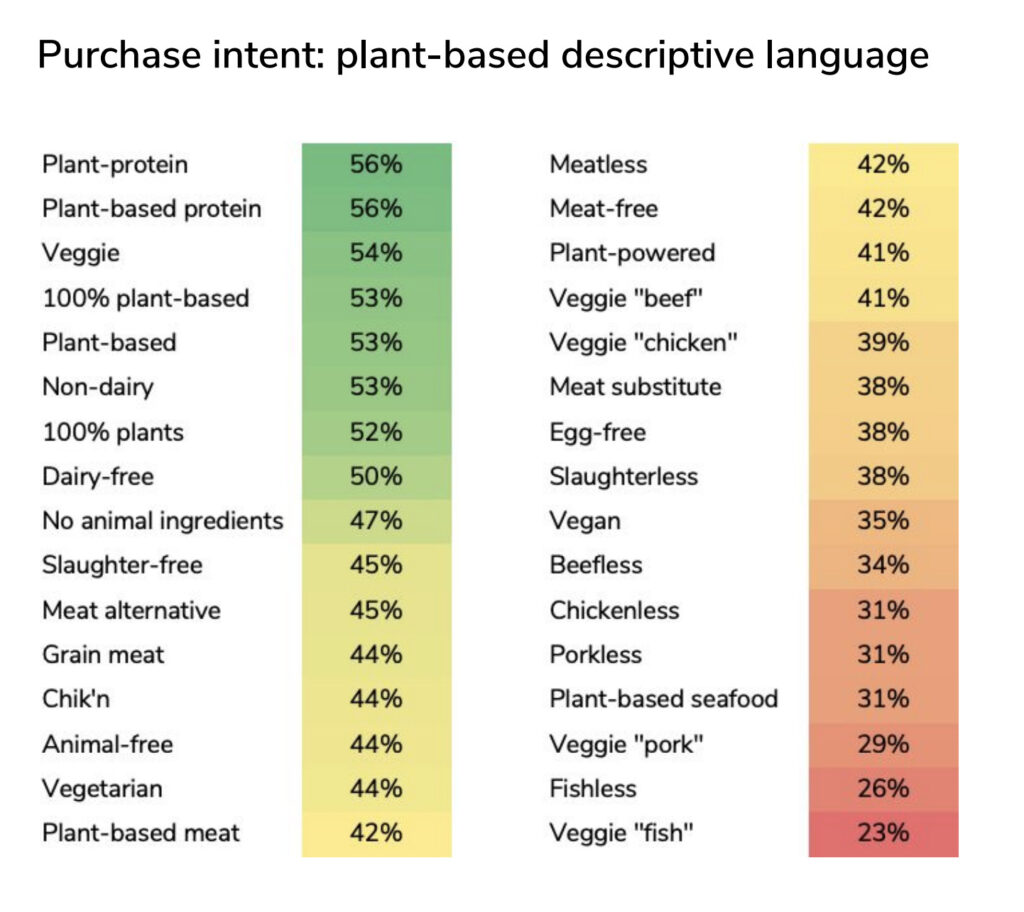
This chimes with a plethora of other studies on sustainable food labelling. In 2019, analysis by alternative protein think tank the Good Food Institute found that terms like ‘100% plant-based’ and plant-based (both 53%) are much more appealing to consumers than ‘vegan’ (35%), which was amongst the least effective ways to label vegan food.
Similarly, an oft-cited study by the University of Southern California last year – covering 7,341 people – used gift baskets as a gauge for which labels work. Participants were asked to choose between a vegan and non-vegan food basket, with the former being labelled in five different ways.
Only 20% chose the ‘vegan’ gift basket over the meat and dairy one, while 27% picked it when labelled ‘plant-based’. However, describing them with impactful attributes represented a significant upturn: when marked as ‘healthy’, 42% went with the vegan basket, while 43% did so for those tagged as ‘sustainable’ or 44% when labelled as both ‘healthy’ and ‘sustainable’.
This is why phrases like “100% sustainably sourced oils”, “free from artificial colours and flavours”, and “good source of omega-3” are prominent in Hellmann’s messaging around the rebranded Plant Based Mayo.
Vegan giants like Impossible Foods and Eat Just have also been using terms like ‘meat from plants’ and ‘made from plants’ for their meat and egg analogues, respectively. In fact, the latter simply labels its relaunched vegan spread as ‘Just Mayo’ to attract flexitarians, who hold the key to success for plant-based food manufacturers.
But when the world’s largest mayonnaise brand – a subsidiary of one of the biggest CPG companies globally – bids adieu to the word ‘vegan’, it’s a telling reminder that labelling matters. Hellmann’s plant-based sales have been growing for four consecutive years, so for Unilever to make the change, it’s an indicator that ‘vegan’ wording may be blocking the full potential of climate-friendly food sales.
Since the company is aiming to reach €1.5B ($1.6B) in annual sales from plant-based products in categories that would have traditionally used animal-derived ingredients by next year, targeting flexitarians with its Plant Based Mayo is a shrewd move. In a similar move, its latest non-dairy ice cream is branded as Magnum Chill Blueberry Cookie, a departure from the Magnum Vegan moniker.
Redesigned packaging leaves less Plant Based Mayo in the bottle
Courtesy: Hellmann’s/Green Queen
The announcement accompanied a change in the egg-free mayo’s packaging, part of the brand’s long-standing efforts to cut food waste. Debuting in the UK and Ireland later this year, the new squeeze bottles are now lined with an edible plant-based coating that prevents the mayonnaise from sticking to the sides and minimises the amount left over after the spread is used up.
“We know consumers want to be able to squeeze out as much product as possible – it’s an important cost and value benefit,” Krassimir Velikov, senior science and programme leader at Unilever, said of the new “easy-out” technology. “Some of the ingredients used in the plant-based mayo presented us with specific challenges, as they made the mayo more prone to getting stuck in the bottle. Correcting this issue involved creating an edible, vegan coating that would prevent this sticking problem by making the inside of the bottle more slippery,” he explained.
“We had to make sure that this ‘easy out’ coating hit a balance that would achieve the desired ‘easy out’ effect without interacting with the product. Even a slight change could make an enormous difference. For example, a tenth of a percentage increase of the plant-based ‘egg’ could add a full 15g leftover portion to the waste.”
Velikov added that by minimising the leftover mayo, the tech helps keep its bottles – which are “made with 100% recycled plastic where technically feasible” – in the recycling process. “If they exceed the maximum weight threshold needed, they will be rejected for recycling. By helping consumers to leave less mayo in the bottles, we in effect help them recycle more successfully,” he said.
Hellmann’s has a commendable record with food waste, having launched a Make Taste, Not Waste campaign in 2018 to fight this issue. Its research shows that 59% of consumers feel brands have a role to play here, especially since food waste accounts for 8-10% of global emissions.
The mayo maker’s food waste initiatives have involved a four-week-long Fridge Night challenge, dedicated Super Bowl ads for the last four years, a partnership with Ogilvy for use-what-you’ve-got recipes, a Smart Jar that revealed hidden messages when placed in fridges at 5°C or lower, a Meal Reveal tool to provide recipe ideas from what people have in their fridges, and a collaboration with Italy’s ID.Eight to launch a collection of sneakers made from food waste.
That said, Unilever itself is walking back on several of its climate pledges, including abandoning its goal of cutting food waste in its operations by 50% by 2025. Its commitment to roll out carbon labels on the packaging of all 75,000 of its products by 2026 seems to be forgotten too. “It is possible that some of our brands may wish to communicate product carbon footprints in the future, and for this having accurate data is essential,” a company representative told Green Queen in April.
“We also know information must be provided in context to be meaningful to consumers,” they added, outlining that the business was “committed to improving transparency of GHG emissions” in its value chain. “Our collection of more accurate data will help Unilever to make more informed procurement decisions as we work towards our climate targets.

 Beyond Meat