Showing posts with label children's diets. Show all posts

Sunday, March 29, 2026

Children and teenagers more open to meat free diets – but struggle to maintain it

From news.exeter.ac.uk

Lots of children and teenagers are open to a vegetarian or vegan diet and cut out meat but then struggle to keep it up, according to a new study from the University of Exeter.

The study, published in Psychology of Human-Animal Intergroup Relations, found childhood and adolescence are key windows for reducing meat consumption as children and teenagers are far more open to giving up meat than adults. This offers a promising opportunity for supporting healthier and more sustainable diets in future generations, but there are still several practical barriers standing in the way.

Lead researcher Dr Luke McGuire from the University of Exeter said: “There’s a growing shift towards plant-based eating, but many adults still struggle to change their behaviour and view eating meat as natural, normal, and necessary. This makes dietary change among adults challenging, but research shows children place a similar moral value on animal lives as on human lives and are less likely than adults to view eating meat as morally acceptable.

“We therefore wanted to understand whether these beliefs are related to behaviours and what makes young people consider vegetarian or vegan diets and found many are motivated by moral, environmental, and emotional factors.

“Research has shown vegetarian or vegan diets are safe for children and can be beneficial to their health, if done correctly. It means with the right support from parents and schools – and improvements in the convenience and appeal of plant-based foods – childhood could represent a powerful opportunity to encourage healthier and more sustainable eating habits.”


Researchers surveyed more than 1,000 UK young adults aged 18 to 26 years old, asking whether they had ever thought about giving up meat while growing up. Around half (48.5 per cent) of all participants said they had considered stopping eating meat before finishing secondary school, with these thoughts first occurring aged 11 on average. Of those who considered it, about half (50.4 per cent) actually tried to stop eating meat, ranging from a few days to several years.

However, the study found that most young people eventually returned to eating meat, with practical barriers such as taste, convenience, social pressure, and fitting in with family routines among the common reasons. Researchers also found parental support was the strongest factor in whether young people successfully maintained a meat-free diet – but parents were often more supportive of their child returning to eating meat than of their initial attempt to give it up.

The study found two key reasons why young people reduced meat consumption. The first was disgust at learning that meat came from animals, an insight which often prompted an interest among young children in avoiding meat. Meanwhile, older children and teenagers were more likely to be motivated by health or environmental concerns, reflecting rising awareness of global sustainability issues among younger generations. Participants also described “meat epiphany moments,” when learning about food systems prompted them to re-evaluate what they ate.

Co-author Professor Natalia Lawrence from the University of Exeter said: “Our findings suggest childhood and adolescence are natural periods for encouraging plant-based eating. However, for children and young people to successfully stop eating meat they need parental engagement and support.

“Part of the issue is offering more accessible and appealing plant-based options for families. Stronger food education in schools, alongside wider public messaging – like the recent ‘Bang In Some Beans’ campaign – highlight how an individual’s dietary choices contribute to health, environmental, and animal welfare goals.”

The paper titled ‘Early attempts to stop eating meat: Prevalence, predictors and outcomes among UK youth’ is published in Psychology of Human-Animal Intergroup Relations.

The study was funded in part by a grant from Children & Young People’s Wellbeing @ Exeter. More info on Bang In Some Beans: https://foodfoundation.org.uk/initiatives/bang-in-some-beans 

https://news.exeter.ac.uk/faculty-of-health-and-life-sciences/children-and-teenagers-more-open-to-meat-free-diets-but-struggle-to-maintain-it/

Monday, December 22, 2025

Major Meta-Analysis Reveals Vegetarian and Vegan Diets Can Support Healthy Growth in Children with Proper Supplements

From news.ssbcrack.com

A comprehensive new meta-analysis has found that carefully planned vegetarian and vegan diets can support healthy growth in children, provided they include appropriate supplements. This study, conducted by researchers from Italy, the USA, and Australia, is the most extensive review to date evaluating plant-based diets among young individuals. The analysis examined health, growth, and nutritional outcomes in over 48,000 children and adolescents globally and assessed various dietary patterns.

The research reveals that vegetarian and vegan diets can supply essential nutrients conducive to normal development. However, it also highlights a heightened risk of nutrient deficiencies if key nutrients are not obtained through fortified foods or supplements. Published in Critical Reviews in Food Science and Nutrition, the study suggests that these plant-based diets may also offer additional health benefits, such as improved cardiovascular markers when compared to diets that include meat, fish, and other animal products.

The meta-analysis reviewed data from 59 studies across 18 countries, focusing on children under 18 years of age. It compared lacto-ovo-vegetarian diets (which include dairy and eggs) with vegan diets (which exclude all animal-derived foods) against omnivorous diets. It included a significant number of participants: 7,280 lacto-ovo-vegetarians, 1,289 vegans, and 40,059 omnivores, enabling a comprehensive assessment of differences in nutrient intake, growth, and general health.

Interestingly, the results indicated that vegetarian children consumed higher levels of fibre, iron, folate, vitamin C, and magnesium than their omnivorous counterparts. However, they had lower intakes of energy, protein, fat, vitamin B12, and zinc. Similar trends were noted among vegan children, albeit with fewer studies focusing specifically on this group.


The study highlighted critical nutrient gaps, particularly noting that vitamin B12 levels fell short without supplementation or fortified foods. Additionally, calcium, iodine, and zinc intakes were often found to be at the lower end of recommended ranges, which is essential to consider for children on plant-based diets. Dr. Jeannette Beasley, a co-author of the study, pointed out that vegan children, in particular, displayed notably low calcium intake.


Despite concerns regarding nutrient intake, both vegetarian and vegan children exhibited better cardiovascular health profiles compared to those consuming omnivorous diets. They presented lower levels of total cholesterol and low-density lipoprotein (LDL) cholesterol. Measurements relating to growth and body composition indicated that children following plant-based diets tended to be leaner, with vegetarian children averaging shorter stature and lower body mass index (BMI) than omnivores.


Dr. Monica Dinu, the lead author, stated that the evidence suggests well-planned and supplemented vegetarian and vegan diets can fulfil nutritional requirements and support healthy growth in children. The researchers conveyed that plant-based diets remain a viable option for families, offering various health and environmental benefits. They encouraged parents to thoughtfully plan these diets and, when feasible, seek expert guidance from dietitians and paediatric health professionals to ensure that children’s developmental needs are fully met.


The authors also stressed the need for clearer, evidence-based recommendations to assist families in crafting healthy plant-based diets, especially during periods of rapid growth. They acknowledged the limitations of their findings, notably that many included studies were cross-sectional, and variations in methods and populations were common. The challenge of accurately measuring children’s dietary intake was also noted.


Dr. Wolfgang Marx emphasized the necessity of a balanced approach, advising families to pay close attention to certain nutrients—particularly vitamin B12, calcium, iodine, iron, and zinc—to ensure their children’s thriving growth and development. The study seeks to provide clarity on both the potential benefits and risks associated with plant-based diets, considering the growing trend among parents choosing these diets for various reasons.


https://news.ssbcrack.com/major-meta-analysis-reveals-vegetarian-and-vegan-diets-can-support-healthy-growth-in-children-with-proper-supplements/

Saturday, December 13, 2025

Most comprehensive study to date maps health benefits and risks of plant-based diets for children

From newfoodmagazine.com

New research explores how plant-based diets affect children’s health, revealing heart benefits alongside risks of nutrient deficiencies without careful planning 

A major new study has highlighted both the health benefits and risks of plant-based diets diets for children. Drawing on data from more than 48,000 children and adolescents worldwide, this large meta-analysis is the most comprehensive study to date of plant-based diets in under-18s and shows that, while these diets can support healthy growth, careful planning is essential to avoid nutrient deficiencies.

The peer-reviewed study, published in Critical Reviews in Food Science and Nutrition, was led by researchers from Italy, the USA and Australia. It reviewed data from 59 studies across 18 countries, comparing children following lacto-ovo-vegetarian diets (including dairy and eggs but excluding meat, fish and poultry) and vegan diets (excluding all animal-derived foods) with those consuming omnivorous diets.

In total, the analysis covered 7,280 lacto-ovo-vegetarians, 1,289 vegans and 40,059 omnivores. The results showed that vegetarian children typically consumed more fibre, iron, folate, vitamin C and magnesium than omnivores. However, they also had lower intakes of energy, protein, fat, vitamin B12 and zinc. While evidence on vegan diets was more limited, similar nutritional patterns emerged.


Study co-author Dr Jeannette Beasley, Associate Professor in the Departments of Nutrition and Food Studies and Medicine at New York University, explained:

Notably, vitamin B12 didn’t reach adequate levels without supplementation or fortified foods, and calcium, iodine and zinc intakes were often at the lower end of recommended ranges, making them important nutrients to consider for children on plant-based diets. Vegan children, in particular, had especially low calcium intake.”


Notable health benefits

Despite these risks, the study also identified notable health benefits. Both vegetarian and vegan children displayed more favourable cardiovascular risk profiles than omnivores, with lower total and low-density lipoprotein (LDL) cholesterol – often referred to as the “unhealthy” form of cholesterol.

Measures of growth and body composition showed that children on plant-based diets tended to be leaner than those on omnivorous diets. Vegetarian children were slightly shorter and lighter, with lower body mass index (BMI), fat mass and bone mineral content. Vegan children also had shorter stature and lower BMI scores.

Lead author Dr Monica Dinu, from the Department of Experimental and Clinical Medicine at the University of Florence, Italy said:

Our analysis of current evidence suggests that well-planned and appropriately supplemented vegetarian and vegan diets can meet nutritional requirements and support healthy growth in children.”


The authors stress that families should not be discouraged from choosing vegetarian or vegan diets for ethical, environmental or health reasons. Instead, they recommend that parents take an informed approach, paying close attention to key nutrients and, where possible, seeking support from dietitians and paediatric health professionals.

Dr Dinu added:

We hope these findings offer clearer guidance on both the benefits and potential risks of plant-based diets, helping the growing number of parents choosing these diets for health, ethical or environmental reasons.”

Further evidence needed

The researchers also highlight the need for clearer, evidence-based guidance to support families, particularly given children’s higher nutritional needs during periods of rapid growth. They caution that most of the studies included were cross-sectional and varied widely in methods and populations, making dietary assessment challenging.

Fellow co-author Dr Wolfgang Marx, from the Food & Mood Centre at Deakin University, Australia, concluded:

While well-planned vegetarian and vegan diets are nutritionally adequate and beneficial for adults, there is far less clarity about their suitability for children – leading to inconsistent or even conflicting advice for parents. Our findings suggest that a balanced approach is essential, with families paying close attention to certain nutrients – particularly vitamin B12, calcium, iodine, iron and zinc – to ensure their children get everything they need to thrive.”       


Thursday, October 30, 2025

Poll: Majority of Americans Want Vegan Milk, Meals in Schools

From vegnews.com

A new poll finds most Americans want schools to offer plant-based meals and dairy-free milk options for kids

                                                                                                                                Canva


A new poll by the Physicians Committee for Responsible Medicine (PCRM) suggests that most people in the US agree that schools should offer dairy-free milk and plant-based meals to children.

The poll, conducted by Morning Consult, surveyed more than 2,200 American adults and found that 67 percent either “strongly” or “somewhat” agreed that students should have access to animal-free options. Younger adults were even more likely to agree.

“We need to raise awareness that most Americans think that school lunch lines should include healthier options, including plant-based meals and non-dairy milk alternatives that can help keep students healthy,” Stephanie McBurnett, RDN, a nutrition educator for PCRM, said in a statement.

Why plant-based food and drink are a healthy choice for children

Further research from PCRM found that plant-based school meals tend to be significantly higher in fibre —nearly three times as much as animal-based meals. They also contain less saturated fat, more vitamins and minerals, and zero cholesterol.

“Serving plant-based meals, which are higher in fibre and lower in fat than typical school lunches, can help students fight obesity, type 2 diabetes, and even early signs of heart disease and set them up for a lifetime of good health,” continued McBurnett. “It also introduces children to healthier meals that they might not be seeing at home.”

VegNews.SchoolLunch.GettyGetty

Dairy-free milk options are also essential for children who suffer from lactose intolerance. Research suggests that more than 30 million Americans live with the condition, which makes it difficult for the body to digest dairy and can cause symptoms such as bloating, cramps, and diarrhoea.

According to the new poll, most respondents were unaware of how common lactose intolerance is in the general population. Fewer than one in four correctly estimated how many Americans are affected.

Progress is being made

Some regions of the US are already making progress in offering healthier, plant-based options to students.

In New York, for instance, the New York City Health Department recently announced updated Food Standards that will expand access to nutritious snacks and plant-based whole foods, and ban processed meats, across 11 city agencies, including hospitals, shelters, and public schools.

“If we are to bend the curve on heart disease, diabetes, and diet-related chronic conditions, we need to harness the power of government food policy to put healthy food within reach for everyone,” said Anupama Joshi, Vice President of Programs with the Center for Science in the Public Interest.

https://vegnews.com/poll-vegan-milk-meals-school 

Thursday, September 25, 2025

Why being vegan has more risks for women and children

From inews.co.uk

Women and children are more at risk from nutrient deficiencies on a plant-based diet 

Walk around a supermarket and the growing shelf space given to plant-based foods makes clear the trend is no flash in the frying pan.

But being vegan carries some inherent health risks, especially for women and children, nutrition experts have warned.

Growing numbers of people could see their health impacted because they are failing to get enough vitamins and minerals, according to researchers at a recent medical conference in London.

So, what are the key nutrients that can be lacking in a plant-based diet and why are certain groups more at risk?

Plant-based eating is not just beloved by influencers – it also gets official encouragement.

The NHS Eat Well Guide says that most people should eat less red and processed meat, because they are high in saturated fat, which is bad for the heart. Vegetables such as beans and lentils are suggested as good meat alternatives because they’re low in fat and high in fibre, which most people don’t eat enough of.

Climate campaigners also want us to eat less meat because livestock, especially cattle and sheep, release methane, which is a potent greenhouse gas.

Schools, councils and hospitals are increasingly trying to nudge people into more vegetarian eating through schemes such as meat-free days in canteens.

In fact, the perfect diet that is both healthy and sustainable for the planet is so plant-based that it limits pork, beef and lamb to 100 grams in total per week – about the amount of mince in one portion of bolognaise. This was the conclusion of a panel of experts commissioned by the medical journal The Lancet in 2019.

But for most omnivores, meat and dairy products supply significant proportions of some essential nutrients, said experts at a recent nutrition meeting called the CluB-12 Symposium in London.

                                                       Plant-based eating usually requires taking supplements (Photo: Xsandra/Getty)


Missing nutrients in plant-based diets

Vitamin B12 – essential for making proteins and DNA. Deficiency can cause fatigue, anaemia and cognitive decline. B12 is naturally found almost only in animal sources and so vegans must take a supplement. Vegetarians can also have low levels.

Riboflavin – another B vitamin. It is most often sourced from dairy products, so plant milk fans should ensure they use a fortified product or take a supplement.

Vitamin D – essential for strong bones and immune systems. Most people in the UK become deficient in vitamin D over winter, and so are recommended to take a supplement, regardless of diet.

Iron – essential for making red blood cells. Deficiency can cause anaemia. Best dietary source is red meat. Plant sources of iron are less easily absorbed.

Proteins – involved in every bodily function. Symptoms of protein deficiency include fatigue, poor immune function and bad skin and hair. Protein in meat is of higher quality than protein from plants.


Key vitamin of concern for women

Vitamin B12 is a key nutrient of concern for vegans, as in nature, it is almost only found in meat or dairy products (although it is added to some breakfast cereals).

Deficiency can cause fatigue, anaemia and harm brain cells. Vegans are recommended to take B12 supplements.

Both men and women can become deficient in B12, but women are more likely to have certain risk factors, including pregnancy and childbirth, said Dr Willemina Rietsema, a GP and researcher who advised on recent NHS guidelines on the vitamin. “The baby needs B12 and can grab it even if the mother has little,” she said.

An anaesthetic often given during childbirth, nitrous oxide – also called “gas and air” – destroys B12. This is why people who use nitrous oxide recreationally can get brain damage.

Another B vitamin, called riboflavin, is available from milk and other dairy products, and so people who drink plant milks are particularly vulnerable to its deficiency, said Professor Mary Ward, a nutrition expert at Ulster University. “It may be one of the reasons why younger women particularly have poor intakes of riboflavin, because they tend to veer away from dairy,” she said.

Only some plant milks are fortified with riboflavin. “You really need to be careful, when you’re taking a milk alternative that it is fortified, and if it’s not, then you need to take a supplement,” said Professor Ward.

In a recent study by Professor Ward, her team found about half of women in the UK are deficient in riboflavin, although she did not investigate if their diet was a factor.

Women also lose iron when they menstruate, and so are more likely to get anaemia if they become vegetarian or vegan.

Vegans and vegetarians are usually advised to take iron supplements, but this doesn’t always work because iron from meat is in a different chemical form that makes it easily absorbed by the gut, said Professor FrĂ©dĂ©ric Leroy, a food scientist at the Free University of Brussels.

Plant-based diets also have high levels of compounds called phytates, which reduce gut absorption of both iron and zinc, another essential nutrient. “In plant based products, the bioavailability of nutrients like iron and zinc is lower,” said Professor Leroy.

Emily Angus, a senior dietitian at the Vegan Society, said: “It is true that the iron provided by plants is less bioavailable, but our bodies adapt to this by absorbing more iron in the intestine. Many plants provide us with iron and zinc. Great sources of both include lentils, pumpkin seeds, kidney beans, chickpeas, peas, nuts and tofu.”


Has plant-based diet been over-egged?

While concerns about the climate aren’t going away, the potential limitations of plant-based eating, especially for women, have started getting more attention in the pages of medical journals.

In 2023, the Swiss-based Global Alliance for Improved Nutrition calculated that the 2019 Lancet diet would lead to shortfalls of four nutrients (iron, zinc, calcium and vitamin B12) for both sexes, and that the deficit was particularly bad for iron in women of childbearing age.

And a recent randomised trial comparing a standard healthy diet to a “sustainable” low-meat diet found the latter raised the number of people who had nutrient deficiencies, including of B12, riboflavin, zinc and selenium.

Another concern is that if women have a vegan diet while they are pregnant or breastfeeding, any nutrient deficiencies will affect their children.

Various European and US medical societies warn against veganism for pregnant or breastfeeding women, and babies and young children.

Doctors are generally more cautious about health risks of any sort for children than adults, because their bodies are developing and growing.


Risk to kids of cognitive damage

When babies and toddlers are still having both milk and solid foods, vegan diets are “generally discouraged” and should only be done under medical supervision, according to the European Society for Paediatric Gastroenterology Hepatology and Nutrition.

“The risks of failing to follow advice [for supplementation] are severe, including irreversible cognitive damage from vitamin B12 deficiency, and death,” said the society’s weaning guidelines.

Other bodies go further. The German Nutrition Society, for instance, recommends against a vegan diet for pregnant and breastfeeding women, children and adolescents as it is “difficult or impossible to attain an adequate supply of some nutrients”.

The British Dietitic Association, on the other hand, says that vegetarian and vegan diets can be healthy at every age and life stage, as long as they are well planned. “Reducing animal-derived foods and choosing a range of plant foods can be beneficial to the planet, animals and our health,” say their guidelines.

When experts disagree, it can be hard for consumers to know which advice to follow. Professor Ward said the right approach may be to try cutting down on meat rather than cutting it out.

“We’ve got to be careful as we move to more sustainable diets that we don’t make nutrient deficiencies worse,” she said. “I like to think about a plant-rich diet, rather than a plant-based diet.”

https://inews.co.uk/news/science/why-vegan-more-risks-women-children-3934459

Saturday, September 13, 2025

Easy Vegan Meal Prep Ideas For Back-To-School Season

From plantbasednews.org 

Chef Jenné Claiborne's vegan meal prep ideas will keep kids (and grown ups) happily fed all week

The back-to-school season often means busy mornings, packed evenings, and little time to cook. For JennĂ© Claiborne, the chef, cookbook author, and creator behind the popular YouTube channel Sweet Potato Soul, that’s where meal prep comes in. Known for her approachable take on plant-based eating, Claiborne recently shared a video where she explains how to meal prep effectively for the week with nutritious vegan meals.

The Atlanta-born chef has built a career showing that healthy food can also be vibrant, soulful, and family-friendly. She’s also a mom – so her system needs to work for both adults and kids. In her latest prep session, Claiborne makes a mix of savoury breakfasts, hearty dinners, and even a sweet treat to carry her and her daughter through the week.

Red lentil curry with sweet potato

Claiborne starts with a hearty pot of curry. She chops onions, garlic, and ginger before toasting them with curry powder, garam masala, cumin, coriander, and turmeric. “We are toasting our spices, which inevitably means that they’ll stick to the bottom. You want to scrape them off the bottom as much as possible,” she says.

Instead of the usual red lentils, Claiborne chooses split mung beans for extra creaminess, rinsing them carefully before cooking. Chunks of sweet potato, coconut milk, and tomato sauce round out the dish. Using her Instant Pot makes the process hands-off, though she points out it can also be done on the stove. She serves the finished curry over brown rice and freezes part for later in the week.

Savoury tofu scramble

Next comes breakfast. Claiborne prepares a large batch of tofu scramble so she doesn’t need to cook each morning. She sautĂ©s onion, bell pepper, garlic, and mushrooms until tender before crumbling in tofu by hand. “Honestly, using the fingers is the easiest way to do this,” she says.

Nutritional yeast, salt, and turmeric give the scramble its savoury depth and golden colour, while frozen spinach adds nutrients and a pop of green. Stored in the fridge, the scramble lasts well through the week and makes for quick breakfasts on busy mornings.

Barbecue tofu

Claiborne brushes the tofu with bbq sauce while grilling it in her video on easy vegan meal prep for back-to-school season
YouTube/Sweet Potato SoulFor a weeknight meal, Claiborne pairs her two-ingredient BBQ tofu with creamy carbonara pasta

For a simple protein-packed dinner, Claiborne slices pressed tofu and marinates it in barbecue sauce. “This is a two-ingredient recipe. It is so easy to make,” she says. Ideally, the tofu rests overnight, but it can also be simmered in sauce for a faster version.

The marinated slices are grilled or baked, basted with extra sauce, and paired with pasta. Claiborne notes the leftover marinade can be frozen and reused, making the dish as waste-free as it is convenient.

Creamy carbonara pasta

          Chef Claiborne preps a creamy carbonara pasta for her daughter to take to school - Media Credit: YouTube/Sweet Potato Soul


To go with the barbecue tofu, Claiborne whips up a dairy-free carbonara. She sautés shallots and garlic, then stirs in flour to create a roux before adding soy milk. Nutritional yeast, miso, salt, pepper, and lemon juice complete the creamy sauce.

Short pasta makes the dish easier for kids to eat, but any shape works. Claiborne adds the sauce to cooked pasta for a meal that is quick, filling, and lunchbox-friendly. “This is going to school with Baby Jay,” she explains.

Rice and beans

Claiborne also makes a classic pot of beans simmered with onion, celery, garlic, and a bay leaf. Paired with rice, it’s an inexpensive staple she knows her daughter will eat. She freezes extra portions in large silicone cubes for easy reheating later in the week.

Almond flour chocolate chip cookies

Finally, Claiborne and her daughter bake cookies together. Made with almond flour, flaxseed, vegan butter, and chocolate chips, they’re healthier than packaged sweets but still feel like a treat. “Because these are made from almond flour, they don’t spread like traditional cookies do. So, you’re just going to press them flat,” Claiborne explains as they prepare the tray for baking.

The cookies bake for just 13 minutes, coming out golden and chewy. For Claiborne, ending her prep session with dessert ensures the week ahead has balance – nutritious meals with room for joy.

Find more plant-based lifestyle content and recipes on the Sweet Potato Soul YouTube channel.

https://plantbasednews.org/lifestyle/food/easy-vegan-meal-prep-ideas-school/

Friday, August 22, 2025

What This Vegan Mom And Her One-Year-Old Eat In A Day

From plantbasednews.org

A peek into what a realistic day of plant-based eating looks like for a new mom and her baby 

Maddie, the creator behind the YouTube channel Let’s Eat Plants, is no stranger to the everyday challenges of feeding a vegan family, especially with a toddler in the mix. In a recent video, she offers a personal look into what she and her one-year-old daughter (known affectionately as “Baby Plants”) eat in a typical day. Still breastfeeding and recently recovering after a post-wisdom-tooth infection health scare, Maddie focuses on simple, whole-food meals that support healing and growth.

The video is as much about food as it is about figuring things out as a new parent. “If you’re going through this phase right now like me, hopefully this video will at least give you some ideas for healthy vegan meals that your one-year-old can eat,” she says.

        If you're raising a plant-based baby, here's some recipe inspiration - Media Credit: YouTube/Let's Eat Plants

Starting slow with oatmeal and fruit

Mornings begin gently in Maddie’s house, with Baby Plants breastfeeding first thing. An hour later, it’s breakfast time.

Breakfast is a family meal, and it’s usually the easiest one to share. “Breakfast is probably the one meal that she will tolerate what we are eating because we pretty much always eat oatmeal and she is still okay with oats.”

To make it more appealing, Maddie adds fruit to her daughter’s bowl. “I do put extra fruit in hers to make it a little bit more delicious.” The routine includes making tea or coffee with help from Baby Plants and heating everyone’s food before they eat together.

If her daughter is still hungry after the oatmeal, Maddie adds cut fruit like tangerines: “I’m just going to cut those up for her and she can practice feeding herself.”

Breastfeeding on demand, water goals, and playtime

There’s no structured morning snack, just responsive feeding. “Usually she will just breastfeed on demand if she is hungry after breakfast.” Maddie also makes sure her daughter has access to water throughout the day: “I do make water available to her and just offer it.”

She adds that she’s trying to improve her own hydration habits: “I’ve actually been really bad about my water intake lately. I’m trying to get back into the habit of just having a jar or a large glass of water nearby me at all times.”

Mornings also include some relaxed bonding time. “She is really into books lately so she will sit with me and have me read books to her or I just let her sit on the floor and read them herself.”

Baby-led lunch with tofu and toast

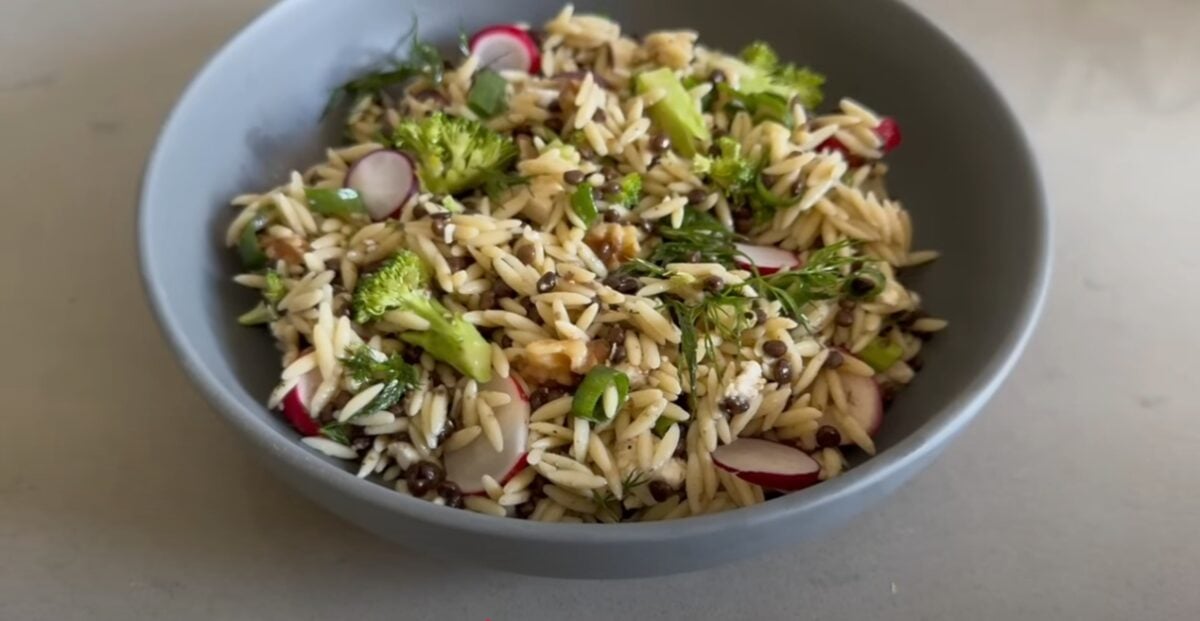
After her daughter’s nap, Maddie prepares lunch. “For lunch we have been doing tofu scramble with a little piece of toast or pancake on the side and then some kind of fruit. Today we have pears.” Maddie and her partner eat an orzo salad: “It’s super easy to throw together and healthy.”

An screengrab of a vegan mother and baby "what I eat in a day" video showing plant-based orzo salad
YouTube/Let's Eat PlantsOrzo salad is an easy and convenient meal for new parents

She says the salad was inspired by an older recipe on her channel. “I mix it up sometimes with whatever veggies I have.” Right now Maddie has some raw broccoli and cooked lentils in her fridge, so, along with chopped green onion and dill for extra flavour, that’s what she throws in. She tops the salad with vegan feta for saltiness and walnuts for crunch.

Her dressing is a basic lemon vinaigrette, and she notes that you can also swap the oil for aquafaba.

Baby-led weaning: figuring it out

After months of homemade purĂ©es, Maddie is shifting toward a baby-led approach. “I am leaning now more into the baby-led weaning style, giving her different foods to try and letting her feed herself more.” But she admits that it’s not easy: “No one prepares you for how weird it feels to just hand your baby a chunk of food and just hope for the best.”

She’s cautious about overly processed foods, sugar, and salt. “I definitely don’t want to all of a sudden now that she’s one-year-old just start feeding her everything processed or super sweet or super salty things.”

Texture is also a challenge. “She only has like four teeth… it just really throws me off to just hand her a chunk of something and expect her just to chew it like we do.” Maddie relies on the Solid Starts app for guidance: “I did find the Solid Starts app is really helpful for finding out how to cut and serve foods to your baby.”

Dinner: quick veggie pasta and a backup plate

Dinner is a simple pasta dish made during Baby Plants’ second nap. “Today I’m just going to do a quick pasta sauce because I already have some veggies prepped and it’s really easy to just throw everything into a pan and then add some tomato sauce and some herbs.”

The sauce starts with onion, broccoli, bell peppers, and seasonings. “I usually do garlic powder, oregano, and dried basil.” Maddie adds cooked lentils and plant milk for creaminess. “You can always add a little bit of soy milk or any plant milk of your choice for a little extra creaminess in your sauce.”

She’s aware her daughter may not love it: “I have given Baby Plants some pasta sauce once before and she was not a huge fan. Maybe it was a little bit like sour for her.” Still, she’s trying again: “I’m going to try it again with her tonight and I do have a backup dinner for her if she doesn’t like it.”

The backup is quinoa with corn and butternut squash. “I don’t think she loves the texture to be honest but I add some corn and butternut squash to it to make it a little tastier.”

Finding balance and embracing the unknown

Maddie’s day ends with reflections and questions for her viewers. She’s looking for advice on texture issues, repetition, and meal variety. “When you find a meal that your baby likes you kind of just want to eat that for a few days and not have to worry about finding something new all the time,” she says. “But I also don’t want her to get tired of it.”

Even when meals don’t go as planned, she stays positive. “Even though that pasta dinner was not a huge hit with baby girl, at least it was with my husband,” she says with a laugh.

In true Maddie fashion, she ends the video with appreciation: “Thank you for spending the day with me. I just love hanging out with you.”

For more vegan lifestyle content, check out Maddie’s YouTube channel.

https://plantbasednews.org/lifestyle/food/what-vegan-mom-and-one-year-old-eat/