Showing posts with label tofu. Show all posts

Tuesday, September 22, 2026

Tofoo & Co launches sizzling new sausages and silken tofu for its 10th birthday

From veganfoodandliving.com

Tofoo & Co celebrates a decade in business, launching new organic seitan sausages and silken tofu in major UK supermarkets


Tofoo & Co is marking a decade of plant-based innovation with three tasty new additions to its natural protein range.

Broadening its focus beyond traditional tofu, the brand is introducing organic frankfurters, bratwurst, and silken tofu to meet growing demand for whole, minimally processed plant proteins.

The launch follows a recent rebrand (from The Tofoo Co) and showcases Tofoo & Co’s new-look packaging, designed to be simple, impactful, and instantly recognisable on the shelf.

These new additions build on the momentum of its seitan launch in 2024 and the brand’s acquisition of German plant-based pioneer Topas. By offering high-protein, organic options, the producer aims to make wholesome plant-based ingredients far more accessible for everyday cooking.

New Tofoo & Co vegan sausages and silken tofu

Two new vegan sausages will be available in major UK supermarkets starting this month. Image © Tofoo & Co/Vegan Food & Living


Tofoo & Co has launched two new vegan sausage products: Frankfurters (£2.99 for 180g) and Bratwurst (£3.50 for 200g).

Made from organic seitan, both sausage varieties pack a punch with 27 grams of protein per 100g.
In a statement published by The Grocer, the brand highlighted their versatility, noting they are “perfect piled into a hot dog, served alongside your favourite sides or added to a warming sausage casserole.”

Joining the savoury sizzlers is Tofoo & Co Silken Tofu (£2.50 for 300g). With 5.2 grams of protein per 100 grams, this smooth block blends seamlessly into sweet and savoury creations, serving as an “easy protein boost or natural dairy replacement” for sauces, soups, and tofu dessert recipes alike.

Where to buy Tofoo & Co’s new range

The new range rolls out to major UK retailers starting today. Shoppers can find the Frankfurters and Bratwurst on the shelves at Tesco and Sainsbury’s, while the Silken Tofu will enjoy an even wider release across Tesco, Sainsbury’s, and Waitrose.

The range expansion caps off a landmark anniversary year for the business, which featured its ‘You Too Can Foo‘ campaign and a 27-date summer sampling tour.

“As consumers increasingly look beyond highly processed meat alternatives and seek out more natural sources of protein, we see a huge opportunity to make products like tofu and seitan more accessible and exciting for everyday eating,” said Tofoo & Co CEO David Knibbs.

“Expanding our range with Frankfurters, Bratwurst and Silken Tofu is the next exciting step in our journey to become the go-to brand for natural plant-based protein.”

You can ‘Foo it too, with these delicious vegan tofu recipes

https://www.veganfoodandliving.com/news/tofoo-co-new-sausages-silken-tofu/ 

Sunday, September 13, 2026

This Vegan Sushi Burrito Is The Perfect On-The-Go Lunch

From plantbasednews.org

Use baked tofu for flavour and plant protein 

When lunch needs to survive a commute, a busy workday or simply an afternoon away from the kitchen, portability matters almost as much as flavour. In a video on his Yeung Man Cooking YouTube channel, Wil Yeung turns a handful of familiar sushi ingredients into a vegan sushi burrito, a substantial and delicious handheld lunch filled with seasoned rice, caramelized tofu, avocado and spicy mayo.

Yeung, a Hong Kong-born Canadian author of four cookbooks, focuses his cooking channel on plant-based food. In this episode, he prepares a finished burrito that has plenty of contrast, from fluffy rice and tender tofu to crisp vegetables and creamy avocado.

Start with fluffy rice and caramelized tofu

For a packed lunch, Yeung wraps the finished sushi burrito in parchment paper, making it easy to transport and eat on the go - Media Credit: YouTube / Yeung Man Cooking

Yeung begins with sushi or short-grain rice, using about one and a half cups. “I’m using sushi or short-grain rice, which is one of my favourites,” he says, describing the cooked grains as “plump and fluffy.”

He rinses and drains the rice two or three times “to get rid of the excess starch,” then adds an equal amount of water. Once bubbles begin appearing, he lowers the heat, stirs to release rice sticking to the bottom, and covers the pan for 15 minutes. He later switches off the heat and lets the rice cook for another 10 minutes.

For the tofu, Yeung pats dry a roughly 350-gram block of extra-firm tofu and slices it into half-inch slabs. He coats the pieces with toasted sesame oil, maple syrup, soy sauce and dark soy sauce, then presses and rolls the tofu through the mixture.

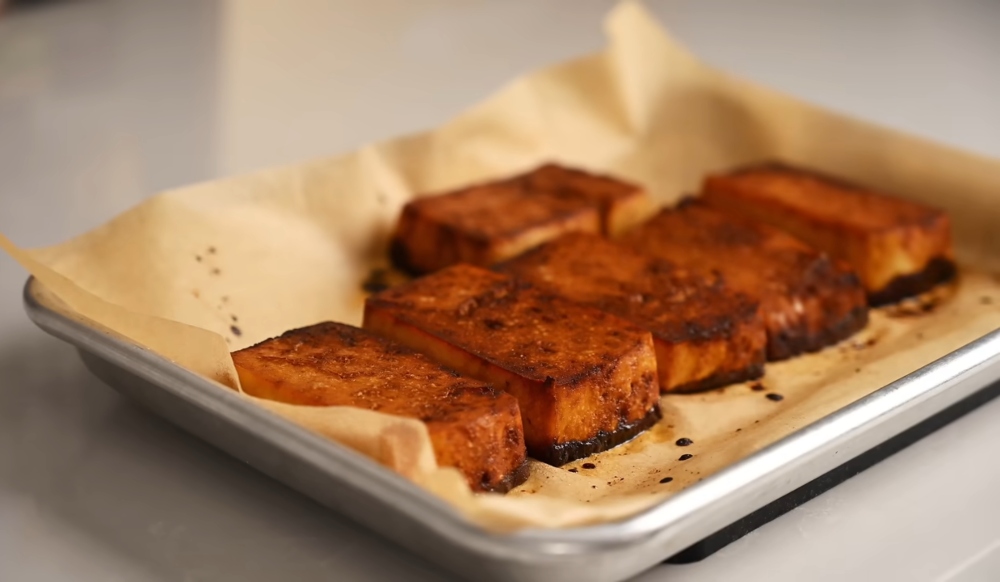
The tofu bakes for about 20 to 25 minutes. Once it comes out of the oven, Yeung says the slabs are “packed with delicious umami” and should have “a beautiful caramel colour.”

He later explains what each part of the marinade contributes. The tofu has “this really nice umami since it was baked with the soy sauce,” he says, while the maple syrup gives it “cotton candy-like sweetness.” The dark soy sauce creates the caramel colour, and there is also “that hint of toasted sesame oil fragrance.”

Fresh vegetables and quick spicy mayo

Caramelized tofu fresh from the oven, prepared as a filling for the vegan sushi burrito with a soy sauce and maple syrup coating
YouTube / Yeung Man CookingYeung bakes the tofu for 20 to 25 minutes, allowing the soy sauce and maple syrup coating to develop a deep caramel colour and rich umami flavour
While the tofu bakes, Yeung prepares the fresh fillings. He cuts half a carrot into thin matchsticks and says it will “add natural sweetness and a nice crunchiness.” His main advice is simple: “Do your best to slice it thin.”
A mini cucumber is cut the same way. “The cucumber will add a nice refreshing bite,” Yeung says.
He also makes it clear that the vegetables are flexible rather than fixed. “The great part about this recipe is that you can really use any veggies you like,” he says, adding that the burrito makes “a great grab-and-go lunch or snack.”
Thinly sliced avocado adds what Yeung calls “a lovely buttery texture.” For the sauce, he combines plant-based mayonnaise, Sriracha and a little water, then whisks everything together. “This is a nice and easy way of making a spicy mayo,” he says.
Yeung transfers the sauce to a squeeze bottle because it makes it “nice and accessible” when he starts assembling the burritos. The cooked rice is seasoned with salt and rice vinegar, then mixed gently with a rice paddle. Yeung presses it against the sides of the bowl and lets it cool for a few minutes before moving on to the nori.
Rolling the vegan sushi burrito
Yeung starts each vegan sushi burrito with a sheet of toasted nori and a thin layer of rice. He dips his fingers in water as he works because it helps “prevent the rice from sticking to your fingers.”
He also leaves a little space at the top of the nori. “That will just make the roll look a little bit cleaner,” he says.
The fillings go into the middle: toasted white sesame seeds, two tofu slabs, carrot, cucumber, avocado, spicy mayo and microgreens. Yeung then uses a sushi mat to tuck and roll the burrito, applying gentle pressure as he goes.
“The rice will stick to the nori, which ultimately will help it keep in place,” he says. Once rolled, the burrito can be wrapped in parchment paper so that it is “ready to go.”
The tofu quantity makes enough for around three burritos. Yeung also notes that any extra can be saved for another dish rather than used all at once.
‘So tasty, so fresh’
After taking a bite, Yeung does not hold back. “That is so tasty, so fresh, just delicious,” he says.
He describes the rice as “chewy and nice and fluffy,” while the tofu stays tender. The cucumber and carrot bring crunch, the carrots add sweetness, and the microgreens provide freshness. The spicy mayo contributes “a small hint of spiciness” from the Sriracha.
For Yeung, though, the biggest advantage is how uncomplicated the dish is. “The best part about this recipe is that it’s so simple to put together,” he says, calling it “the perfect lunchtime companion whether you’re at home or on the go.”
He even jokes about how easy they are to eat: “I can definitely enjoy two or three of these in one sitting if I don’t pace myself.”
That combination of portability and simplicity is what makes the burrito useful for weekday lunches. As Yeung puts it, “It’s simple, delicious recipes like this that makes it so much fun and exciting to cook and dine in at home, or in this case, to take with you on the go.”
Find more irresistible plant-based recipes from around the world on Wil Yeung’s YouTube channel.
https://plantbasednews.org/lifestyle/food/vegan-sushi-burrito/

Friday, September 11, 2026

Which meat-free alternatives are best for your health?

From saga.co.uk

By Ruth Tierney

From tofu and tempeh to Quorn and pea protein, experts explain the pros and cons of today's most popular meat-free proteins 

So-called “vegan” meats are often low in saturated fat, high in fibre, and they’re good for the planet. However, most count as ultra processed foods, which doesn’t sound so healthy. It’s thought recent concerns over UPFs is behind the £23 million fall in sales of plant-based proteins.

So what’s the truth? While there is no denying that plant-based meat substitutes are processed, this doesn’t automatically make them unhealthy.

“Ultra-processing is a nuanced term – biscuits, crisps and ready meals fall into this category, and all contain high saturated fat, sugar and salt,” says dietitian Louise Symington. “While vegan meat is quite heavily manufactured and may contain stabilisers or emulsifiers, the mince and chunk versions are usually low in fat and sugar, making them a healthy choice.”

Professor Christopher Bryant, executive director of Bryant Research and a fellow at the University of Bath, agrees: “‘Natural equals healthy’ is a rule of thumb that feels intuitive to people, but it doesn’t survive scrutiny. Red meat is natural, yet excess consumption is linked to heart disease, cancer and lowered life expectancy.”

Sometimes, ultra-processing can make food healthier, Prof Bryant points out. “The process of turning legumes, lentils and soya into vegan meat substitutes reduces their phytic acid content, which is desirable as phytic acid hampers the absorption of iron, calcium and zinc. Fortifying vegan products with minerals such as iron and B12 is also beneficial to our health.”

Many consumers of plant-based meat substitutes are younger, yet it’s those over 50 who would probably benefit most from adding them to their diet, says Symington. “Vegan meats are a good option for anyone worried about diabetes or heart disease as they’re generally low in saturated fat,” she explains. “And plant-based alternatives shine in their high-fibre content compared to zero fibre in meat. Most of us aren’t getting the recommended 30g a day, but it’s so important as you age, transforming everything from sluggish digestion to immunity levels, thanks to its ability to boost good gut bacteria.”

Symington does have one caveat, though: “If you have high blood pressure, do check the salt content as some products can be higher in sodium than their meat equivalents.”

How healthy are these four plant-based meats?

Tofu (also called bean curd)

What is it? Tofu is made by curdling, pressing and setting soy milk into a block.

Health benefits: “Soya in the form of tofu, and tempeh [also used in hydrated vegetable protein], is a complete protein with unusually high amounts of all nine essential amino acids. It really competes on the protein scales with animal products,” says Professor Bryant. Essential amino acids are necessary for muscle repair, brain function and immunity.

Getty

Tofu could be beneficial for older adults due to its high content of compounds called isoflavones. A study by Chinese scientists found that higher intake of tofu and isoflavones was associated with a lower risk of cardiovascular disease.

Isoflavones have also been found to prevent osteoporosis-related bone density loss. For extra bone protection, buy calcium-set tofu, adds Symington: “Look for calcium sulphate or calcium chloride in the ingredients, also called firming agents 516 and 509.” A 100g serving of tofu contains 405mg of calcium, which is 40% of your daily needs.

  • Calories (all per 100g): 118 kcal
  • Fat: 7.1g
  • Saturated fat: 1.2g
  • Protein: 13g
  • Fibre: 1.9g

Serving suggestion: A staple in Asian dishes, it works in stir fries, where seasoning disguises its neutral flavour.

Tempeh

What is it? Less processed than tofu, tempeh is made from whole soybeans that have been fermented then shaped into a block.

Health benefits: The most nutrient-dense of the meat alternatives, tempeh contains more calories than tofu but on average it has double the amount of protein and significantly more fibre.

Getty

Its real superpower lies in the fermentation, which increases the diversity of the gut microbiome. A study by Polish scientists found that tempeh encouraged the growth of healthy bacteria in the digestive tract, including lactobacillus, a probiotic that supports the immune system, relieves gut issues such as bloating, and promotes urinary tract health. According to Malaysian research, the fermentation process in tempeh also raises the levels of nutrients of the raw soybeans and enhances their absorption, particularly vitamins B2, B12 and the neurotransmitter GABA, which can improve memory.

  • Calories (all per 100g): 173 kcal
  • Fat: 8g
  • Saturated fat: 1.5g
  • Protein: 22g
  • Fibre: 6.7g

Serving suggestion: Its chewy texture is an acquired taste, but it works well in Indonesian curries (where tempeh originated).


Mycoprotein

What is it? Used in Quorn products, mycoprotein is made from the fermentation of a type of fungus found in the soil. It may sound unappealing, but Quorn is the most meat-like substitute in taste and texture.

Health benefits: Created in 1985, Quorn’s health credentials are the most researched of the meat alternatives. A recent study by the University of Exeter found that participants who ate 180g of Quorn products daily (equivalent to two servings of Quorn mince) had a 10% drop in LDL (bad cholesterol) after four weeks compared to those eating red and processed meat.

Another study by Northumbria University found that swapping red and processed meat for Quorn led to a big reduction in intestinal genotoxins (chemicals that can cause bowel cancer), and to a significant increase in good gut bacteria. Scientists at the university are currently studying how the gut uses soluble and insoluble fibres in Quorn to boost the immune system.

Getty

Introduce it to your diet slowly, says Symington. “Some people have digestive issues when trying mycoprotein as their gut bacteria goes crazy fermenting the fibre,” she explains. “Your body does get used to it, but it can be an irritant to people with IBS.” Also worth noting, standard Quorn products are not vegan as they contain an egg binder, but there is Vegan Quorn.

  • Calories (based on 100g Quorn Pieces): 97 kcals
  • Fat: 1.6g
  • Saturated fat: 0.3g
  • Protein: 14g
  • Fibre: 5g

Serving suggestion: You can substitute most meat products with Quorn’s faux products, from minimally processed Quorn pieces (just three ingredients) to Veggie Ham Slices.

Pea protein

What is it? Extracted from yellow split peas, this is a relatively new protein used by brands such as Beyond Meat in their mince, burgers etc.

Health benefits: One of the best tolerated veggie proteins, it is naturally wheat-free, gluten-free, and soy-free. Its USP is its hefty iron content – it contains more of the mineral than red meat (and all other plant-based meats), according to a new study by scientists in the Netherlands.

Researchers found 3.32g of iron per 100g of pea-based meat, compared to 1.9g in beef. While it’s more difficult for the body to absorb non-heme iron (from plants) than heme iron (from meat), taking vitamin C at the same time helps – pea-based meat is high in vitamin C. However, it is generally high in fat, including saturated fat, likely due to the oils added (often coconut or sunflower) for a “juicy” meat texture.

  • Calories (all per 100g): 221 kcal
  • Fat: 14.7g
  • Saturated fat: 5.8g
  • Protein: 15.9g
  • Fibre: 4.1g

Serving suggestion: British brand Squeaky Bean uses pea protein in its products. Its Chargrilled Cajun Mini Fillets are great in a salad wrap.

How healthy is jackfruit?

Jackfruit is a popular pulled pork substitute, but our experts don’t rate it as a meat replacement. “Although all plants contain some protein, jackfruit is not a great source of it (just 1-2g per 100g). The clue is in the name – it is a fruit after all,” says Dr Justine Butler, head of research at vegan charity Viva! “Its main benefits are that it is low in fat and provides some vitamins, which can contribute to a balanced diet. Just remember to serve protein-rich foods alongside.”


https://www.saga.co.uk/magazine/health-and-wellbeing/meat-free-alternatives-best-for-health

Tuesday, September 8, 2026

Beans Lead UK’s Plant-Based Food Growth As Shoppers Shun Meat & Vegan Alternatives

From greenqueen.com.hk

Legumes, tofu and tempeh are driving the resurgence of the UK’s plant-based protein sector, with conventional and vegan meat falling out of favour due to health and price concerns.

As meat prices continue to climb and vegan alternatives suffer from the ultra-processed tag, whole-food and minimally processed plant proteins are surging in the UK.

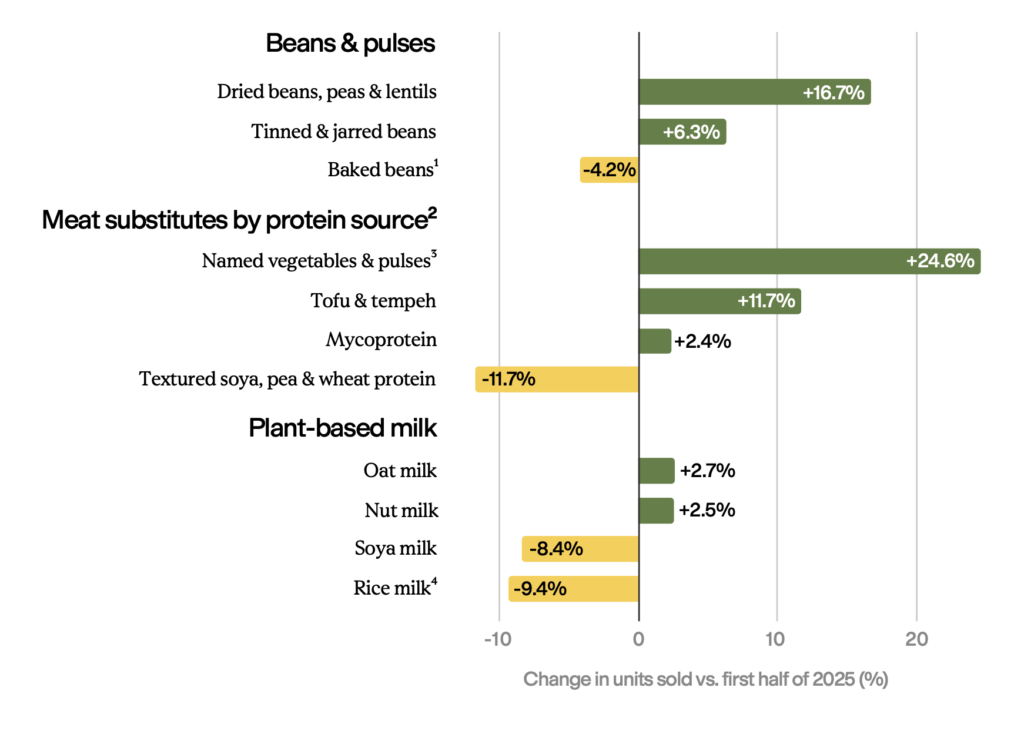
Madre Brava’s analysis of NielsenIQ data shows that, in the first half of 2026, unit sales of beans, pulses, tofu and tempeh grew by 7.3% compared to the same period a year ago, with value sales also up by 10.1%.

Plant-based meat alternatives, however, continued their slide with a 4.3% decline in units and 2.7% in value, though there was respite for mycoprotein (whose unit sales increased by 2.7%) and vegetable-led analogues like sausages and pies (+24.6% from a small base).

It’s not just vegan alternatives that suffered – sales of conventional meat products dipped by 1.8% during this period, according to Madre Brava’s review of Euromonitor International figures.

“Shoppers are not abandoning plant proteins – they’re shifting toward simpler, higher-fibre foods, whose prices are rising more slowly than food inflation, widening the price gap with meat. This indicates that, while food inflation and affordability remain key factors, nutrition and health benefits are also driving purchasing decisions,” the report noted.

Growth across budget and premium bean categories

uk plant based sales
Courtesy: Madre Brava

Within the traditional plant protein category, retailers sold 16.7% more units of dried beans, peas and lentils, with similar increases for canned and jarred beans (6.4%), tofu (7.2%), and tempeh (71.5%).

Textured vegetable proteins made from soy, wheat or pea experienced an 11.7% reduction in unit sales, while baked beans saw a 4.2% drop. The latter came as Brits switched from individual to multi-pack purchases, while the overall reduction came from beans that contained sausages or other processed meats.

While standard baked bean options declined in value, organic versions grew by 9.7% in unit sales. “These exemplify consumer shifts more generally, as shoppers seek healthier products, budget savings, and the success of ‘premium beans’ at the higher end of the market,” Madre Brava said.

Courtesy: Bold Bean Co

Health may just be the top driver, considering that the bean category is expanding at both the budget and premium ends. For four of the six canned and jarred bean segments (including chickpeas and butter beans) that saw a hike in demand, the price per unit lifted faster than inflation, indicating that people are spending more on premium options in these categories.

Brits’ appetite for premium beans has been driven by the popularity of London-based Bold Bean Co, which has witnessed a year-on-year growth of 117% since its launch in 2021. Such has been its success, retailers have begun coming out with jarred beans under their own-label brands.

“The canned pulses category is undergoing a real transformation,” said Beth Latham, the brand’s head of category and strategic projects. “It was previously a dusty, highly commoditised aisle in the store that lacked innovation. However, over the last few years, the premium end of the category has reshaped how consumers think about beans, proving they are delicious and can be the hero of a meal.”

Chloe Mackean, food business transformation manager at the UK’s Food Foundation (whose Bang in Some Beans initiative aims to double national legume intake by 2028), said she wasn’t surprised to see beans’ ascendancy.

“Beans are a triple win for health, sustainability and our wallets. They are a healthy and affordable protein source, high in fibre and emit far fewer greenhouse gas emissions than animal protein,” she pointed out. “But beans are also tasty, and it is thanks to brands like Bold Bean Co, who pepper social media with photos of delicious bean recipes, that have helped to change people’s perception.”

Oat milk dominates as supermarkets urged to embrace plant proteins

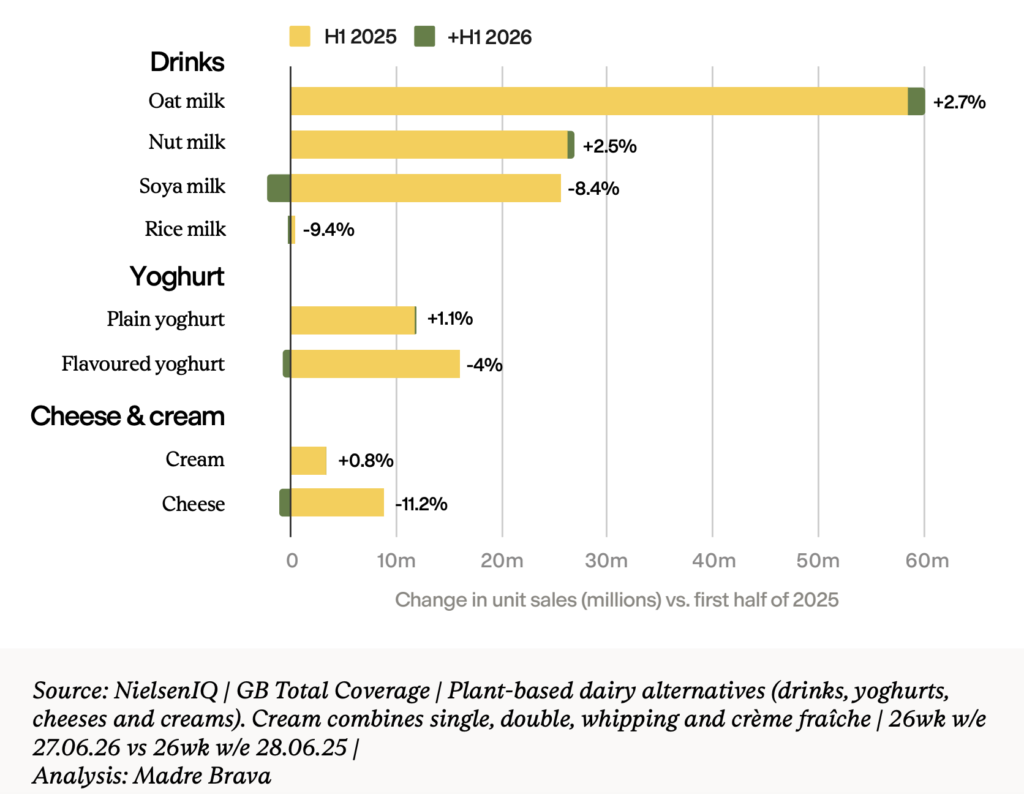
Moreover, the report looked at the performance of plant-based dairy, which decreased by just under 1% in unit sales but increased in value by 4.4%. Milk alternatives now account for 7% of the overall milk market, although sales flatlined in the first six months of 2026.uk plant based milk sales

                                                                                                Courtesy: Madre Brava

Oat milk continues to dominate with a 2.7% hike in unit sales, just as nut milks sold 2.5% better too. But purchases of soy and rice milk fell by 8.4% and 9.4%, respectively. Meanwhile, the performance of plain vegan yoghurt and non-dairy cream improved by 1.1% and 0.4%, respectively, with declines for flavoured yoghurts (-4%) and cheese (-11.2%).

Plain yoghurt is sold in larger packs in the UK, so the shift is likely to be larger in volume than unit demand. “The switch is an indication that some consumers are prepared to pay for healthier products, as the price per unit rose 4.5% for flavoured yoghurts, which contain added sugar, and 8.1% for plain yoghurt, which is lower in sugar,” the report stated.

Madre Brava has been working with other groups to urge retailers to embrace plant proteins and to ensure they account for 30% of their protein sales by 2030. A recent report co-authored by the organisation found that this would achieve 64% of supermarkets’ supply chain emissions reduction targets, while saving money on climate measures.

Lidl blasted past its target to increase alternative meat and dairy sales by 400% by 2025, recording a 694% hike since 2020. It also rolled out 20 own-brand plant-based products to encourage more consumers to eat more such foods. Tesco, which missed its sales goal for meat alternatives last year, reported that the sector was “back in growth”, with sales of vegan mince up by nearly 25% and whole-food proteins by 12%.

And Sainsbury’s has launched a Full on Fibre label to highlight high-fibre products, which include fruits, vegetables and plant proteins like beans and tempeh, building on the fibremaxxing trend that has engulfed the food industry.

“The bounce back in plant-based sales shows consumers are choosing foods that are a win for their health, their budgets and can compete on taste,” said Madre Brava’s UK director, Sara Ayech.

“Supermarkets account for more than 80% of our calorie intake. They can help drive this trend by ensuring a growing range of products that are the most convenient and appealing options for flexitarian customers, who want to eat more plants to fulfil nutrition goals. Setting targets for increasing the mix of plant proteins can also help retailers meet healthy sales and sustainability targets.”

https://www.greenqueen.com.hk/uk-plant-based-food-sales-growth-beans-meat-alternatives-tofu/ 

Saturday, August 29, 2026

This High-Protein Vegan Poke Bowl Is The Ultimate Summer Meal

From plantbasednews.org

Go catch some fresh tofu, then turn it into this mouth-watering poke bowl 

Poke bowls may be known for raw fish, but this high-protein vegan poke bowl shows just how satisfying a plant-based version can be. In a recent video, The Happy Pear founders Dave and Steve Flynn turn tofu, edamame, brown rice, mango, avocado, and fermented vegetables into a colourful summer dinner with 35 grams of protein per serving.

The Irish twins founded The Happy Pear in 2004, starting with a small fruit and vegetable shop in Greystones, County Wicklow. The business has since grown into a plant-based food and lifestyle brand spanning cafes, cookbooks, packaged foods, online courses, and a recipe club, all built around their mission to help people eat more plants and live healthier, happier lives.

Their poke bowl fits that approach perfectly. It is quick, varied, packed with fibre, and designed to make plant-based eating feel generous rather than restrictive.

“It’s diverse. It’s packed full of fibre, and it’s super tasty,” one of the brothers says. “That’s the big thing.”

Crispy tofu brings the protein

This poke bowl combines crispy glazed tofu, brown rice, edamame, mango, seaweed, and fermented vegetables - Media Credit: YouTube / The Happy Pear


The recipe begins with a 200-gram block of firm tofu, which the brothers cut into four large triangles. They add olive oil and fresh ginger to a hot pan, then press the tofu down so it can develop a golden crust. After joking that they “caught it earlier this morning,” they leave the tofu to sear while preparing the glaze.

They keep the skin on the ginger because it is organic. “The skin has more fibre and typically more minerals in it,” one of the brothers says. The ginger also infuses the oil as it cooks, adding flavour before the tofu is placed in the pan.

The glaze combines grated garlic, tamari or soy sauce, sesame oil, maple syrup, and rice vinegar. Apple cider vinegar can also be used, which makes the sauce easy to adapt. Once the tofu starts to brown, half of the glaze is poured into the pan, and the heat is reduced.

As the sauce cooks, it thickens and coats the tofu. The brothers advise leaving it alone long enough to caramelize rather than moving it constantly. “Give it time so that it starts to caramelize on the surface,” one says. They then switch off the heat and allow the warmth left in the pan to continue browning the tofu.

Fresh toppings keep the bowl colourful and filling

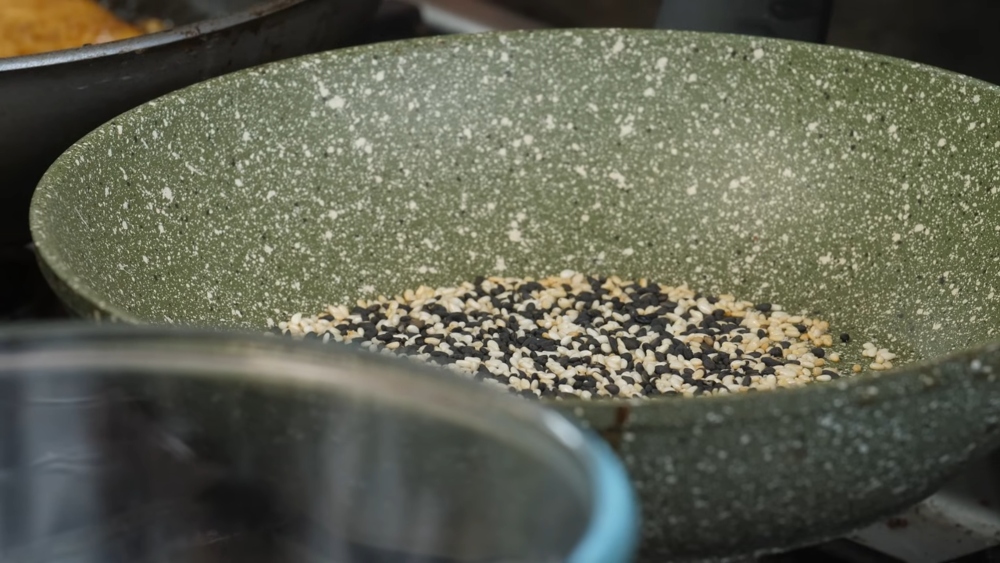
Image of white and black sesame seeds toasting in a pan to make a furikake topping for the high protein vegan poke bowl
YouTube / The Happy PearTo create the furikake-inspired topping, toast the sesame seeds until they start turning golden and popping

While the tofu cooks, the brothers prepare the rest of the bowl. Brown rice forms the base, while edamame adds another source of protein. Each serving contains around 100 grams of edamame, helping bring the total protein content to 35 grams.

They also make a simple cucumber and seaweed salad using sliced cucumber, wakame, lime juice, and salt. The dressing is intentionally light. “We’re just keeping this very simple because there’s a lot of components to this dish,” one of the brothers says.

Mango adds sweetness, while avocado brings creaminess and what they describe as a whole-food source of fat. Sauerkraut and pickled ginger provide sharper flavours that balance the richer tofu and avocado. Together, the ingredients give the bowl a mix of sweetness, acidity, crunch, and softness.

For the final topping, the brothers toast black and white sesame seeds with a pinch of salt. They suggest that seaweed or nutritional yeast could also be added, but keep their version simple. The seeds are ready when they turn golden and begin “popping like little jumping jacks.”

To assemble the high-protein vegan poke bowl, the ingredients are arranged over the brown rice and topped with two tofu steaks. The remaining glaze is drizzled over the bowl, followed by the toasted sesame mixture. The full recipe contains 70 grams of protein and makes two servings.

“Delicious poke bowl, high in protein, 35 grams per portion,” the brothers say. They close the video with a familiar reminder: “Go forth and eat your vegetables.”

You’ll find more healthy plant-based recipes on The Happy Pear YouTube channel.

https://plantbasednews.org/lifestyle/food/high-protein-vegan-poke-bowl/