Showing posts with label Unilever. Show all posts

Wednesday, September 13, 2023

Unilever wants to make vegan kebabs mainstream by putting plant-based skewers in restaurants across Europe

From veganfoodandliving.com

The Vegetarian Butcher wants vegan kebabs to become the norm in eateries across the continent, following a recent partnership with a döner producer…


Unilever has unveiled an ambitious plan to help make vegan kebabs ‘mainstream’. 

The food giant acquired vegan meat maker The Vegetarian Butcher back in 2018. Now, it has partnered with döner producer The Düzgün Group. 

Together, the duo have created a soy-based döner which is designed to be grilled on the skewer just like animal meat kebabs. It also features traditional spices such as cumin and oregano to simulate an ‘authentic taste’. 

The Vegetarian Butcher even incorporated a blend of fats with different melting characteristics.

Moreover, it worked to make sure that ‘when the plant-based meat was perfectly browned and ready to be sliced, it was still juicy’.

Vegan kebabs – is there demand? 

Unilever states that consumer demand for plant-based kebabs is ‘certainly present’ – citing a study where 60 per cent of 16-59-year-olds in Germany said they would order one. 

Overall, Europe produces 400 tonnes of kebabs daily, mostly exported out of Germany, bringing in revenues of up to €12 billion a year.

Unilever wants to jump on this trend and ‘fill the gap’ for kebab restaurant operators by delivering plant-based skewers ‘at scale’. 

The conglomerate says this will turn ‘a once-niche purchase into a readily available option on menus across Europe.  

Unilever wants to deliver plant-based skewers ‘at scale’ and make them readily available on menus across Europe. Photo © Unilever

‘Can’t taste the difference’

“We can deliver on a large scale. So, we’re perfectly set up to offer restaurateurs an international supply chain for plant-based skewers,” Blue Yildizbakan of The Düzgün Group said in a statement.

Hugo Verkuil, CEO of The Vegetarian Butcher, added that the skewers can ‘seamlessly fit’ with restaurants’ equipment and procedures. 

“The product performs just the way we intended to,“ he added. “Hacking meat icons like the döner kebab with plant-based equivalents is what it is all about for us.

“We are targeting meat-lovers – from vegans to carnivores – who don’t want to miss out. And when it comes to guests, we’re convinced people won’t be able to taste the difference.”

All this kebab talk got you hungry? Check out these Peanut Satay Tempeh Skewers

https://www.veganfoodandliving.com/news/unilever-vegan-kebabs-mainstream/

Friday, June 16, 2023

Unilever’s New Vegan Bacon Technology Makes It a Worthy Contender for Meat Lovers

From vegnews.com

Unilever-owned The Vegetarian Butcher unveils a new vegan bacon made with its patented technology that mimics pork on every level

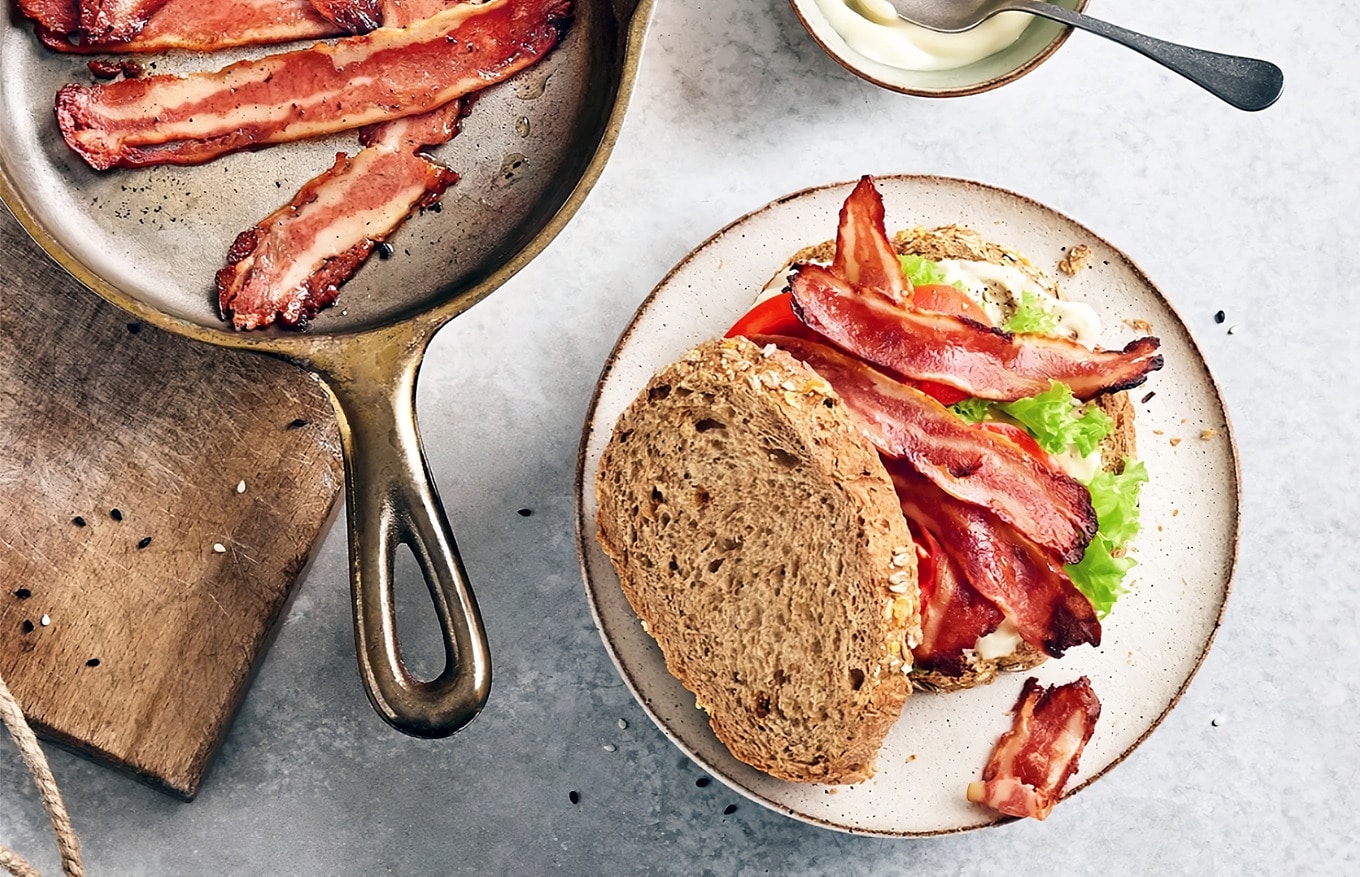
Vegan bacon is already an improvement on animal-based pork in many ways but European company The Vegetarian Butcher thinks it can be even better. The Unilever-owned company just announced the launch of its NoBacon 2, an improved vegan bacon made from a carefully selected ingredient list that includes soy and wheat protein and perfected with The Vegetarian Butcher’s new fat technology. 

The new fat technology solves the main issues that pork alternatives face to truly deliver the eating experience of bacon without the ethical and environmental costs. The new patented technology encapsulates oil and releases it at 20-times the rate of previous iterations, allowing for a fatty, crispy texture and a similar sizzle when cooking. 

The new fat technology also allows for a tender texture and, because it becomes translucent when cooked, a similar visual and eating experience. 

VegNews.VeganBacon4.UnileverUnilever

Improving vegan bacon to better mimic its pork counterpart has myriad benefits, according to The Vegetarian Butcher CEO Hugo Verkuil. “Releasing all animals from the food chain is not just good news for animals, it’s also great news for our planet,” Verkull said in a statement. 

Vegan bacon is sizzling

Approximately 3.5 million pigs are slaughtered globally every year for food and the production of traditional bacon and other pork products involves industrial farming practices that often prioritize profit over the well-being of animals. 

Plus, producing bacon this way is environmentally damaging and requires vast amounts of resources, including water and grain, which puts pressure on already strained ecosystems.

The Vegetarian Butcher’s new vegan bacon makes no compromises when it comes to taste, sizzle, and environmental benefits. “Taking animals out of the equation makes the food system more efficient and more environmentally friendly,” Verkull said. 

“Instead of feeding legumes to animals and making meat out of these living creatures, The Vegetarian Butcher makes plant-based meat directly from legumes,” Verkull said. “Our plant-based bacon’s taste and texture is fantastic, so it truly is a win-win-win.”  

While NoBacon 2 is currently available only in the Netherlands, Unilever’s The Vegetarian Butcher has foodservice partners that could greatly benefit from this development, most notably Burger King. 

Since launching the Impossible Whopper stateside in 2019, Burger King dug its heels into the plant-based revolution. The Vegetarian Butcher has supplied the fast-food giant along the way in Europe and other regions, where Burger King has added a bevy of vegan options and opened multiple plant-based popups to better understand consumer behaviour while slashing its environmental footprint.  

In the United Kingdom, where Burger King aims to make 50 percent of its menu plant-based by 2030, the menu has undergone some serious innovation. 

VegNews.VeganBaconBurgerLaVie.BurgerKingBurger King

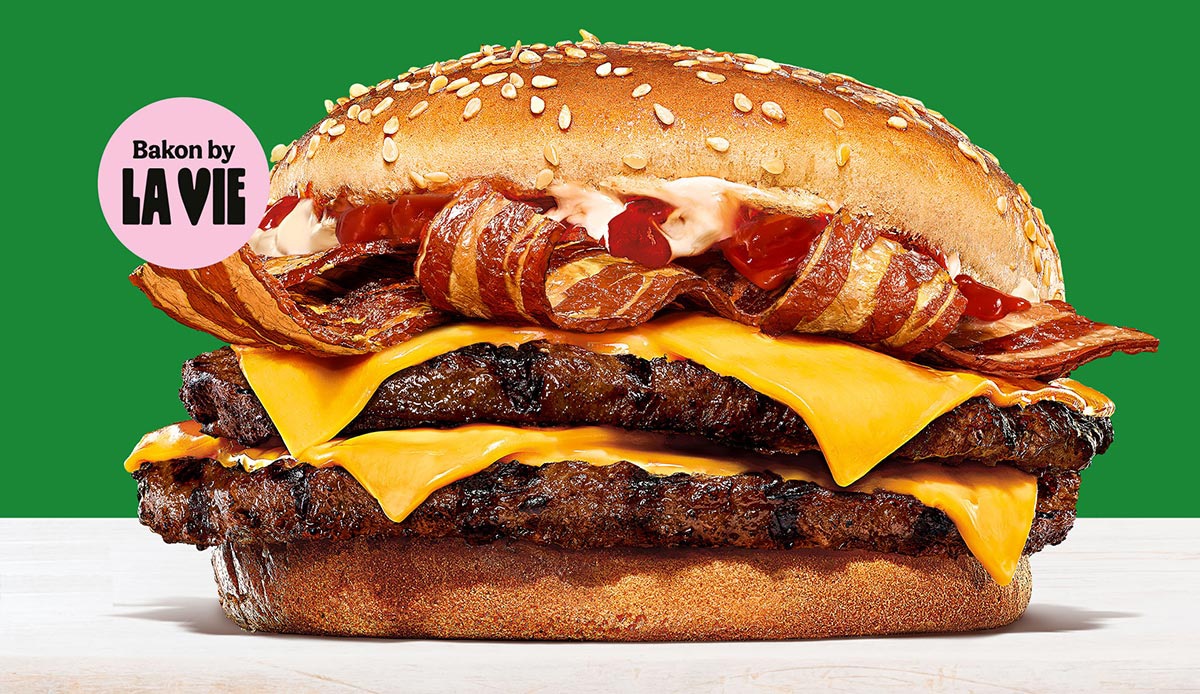
Earlier this year, Burger King added three vegan bacon cheeseburgers to the menu, featuring Violife’s cheese, The Vegetarian Butcher’s vegan patty, and bacon made by French company LaVie. The vegan bacon company counts actress Natalie Portman as an investor and first made its appearance on the Burger King menu in France after a humorous campaign. 

With NoBacon 2, The Vegetarian Butcher now has its own improved vegan bacon offering should Burger King choose to explore the option in more markets. 

Better bacon, made without pigs

The Vegetarian Butcher and La Vie are not the only companies working to take pigs out of the food system by developing realistic vegan bacon and other pork products. 

Hong Kong’s OmniFoods—known for its plant-based pork products—recently unveiled its OMNINano Vegan Fat. This patented technology locks flavour into its vegan meat while delivering a juiciness and texture that is identical to animal meat but without any of the downsides of eating animal products.

In New York, MyForest Foods is making whole-cut vegan bacon, called “MyBacon,” using mycelium, the fast-growing root system of mushrooms. Last week, the company raised an additional $15 million in funding to help bring its vegan bacon to more consumers across the East Coast.

“The plant-based category is at a unique inflection point, where only the most promising and delicious innovations will thrive,” Gary Hirshberg, Co-Founder of Stonyfield Farm and MyForest Foods Board Member, said in a statement. “I believe MyForest Foods has met this call with its unique MyBacon offering.” 

Over in San Francisco, start-up Lypid recently developed a vegan pork belly to showcase its debut product: PhytoFat, microencapsulated fat particles with a high melting point that behave like animal fat when cooked. After launching at Taiwanese chain Louisa Coffee, Lypid made its PhytoFat ingredient available to food companies and restaurants in the United States to bring pork-identical vegan bacon to market. 

https://vegnews.com/2023/6/unilever-vegan-bacon-greasy


Thursday, February 11, 2021

Unilever CEO says ‘every single country’ is moving towards a plant-based diet

From veganfoodandliving.com

Unilever CEO Alan Jope has remarked that a plant-based diet is not a fad, and in fact 'every single country' is moving towards one

Plant-based diets are officially here to stay, according to Unilever CEO Alan Jope.

Speaking to the Guardian, Jope remarked: “We are seeing in every single country in the world a shift towards more plant-based diets, even in emerging markets.”

He insists that plant-based alternatives are not merely a fad, but an ‘inexorable’ trend, meaning it is unstoppable.

Recognising the inevitable continuation of the plant-based trend, Unilever aims to capitalise on this by increasing sales of plant-based diet alternatives to €1 billion by the year 2027, an increase of five-fold.

Unilever is behind popular brands Ben & Jerry’s, Magnum and Hellmann’s, all of which have increased their vegan offerings in the past few years. For Veganuary, Hellmann’s caused a stir on social media with the addition of a bacon flavoured vegan mayo which tastes like the real thing.

Unilever invests in the plant-based rise

Unilever is taking the rise of plant-based diets seriously, and in December 2019 it invested €85 million in The Hive – a new food development centre. The Hive will involve the collaboration of academic researchers, start-ups and other partners to innovate new products such as plant-based meats and sustainable food packaging.

And Unilever isn’t stopping there. The company aims to acquire more of the plant-based beauty and nutrition sectors, which are significant growth areas for the next few years. Unilever already owns upmarket vegan beauty brand REN, and the plant-based beauty industry is increasingly gaining popularity.

We can’t wait to see all the new products emerging from The Hive!

https://www.veganfoodandliving.com/news/unilever-ceo-plant-based-diet/

Wednesday, November 18, 2020

UK giant Unilever bets on vegan food with 'scary target'

From bbc.co.uk

One of the UK's biggest consumer goods firm is betting on more people eating vegan food and has set itself a "scary target" to increase sales.

Unilever wants to increase its annual sales of plant-based meat and dairy products five-fold within seven years, hitting €1bn (£900m) by 2027.

"It's a scary target, but it's important we set it," the firm said.

Consumers are increasingly turning to vegetarian foods for health and environmental reasons.

In the UK, there has been exponential growth in vegan food sales with sales of meat-free products in the UK up from £488m last year to £577m this year, according to analyst firm Kantar.

It doesn't necessarily mean people are becoming vegetarian, said Tesni Steele-Jones, consumer insight director at Kantar.

"Shoppers are looking for healthier alternatives and adopting a more flexitarian routine," she said.

"The most popular plant-based products are those that can be used when cooking from scratch or baking as people try their hand at new recipes while we are all spending more time at home."

'Scary' target

The EAT-Lancet Commission, a group of 37 scientists, reported this summer that eating more fruit and vegetables and fewer foods from animals gave health and environmental benefits.

Unilever said that the global plant-based meat market alone is estimated to be worth $35.4bn by 2027.

But the consumer goods giant will still have to pull out all the stops to reach its target.

"It will require really, really high growth rates," Hanneke Faber, president of Unilever's foods and refreshment business, said.

In 2019, Unilever's total sales were €52bn, with foodstuff sales of €19.3bn.

The company is betting on growing its plant-based meat brand The Vegetarian Butcher, which it acquired two years ago, and now sells in 30 countries.

It's through this brand that Unilever supplies Burger King's plant-based Whopper in 26 countries, with the fast-food chain having plans to sell its plant-based nuggets.

Unilever also wants to push its vegan dairy ranges, which include Vegan Ben & Jerry's ice cream, Magnum Vegan, Vegan Cornetto, and Hellmann's Vegan mayonnaise.

Price point

Plant-based mince from the Vegetarian Butcher is more expensive, pound-for-pound, than some premium beef mince products.

This could weigh on some price-conscious consumers minds, especially as the coronavirus crisis continues to affect the global economy.

However, Unilever is confident that by scaling up its plant-based food production it can bring prices down.

"Scale is going to make a difference over time," Ms Faber said, although it could be a few years before plant-based meat prices are comparable, she added.

Retailers are increasingly placing an emphasis on their vegetarian and vegan ranges.

In September, Tesco said it wanted to sell four times as much meat alternative protein by 2025 as part of a sustainability drive.

Green efforts

Along with its plant-based target, Unilever has also committed to halving food waste from factory to shelf by 2025, and to continue lowering calorie, salt and sugar levels in its products.

"It is widely recognised that the current global food system is inequitable and inefficient," said Ms Faber.

"One billion people around the world are hungry while two billion are obese or overweight. One third of all food produced is thrown away. 

"And animal agriculture is the second largest contributor to greenhouse gas emissions after fossil fuels and a leading cause of deforestation, water and air pollution and biodiversity loss."

In September Unilever pledged to drop fossil fuels from its cleaning products by 2030 to reduce carbon emissions.

https://www.bbc.co.uk/news/business-54986315

Sunday, July 26, 2020

UK demand for new vegan food products soars in lockdown

From theguardian.com

Trademarks registered double in a year as supermarkets and restaurants eye fast-growing sector

The number of trademarks registered for new vegan food and drink products in the UK more than doubled to a record high last year.

Latest figures reveal that companies successfully applied for 107 trademarks in 2019 for everything from ice cream to meat-free burgers – a 128% increase on the 47 recorded in 2018 – as consumer demand for vegan alternatives continued to soar.

They were filed prior to lockdown, but supermarkets have meanwhile reported strong sales of plant-based ranges since the coronavirus outbreak began, highlighting the fragility of the traditional food chain.

       ‘There are now more vegan products on shelves than ever before,’ says law firm EMW.                                                                Photograph: Leon Neal/Getty Images
The ongoing trend reflects people paying closer attention to their diet during lockdown, increasingly adopting “flexitarian” diets – cutting down on meat and dairy while eating more plant-based foods.
The new trademark figures are compiled by law firm EMW, which says the fast-growing vegan food category is now attracting interest from large multinational businesses with the resources to invest heavily in branded products.

Among them are consumer goods giant Unilever, which has trademarked vegan ice cream for its Magnum and Ben and Jerrys brands.

With further innovations in the pipeline, two manufacturers – Upfield and Beyond Meat – have trademarked product names based on variations of “Beyond Butter”, “Beyond Cheese” and “Beyond Mince”. Upfield, the owner of Flora, bought the vegan cheese producer Violife for a reported €500m (£455m) earlier this year.

Daisy Divoka, an associate at EMW, said: “There are now more vegan products on supermarket shelves than ever before. Multinational corporations have identified this as a fast-growing sector and are competing to register their trademarks with the aim of capturing and defending a share of the market.”

Discount supermarket chain Lidl has trademarked a range of vegan products including pastries and baguettes, while restaurant chains Honest Burger and Leon also entered the fray for meat substitutes and plant-based condiments. The furniture chain Ikea will next month start selling “plant balls”; versions of its eponymous meatballs made from pea protein.

Sainsbury's, which has trademarked its mushroom-based “shroomdog”, reported double-digit growth of its plant-based and meat-free range. Rosie Bambaji, plant-based buyer at Sainsbury’s said: “We expect to see this area continue to grow as we emerge out of lockdown.”

Tesco said it had launched more than 30 new plant-based products across its Wicked Kitchen and Plant Chef ranges in June, including BBQ, Asian-inspired and meal kits. Plant-based barbecue options had proved very popular during the recent hot weather, it said.

Companies can also apply to use the Vegan Society’s sunflower logo, for which they pay a licensing fee based on turnover. A spokeswoman said: “We have only recently starting reporting by category but the number of fashion products registered has doubled so far in 2020. Drinks, household and toiletry products are our next biggest growth categories.”

https://www.theguardian.com/lifeandstyle/2020/jul/25/uk-demand-for-new-vegan-food-products-soars-in-lockdown