Showing posts with label Europe. Show all posts

Saturday, April 11, 2026

Beyond Substitution, Everyday Products Drive 5% Growth of Europe’s Plant-Based Market

From greenqueen.com.hk

By Anay Mridul

Europe’s plant-based food market grew by 5% from 2024-25, reaching €16.3B in value as several products outpaced animal proteins – but it still makes up a fraction of the region’s food and drink sales.

Demand for plant-based food remained strong in Europe in 2025, driven by interest in everyday formats rather than just meat mimics.

Across the six largest markets in the region – the UK, Germany, Italy, Spain, France, and the Netherlands – the plant-based category reached €16.3b in value in 2025, up 5.1% from the year before, according to market research firm Circana.

Despite the hike, this sector accounts for just 2.4% of overall food and drink sales in Europe, indicating a gap between consumer interest and true market scale and significant headroom for growth.

“Plant-based food and drinks have reached a pivotal moment,” Ananda Roy, Circana’s senior VP of thought leadership and consumer goods advisor for Europe, said during a keynote address at the Plant FWD conference in Amsterdam (April 9).

“The foundations for growth are firmly in place, but the next phase will not be driven by hype or novelty. It will be driven by how effectively the industry delivers products that fit into everyday consumer behaviour,” he added.

                                                                                                         Courtesy: Omami

Flexitarians lead demand as GLP-1 drugs shift consumer habits

The momentum of the plant-based market is increasingly driven by products for everyday consumption rather than niche alternatives, according to Circana.

Nuts and seeds alone make up 45% of all value sales in the category, followed by dairy alternatives (21%) and ready meals (15%) – meat and seafood analogues represent just 4% of the market in these six countries.

That shift reflects how consumers are changing their behaviour to move away from substitution and towards integration into their daily diets. Circana noted that the demand is being driven by everyday shoppers, but not just historical plant-based consumers.

Flexitarians are the most important lever of growth. Only around 11% of Europeans follow a vegan or vegetarian diet, but the number of people who identify as flexitarian grew from 21% in 2022 to 31% in 2024.

The next phase of growth will be driven by consumers’ shifting expectations from their food, with health, nutrition and affordability among their top priorities.

People are looking for more than just a vegan burger now. They want meat alternatives that deliver benefits across protein consumption, energy, and gut health. At the same time, the boom in GLP-1 drugs is pushing people to eat smaller, more nutrient-dense meals.

Take the UK, for example: more than 1.5 million Brits now use a weight-loss medication, a share that nearly doubled between 2024 and 2025. And savvy food brands are already responding with formats that put protein and fibre at the centre.

Nielsen analysis shows that chilled plant-based food volume demand rose by just under 1% across UK supermarkets in 2025, rising to 1.7% in the final quarter. Tesco, the country’s largest retailer, ascribed the revival of this market to the heightening demand for “veg-led foods” rich in protein and fibre.

                                                                                                                      Courtesy: Tesco

Plant-based brands should prioritise affordability and functionality

Circana’s report reinforces Germany’s leadership in Europe’s plant-based market, where value sales rose by 7.2% and volumes by 4.2%. Spain saw value growth accelerate by 7.5% as well.

However, some countries didn’t perform as strongly. The UK, despite being the second-largest market at €4.5B, continued to stagnate, with volumes down 0.7% last year. It was one of the only countries in Europe to experience a volume decline in 2024, too.

This divergence outlines the importance of execution, pricing and relevance in driving category performance, according to Circana. In fact, closing the price gap between plant-based and animal proteins remains a top barrier.

Despite that chasm, vegan products are outperforming their animal-based counterparts in volume growth across key segments such as dairy and ready meals. Greater affordability for plant-based proteins will only unlock broader adoption.

Circana suggests the industry is at a critical inflection point, where future growth will depend on how well brands and retailers respond to changing consumer needs.

“With flexitarian consumers now leading demand, and growth becoming more uneven across markets, the plant-based category is entering a new, more competitive phase,” it said. “For retailers and manufacturers, the challenge is no longer about building awareness, but about turning interest into habit.”

It pinpointed several priorities for Europe’s plant-based food industry, including a focus on taste-led innovation to drive repeat purchases and better price competitiveness to expand mainstream adoption. Brands should also deliver credible nutritional and functional benefits, integrate ‘plant-based’ into core categories rather than isolate it, and expand beyond substitutes into broader alternatives that stand on their own.

“We are seeing a clear shift away from niche, imitation-led innovation towards more natural, functional and accessible products,” said Roy. “The winners will be those who can close the gap between taste, nutrition and price, and integrate plant-based seamlessly into everyday consumption occasions.”

https://www.greenqueen.com.hk/europe-plant-based-market-sales-growth-2025-circana/

Tuesday, April 7, 2026

EU's meaty label ban: What's at steak for Belgium's vegan butchers?

From brusselstimes.com

EU lawmakers agreed last month to ban meaty names, such as bacon and steak, for plant-based alternatives. How are Belgium's self-proclaimed 'vegan butchers' faring in the face of the controversial new legislation?

The EU Council reached a provisional agreement on 5 March to ban 31 'meaty' labels from plant-based products. These include drumstick, steak, ribs, liver, bacon, chicken and beef. Veggie burgers and sausages were also initially on the chopping block, but in the end, they were spared and will therefore remain on the menu. 

The central reasons cited for the controversial decision were to protect farmers "against unfair competition" and avoid consumer confusion, according to French MEP Céline Imart of the centre-right EPP group. Imart spearheaded the clampdown on plant-based products and described the March agreement as an "undeniable success for our farmers", Euronews reported.

"By enshrining the use of terms 'steak' and 'liver' for our farmers' products and by committing to extend the list during the next negotiations, Parliament has taken a decisive step forward," she added.

German Chancellor Friedrich Merz also backed the ban, saying, "A sausage is a sausage. Sausage is not vegan."

But the decision has sparked heated debate across the board and divided opinion.

David Flochel, the chief executive of Quorn Food, said, "In 40 years, not once has a customer told us they bought a Quorn product believing it to be meat."

The familiar terminology makes it "easy for those who want to integrate these options in their diets, and the new rules will increase confusion and are simply not necessary," said Agustín Reyna, director general of The European Consumer Organisation.

"Europe should be backing innovative entrepreneurs, not putting new obstacles in their way," added Dutch Green MEP Anna Strolenberg.

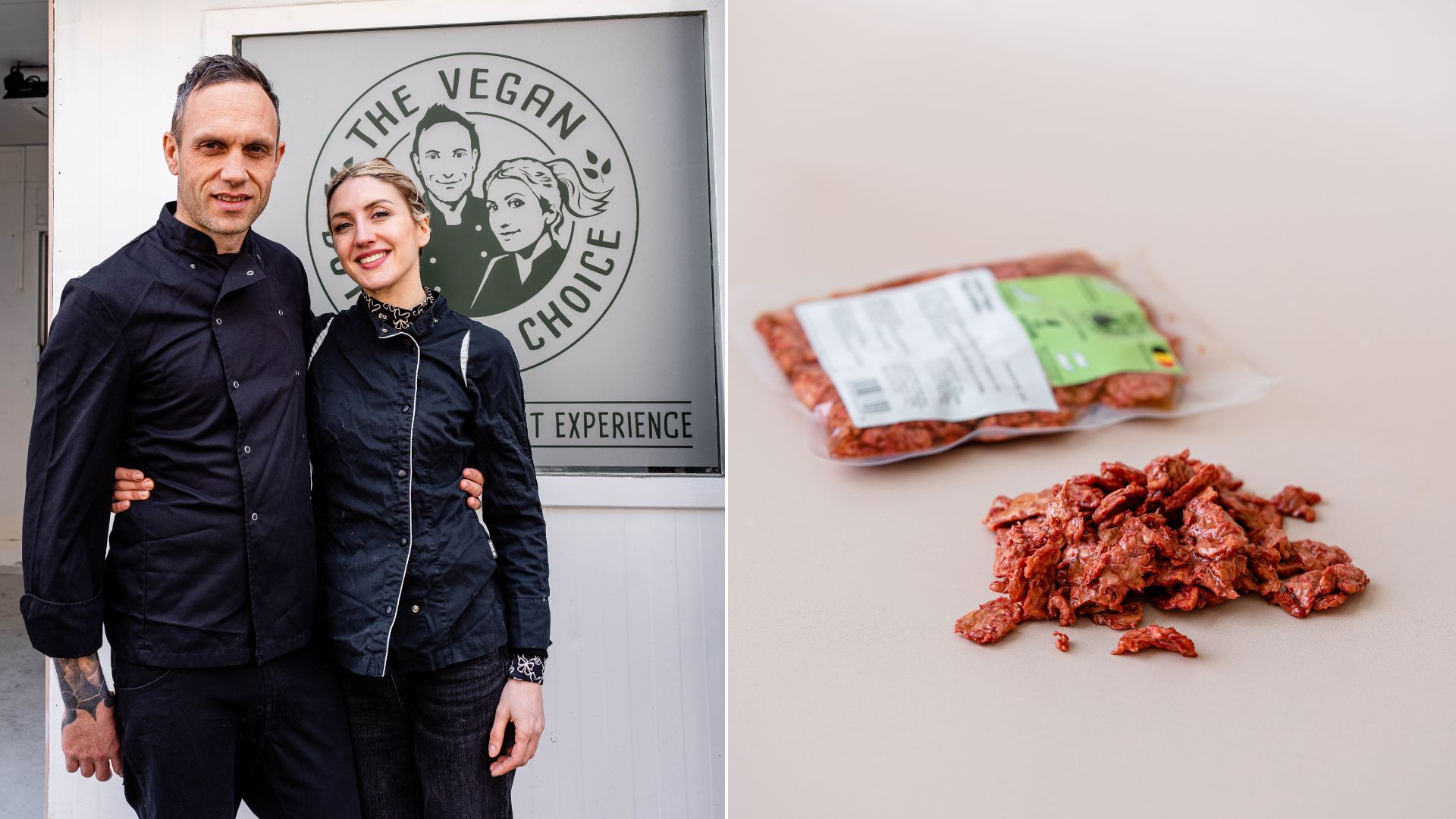
Two such innovative entrepreneurs are Federica Boddi and her husband and business partner Benoit Van den Broeck.

                                                                                   Benoit Van den Broeck and Federica Boddi. Credit: Pumpkin Agency

Boddi, 34, who hails from Genoa in Italy, previously worked in the EU bubble and became vegan 13 years ago. She met Van den Broeck, 47, from Bruges, on the vegan scene in Brussels. He had been volunteering as an animal rights activist, filming abused animals in Belgian slaughterhouses and exposing scandals.

In April 2019, the pair decided to pour their savings into becoming Belgium's first 'vegan butchers' – the only business of its kind in the country.

Van den Broeck had no prior culinary training, but with a great deal of research and testing, he developed his own recipes, which immediately became a hit. After a few months, they even won the Belgian Vegan Awards as the best newcomer, up against the well-established Liu Lin (now closed) and Plant A Pizza.

Corporate catering was a game-changer for the small business, and they got through Covid-19 unscathed thanks to their home delivery system, soldiering on from 05:00 until 23:00 every day. "Benoit was doing the deliveries. I remember that sometimes in one afternoon he had to deliver to 35 addresses," Boddi tells The Brussels Times.

Thanks to their web shop, they now deliver all over Belgium, and their products can be found on the shelves of Delhaize, Carrefour, and most Intermarché shops in Brussels.

But what differentiates them from supermarket brands is the ingredients and nutritional value. "We make [our products] with really natural and as raw as possible ingredients," Boddi says.

In supermarkets, she says, plant-based products contain various oils, E-numbers, and artificial colourings and flavourings.

"We work with plain ingredients, like beans, chickpeas, gluten, cashew nuts and onions, and we use beetroot powder and tomato paste for the colour. So it's really simple ingredients, which are then just assembled and seasoned with spices."

                                                                                                           Credit: Pumpkin Agency

Texture is also a priority: "The problem with a lot of the healthy alternatives on the market right now is that you can buy a veggie burger that is vegetables and potatoes, but when you eat it, it's like a croquette. It's mushy, it doesn't have any protein, and it crumbles."

Their bestsellers include the Belgian classic Américain sandwich spread, gyros, chorizo and drumsticks, which use rice paper to create a chicken skin effect. "I'm very proud of all the products we have right now," Boddi says.

'They wouldn't eat vegan when offered it for free'

Although non-vegans have said the products are almost unrecognisable from the real meat version, the negative perceptions of plant-based products persist.

Belgian healthy food chain EXKi, for example, decided to stock the vegan butchers' Américain baguettes at its Porte de Namur branch, but the meat-free option flopped. "They loved the vegan baguettes – but they sold it so wrong, even the person in charge admitted it was a complete failure."

Overnight, all the meat baguettes were replaced with 'Vegan Américain', which no one wanted. "They wouldn't even eat the vegan one when offered it for free."

Boddi believes that, had the label featured 'plant-based' instead, or listed the ingredients, customers might have been more open to the idea.

"I think the word 'vegan' can be very repulsive because I think it creates some negative emotions in some people."

The couple have even wondered about changing the name of their brand, The Vegan Butcher's Choice, but have kept it because it's recognisable and gets people talking.

"It's a bit of an oxymoron. People get angry and say, 'How can you be vegan and a butcher?' I tell them it's a joke, but that we do butcher beans. And they get even angrier," she laughs.

'Ridiculous' and 'insulting' EU ban

Boddi finds the EU ban on meaty labels equally laughable. She cannot accept that anyone in favour of the legislation believes consumers are confused.

"It's just so ridiculous. I find it quite insulting. Do you really think people are that dumb? By law, you have to write that it's vegan or plant-based – you can see it's not meat and it's written there."

"I also think, is it that important? There are such big issues that we need to address in Europe, in terms of food and farming. Do we really have to waste all this time and energy to discuss terminology?"

The entrepreneur says it's a sign that powerful meat lobbies are losing momentum, and the meat industry is feeling threatened by the growing shift in people switching to plant-based diets.

She agrees that farmers must be protected, but shutting down vegan companies is not the way to do it.

https://www.brusselstimes.com/2063197/eus-meaty-label-ban-whats-at-steak-for-belgiums-vegan-butchers

Wednesday, March 18, 2026

The 31 words that can no longer be used on Vegan products, according to the EU: “Burgers” & “Sausages” saved

From en.protothema.gr

The vegan...“gyro” and the labelling of many other products led the EU to ban companies from using certain words on plant-based products

Takeawaysby Protothema AI
  • The European Union has banned 31 words on vegan product packaging, including terms like "steak" and "liver".
  • The EU aims to support farmers by protecting names associated with meat products.
  • Terms like "burger" and "sausage" will remain allowed for vegetarian and vegan foods.
  • A three-year transitional period is granted for producers to adapt to the new labelling rules.
  • The agreement still requires formal approval and a final vote in the European Parliament.

The European Union has banned 31 words on vegan product packaging, aiming—according to the EU—to support farmers who now hold protected names such as “steak” and “liver,” among others.

EU lawmakers agreed to prohibit the use of names associated with meat, such as “steak” and “bacon,” for vegetarian and vegan foods, but terms like “burgers” and “sausages” will remain allowed. On March 5, the EU reached a compromise regarding rules for food labelling, although critics argue that the legislation introduces unnecessary complexity.


The 31 Words Banned for Vegan Products

The EU has agreed to prohibit vegetarian and vegan foods from using the following terms:

beef, veal, pork, poultry, chicken, turkey, duck, goose, lamb, sheep, mutton, goat, chicken drumstick, fillet (veal), sirloin, flank, pork fillet, steak, ribs, shoulder, shank, rib chop, wing, breast, liver, thigh, brisket, ribeye, T-bone, knuckle, and bacon.

Despite being among the most popular, the EU decision allows companies to continue using terms like “burger” (or “veggie burger”) and “sausage” on their labels. This means products advertised as “vegetarian burgers” or “vegan sausages” will still appear in supermarkets.

The restrictions also extend to “cultivated meat” (meat produced from animal cells), even though it is not yet commercially available.

The EU has agreed to a three-year transitional period, allowing producers to sell existing stock and adapt to the new rules.

However, the agreement still requires formal approval, followed by a final vote in the European Parliament plenary—meaning last-minute changes are still possible.

Why Certain Words Are Banned on Vegan Products

The European Council and European Parliament reached a provisional agreement aimed at giving farmers a “stronger negotiating position” in the food supply chain. In addition to making written contracts between farmers and buyers a general requirement, the amendment to the common organization of agricultural markets also strengthens protection of terms referring to meat.

French MEP Céline Hervieux-Imbert led the push to regulate plant-based labelling, calling the agreement an “undeniable success for our farmers.” “By securing the use of terms like ‘steak’ and ‘liver’ for our farmers’ products and committing to expand the list in future negotiations, the Parliament has taken a decisive step forward,” she added. Hervieux-Imbert argued that stricter rules on these terms will help preserve agricultural and culinary heritage.

Cypriot Agriculture Minister Maria Panayiotou, holding the rotating EU presidency, said: “By improving support for farmers and strengthening the role of producer organizations, we provide farmers with additional tools to secure a more predictable and sustainable future.”

Longstanding Debate Over Plant-Based Food Labels

The question of how plant-based foods can be labelled has been debated across the EU for years. In 2020, the European Parliament rejected an earlier proposal, known as “Amendment 165,” which sought to ban terms like “burger,” “sausage,” and “steak” for plant-based foods.

At that time, supporters argued that familiar names helped consumers understand how the products could be used in cooking.

Similar rules already apply to dairy substitutes in the EU, where plant-based products cannot be labelled “milk,” “cheese,” or “yogurt,” with limited exceptions such as coconut milk or peanut butter.

Proponents of the new restrictions argue they help protect livestock farmers and prevent unfair competition. Critics say the rules are unnecessary and may cause confusion rather than prevent it.

Criticism of the EU Decision: “Consumers Will Be Confused”

Dutch Green MEP Anna Strolenberg said she was relieved that the proposed ban on terms like “veggie burger” did not pass but criticized the inclusion of other words on the prohibited list.

Consumer groups have also voiced concerns. Augustin Reyna, Director General of the European Consumer Organization (BEUC), said the restrictions could make it harder for consumers trying to include more plant-based foods in their diets.

Supporters of plant-based labelling argue that there is little evidence that consumers struggle to distinguish meat from vegan products. According to a 2025 survey by Radar, 96% of respondents said they could clearly tell the difference between vegan sausages and meat sausages, while 75% reported no confusion about plant-based labelling.

Supporters argue that familiar food terms simply help consumers understand how products can be cooked or used—for example, whether something is shaped like a burger or intended for a sandwich.

https://en.protothema.gr/2026/03/17/the-31-words-that-can-no-longer-be-used-on-vegan-products-according-to-the-eu-burgers-sausages-saved/

Friday, March 13, 2026

Opinion: If plant-based foods must be more honest, let’s do the same for meat – fancy some ‘cow muscle’?

From theguardian.com

By Deirdra Barr 

EU rules banning terms such as ‘bacon’ for veggie products are problematic, btw cow muscle = steak

Last week, European policymakers decided that plant-based foods should no longer be marketed with terms such as “chicken”, “bacon” or “steak”. The fear seems to be that shoppers might accidentally buy veggie bacon thinking it came from an actual pig. The change applies to the UK too, because of our trade agreement with Europe.

After considerable pushback from organisations including the one I work with, the Vegetarian Society, and many food brands, words such as “burger”, “nuggets” and “sausage” – as in, vegan sausage rolls – are still permitted, provided the packaging makes clear they are plant-based. But even those allowances could yet be revisited.

The proposal arrived without an impact assessment and will affect UK exports. More worryingly, it sets a precedent. Apparently, Europe’s biggest regulatory threat is the menace of the dangerously misleading plant-based steak. But if clarity is truly the goal, there’s an obvious question: why stop at plant-based foods?

The words ‘burger’, ‘sausage’ and ‘steak’ describe formats and cooking styles as much as ingredients. Photograph: Philip Reeve/Alamy

If lawmakers want absolute transparency in food naming, then meat products could just as easily be required to use their literal descriptions. After all, beef steak is cow muscle. Pork chop is usually pig rib. Bacon is often salt-cured pig belly. Chicken nuggets? Formed chicken parts. And many sausages would require far less appetising names.

Sounds absurd? That’s precisely the point.

Food names have never been strictly literal. If they were, a lot of them would need a serious rethink. There are no canines in hotdogs. There are no amphibians in toad in the hole. Ladyfingers contain no fingers. Food language is ultimately a product of culture, tradition and familiarity.

The words “burger”, “sausage” and “steak” describe formats and cooking styles as much as ingredients. A burger is simply a patty. A sausage is food shaped into a tube and cooked. These are culinary categories, not zoological claims. Plant-based foods use these familiar terms as shorthand to help shoppers understand what a product is and how to cook it.

Meanwhile, meat marketing relies on something else entirely: the pastoral myth. Packaging shows Ye Olde Red Barn, green fields and smiling animals – imagery far removed from modern industrial livestock production. We’ve all seen the cheerful pigs outside butcher shops wielding knives to slaughter their kin, or happy chickens advertising fried nuggets. The suggestion seems to be that animals are enthusiastically participating in their own consumption. If lawmakers are truly worried about consumer misunderstanding and transparency, they might start by addressing the wildly misleading imagery used in meat marketing.

In fact, consumers are far less confused than critics suggest. A YouGov survey in late 2025 found that 92% of Britons said they had never bought, or could not recall buying, a plant-based sausage or burger thinking it contained meat. Clear labels already appear prominently on packaging through certification schemes such as those run by the Vegetarian Society.

No one believes a bean burger contains beef. Nobody assumes a veggie sausage came from a pig. Shoppers are not wandering supermarket aisles in a haze of confusion, clutching tofu and wondering which end of the cow it came from. People choose plant-based products deliberately, often for environmental, ethical or health reasons.

So what problem is actually being solved?

Restrictions on plant-based terminology risk doing the opposite of helping consumers. They create barriers to innovation and make it harder for people to find familiar alternatives to foods they already know how to cook. For someone beginning to incorporate more plant-based meals into their diet, familiarity matters. Language helps people navigate change, and banning familiar words only makes that transition harder.

At a time when we face urgent challenges such as the climate crisis, biodiversity loss, food security and public health problems, encouraging more plant-based eating is widely recognised as part of the solution. Creating linguistic hurdles for plant-based foods sends exactly the wrong signal. And if we’re suddenly so concerned about names reflecting reality, then maybe it’s time to start being honest across the board. Charred cow-muscle tissue with a side of fried potato sticksanyone?

https://www.theguardian.com/commentisfree/2026/mar/11/plant-based-foods-honest-meat-cow-muscle-eu-rules-ban-veggie

Friday, March 6, 2026

European Union: "Veggie burger" is now allowed after all - but not "vegan bacon"

From bluewin.ch

A compromise has been reached: burgers without meat may continue to be sold as "veggie burgers" in the EU. However, "vegan bacon", "tofu ribs" or "chicken" without meat must be renamed 

The names "veggie burger" and "tofu sausage" do not have to disappear from menus in the EU. This was agreed by negotiators from the EU member states and the European Parliament in Brussels, as participants in the negotiations confirmed to the German Press Agency. However, other vegetarian products may no longer be advertised as "veggie chicken" or "tofu ribs" in future.

The compromise still has to be formally adopted by the European Parliament and the European states. It is the result of lengthy negotiations. Last year, MEPs had proposed a ban on terms such as "tofu sausage", "soy schnitzel" or "veggie burger" for vegetarian products. This was justified on the grounds of protecting consumers and farmers.

                                                                                                                    Image: dpa

End for vegetarian bacon, ribs and pork chops

Until now, typical names for meat products could also be used for plant-based alternatives. Following the agreement, this should now continue to be possible in principle. However, according to representatives of the Parliament, designations that refer to animal or meat species and individual cuts are taboo: for example, poultry, beef, ribs, shoulder, chops or bacon.

The compromise thus takes up the EU Commission's original proposal, which the European Parliament had significantly tightened up. Specifically, terms such as "steak", "schnitzel", "burger" and "sausage" should only be used for animal products. The EPP group, which also includes the CDU and CSU, had tabled the proposal in the EU Parliament. French MEP Céline Imart was responsible for the proposal.

Although German MEPs voted against such a ban in a first round of negotiations, with a few exceptions, there was still a sufficient majority in Parliament. The yes votes came mainly from right-of-centre groups. However, for the provisions to come into force, a majority is also required among the EU member states. This was lacking.

Germany against ban

Germany had already spoken out clearly against a ban on veggie burgers. Federal Agriculture Minister Alois Rainer said in October that a ban would cause "incredibly high costs for the economy" as well as bureaucracy. "I stand for reducing bureaucracy, which is why I do not support this proposal." Anyone who buys a veggie schnitzel knows that it is not made from meat.

Consumer advocates and business representatives also reject the proposal. According to business representatives, Germany is the largest market for plant-based alternative products in Europe. Companies would have to rename products and may no longer be able to market them as easily.

According to the Federal Statistical Office (Destatis), the production of vegetarian or vegan meat alternatives in Germany has risen in recent years to 126,500 tons in 2024 (latest available annual figures). This was more than twice as much as five years previously. The value of meat production was nevertheless many times higher (meat and meat products: 44.3 billion euros, meat alternatives: 647.1 million euros).

                                                                                                                      Image: dpa

Association fears millions in losses in the event of a ban

Several retail companies, including Aldi Süd, Lidl and Burger King, also warned of economic damage in a joint letter last year. According to the letter, the familiar terms provide orientation and enable conscious purchasing decisions. A ban would make sales more difficult.

The Federal Association for Alternative Sources of Protein (BALPro) predicted considerable economic consequences for manufacturers of meat substitute products in the event of name bans. "Based on internal estimates and feedback from numerous affected companies, total losses of around 250 million euros can be assumed," the lobby and industry association announced in January. According to the report, costs would be incurred primarily because packaging would have to be redesigned and previous packaging destroyed, marketing and communication would have to be changed and companies would lose out on sales.

CDU MEP Peter Liese commented: "If a product is labelled vegetarian or vegan, then any reasonably intelligent person knows that it is not a meat product." The current EU project is actually primarily about fundamentally strengthening the role of farmers. Dutch Volt MEP Anna Strolenberg, who was involved in the negotiations, regretted how much time was spent on the name debate instead - and that although the term "veggie burger" is now not on the blacklist, numerous other words are. "That's a shame, because Europe should be supporting innovative entrepreneurs instead of putting new obstacles in their way."

https://www.bluewin.ch/en/news/veggie-burger-is-now-allowed-after-all-but-not-vegan-bacon-3128247.html

Friday, February 27, 2026

Why Hospitals are Rethinking Patient Menus

From vegconomist.com

Hospitals are increasingly being recognised not only as places of treatment, but as environments that actively shape health outcomes. As pressure mounts on healthcare systems to address diet-related disease, manage costs, and reduce environmental impact, hospital catering is coming under renewed scrutiny. One response is gaining traction – making plant-based meals the default option.

new analysis from ProVeg International explores why hospitals in multiple regions are rethinking traditional menus, and what this shift could mean for public health and the wider food industry.

                                                                                                                                Image supplied by ProVeg International

Aligning food with health outcomes

Diet-related illnesses place a substantial burden on global healthcare systems, and hospitals serve millions of meals each year to patients whose conditions are often directly linked to nutrition. Plant-based menus can support clinical dietary guidelines by emphasising fibre-rich, lower-fat foods, while reducing reliance on processed and red meats that are increasingly associated with negative health outcomes.

Beyond patient nutrition, hospital catering choices also intersect with broader public health concerns, including antimicrobial resistance linked to livestock production and the role of food systems in pandemic risk. As a result, food is being reframed as a preventative tool rather than a neutral service.

From policy to practice

The move towards plant-based defaults is no longer theoretical. In the United States, public hospitals in New York City have demonstrated how small changes in menu design can drive significant behavioural shifts. By presenting plant-based meals as the standard option, while still allowing patients to opt out in favour of animal-based meals, hospitals dramatically increased uptake (from 1% to 50%), while also reducing food-related emissions and operational costs.

Elsewhere, institutions such as Hayek Hospital have taken more comprehensive approaches, transitioning entirely to plant-based menus as part of a preventative health strategy. Across Europe, pilot programmes are combining staff training, menu redevelopment and procurement support to enable similar transitions at scale.

                                                                                                              Image supplied by ProVeg International / Unsplash

Implications for the plant-based sector

For food producers and ingredient suppliers, hospitals represent a stable, high-volume foodservice channel with growing relevance. As plant-based meals move from niche offerings to institutional defaults, demand is likely to increase for products that meet clinical, cost and operational requirements, from pulses and whole-food ingredients to functional plant proteins.

However, implementation remains complex. Cultural expectations, patient choice, catering contracts, nutritional standards, and supply-chain readiness all influence how quickly hospitals can move. 

The shift towards plant-based hospital menus signals a broader re-evaluation of how food fits into health systems. Whether this approach becomes the norm will depend on policy alignment, operational support and continued collaboration between healthcare providers and the food industry.

Read the full analysis on ProVeg’s website to explore the evidence, case studies, and commercial implications in more depth. For more support, get in touch with ProVeg’s experts at corporate@proveg.org

https://vegconomist.com/gastronomy-food-service/why-hospitals-are-rethinking-patient-menus/ 

Sunday, December 21, 2025

When is a sausage not really a sausage? Ask the meat lobby

From theguardian.com

By George Monbiot

European legislators may ban plant-based products from using the name to prevent ‘confusion’. Just don’t mention beef tomatoes or buffalo wings 

Most of what you eat is sausages. I mean, if we’re going to get literal about it. Sausage derives from the Latin salsicus, which means “seasoned with salt”. You might think of a sausage as a simple thing, but on this reading it is everything and nothing, a Borgesian meta-concept that retreats as you approach it.

From another perspective, a sausage is an offal-filled intestine, or the macerated parts of an electrocuted or asphyxiated pig or other animal – generally parts that you wouldn’t knowingly eat – mixed with other ingredients that, in isolation, you might consider inedible. For some reason, it is seldom marketed as such.

But to the legislators of the EU, a sausage can now have only one meaning: a cylindrical object containing meat. Never mind that cylindrical objects containing no meat have been marketed under names such as “Glamorgan sausage” (selsig Morgannwg) for at least 150 years. Never mind that even Germans once felt the need to call animal sausages mettwurst, to distinguish them from other kinds. Never mind that almost everyone knows what “veggie sausage”, “vegan sausage” or “plant-based sausage” mean. A recent survey of 20,000 Dutch people found that 96% are not confused by such terms, which is probably a higher percentage than those who can readily distinguish left from right. The consumer must at all costs be protected from an imaginary threat.

For the same reason, members of the European parliament decided, burgers must also contain meat. It happens that no one is sure why a burger is called a burger. They were once called “Hamburg steaks”, but no clear link to Hamburg has been established. Nevertheless, before the term was abbreviated, meat patties were widely known as hamburgers, whose literal meaning is an inhabitant of Hamburg. If “veggie burgers” are misleadingly marketed, so is any burger not made from the minced inhabitants of a north German city.

‘Never mind that cylindrical objects containing no meat have been marketed under names such as “Glamorgan sausage” (selsig Morgannwg) for at least 150 years.’ Photograph: Tom Hunt/The Guardian

Last week, the European Council and European Commission tried and failed to make sense of all this. They were unable to agree a common position with the European parliament, and bumped the decision to January, when a new council presidency will have to deal with it. I can’t blame them. You cannot make sense of a senseless policy.

The parliament’s food literalism is remarkably selective. Given the time of year, perhaps I should point out that there is no meat in mincemeat, which is used to fill mince pies. Many years ago there was, but the meat component fell out of fashion. Minced meat, by contrast, is meat – I’m sure that’s not confusing. Similarly, sweetbreads are meat, but sweetmeats are not. None of these terms appear to cause any problems for legislators, though they have insisted that the only permissible definition of meat is “edible parts of the animals referred to in points 1.2 to 1.8 of Annex I to Regulation (EC) No 853/2004”, which is, let’s face it, how it’s commonly understood by shoppers across the EU.

If a vegetarian hotdog is to be ruled out, as the parliamentarians demand, on the grounds that it contains no meat, the meat version should be ruled out on the grounds that it contains no dog (hothorse should in some cases be permissible). They might also be shocked to discover that there is no beef in beef tomatoes, butterfly in butterfly cakes, cottage in cottage pie, baby in jelly babies or finger (mostly) in chocolate fingers. And don’t get me started on buffalo wings.

All this must be deeply confusing to shoppers. Like Wednesday Addams, who, when offered girl scout cookies, asked whether they contain real girl scouts, we puzzle every day over what such names really mean. Human beings are entirely incapable of pattern recognition, derived and secondary meanings, metaphor or conceptualisation. Language never evolves, and nor does food. This is why, when confronted with “pigs in blankets”, “toad in the hole” or “spotted dick”, people curl up on the floor, banging their heads and moaning weakly (OK, there might be other reasons). Everything can have only one meaning, and this meaning must be what legislators say it is.

If you are thinking “benefit of Brexit”, I’m sorry to disabuse you. If the European Council and Commission eventually decide that terms such as veggie burgers and vegan sausages are to be banned in the EU, they are likely to be banned in the UK as well, for fear of jeopardising trade agreements. Already, after a court interpretation of a previous European decision, terms such as oat milk, soy butter and vegan cheese are prohibited on UK labels, but not – because consistency is for suckers – coconut milk or peanut butter.

                           ‘From another perspective, a sausage is an offal-filled intestine.’ Photograph: Westend61/Getty Images

So what explains the selectivity? Lobbying. The decision in the European parliament is a response to pressure from the meat and dairy industries, which have long been seeking to stamp out competition. It has no more to do with preventing confusion than a Rocky Mountain oyster has to do with a marine bivalve. It’s about protectionism. This is why peanut butter and coconut milk are still legal: they seldom compete directly with animal products.

These anti-competitive practices have a long history. In the 19th century, the US dairy industry managed first to get margarine declared a “harmful drug”, then had its sale restricted under the 1886 Oleomargarine Act. It’s reassuring to know that legislators made just as good use of their time then as they do now.

The livestock lobby is immensely powerful. Its campaigns are reinforced by rightwing influencers, who wage war against a wide variety of plant products (vegetable oil, soya, almonds, avocados, any plant-based meat substitute), often on entirely spurious health or environmental grounds, while conveniently ignoring the far greater impacts of animal products on human bodies and the living planet.

The food industry knows that words are a powerful weapon. If Moses had promised the Israelites a land of mammary secretions and insect vomit, I doubt many would have followed him to Canaan, though these are accurate descriptions of milk and honey. It knows that if plant-based foods have to be marketed under alien and alienating names, this will depress their market share.

The livestock lobby seeks to normalise and naturalise the cruel, grotesque, planet-wrecking realities of its industry, while casting plant-based foods as unnatural and wrong. As usual, it has made minced meat of European legislators. Though I should point out that I don’t mean that literally.

https://www.theguardian.com/commentisfree/2025/dec/20/sausage-meat-lobby-europe-plant-based-name