Showing posts with label pies. Show all posts

Tuesday, October 6, 2026

These Are the Best Apples for Vegan Apple Pie (Plus the Ones You’ll Want to Avoid!)

From vegnews.com

Protect yourself from a mushy tragedy. These are the best, and worst, apples for making apple pie

By Kat Smith

The arrival of this season’s apple crop is an annual event that signals warm, spice-laden desserts. But, there are so many varieties, making it difficult to choose the best apples to use for apple pie. 

The fact of the matter is that not just any old apple will do. Some can take the heat of the oven without turning into a mushy tragedy while others … well, they’re just not suited to baking. 

“The most important thing when picking apples for pie is the texture,” Hannah Kaminsky, cookbook author, food photographer, and the creator of the vegan recipe website, BitterSweet, tells VegNews. “That’s why I’d never go for something with a softer bite, like Empire or McIntosh. These are better suited for making applesauce or apple butter instead.”

Thankfully, the best apples for making apple pie don’t change when you’re making the dessert vegan. The perfect apple pie features a filling that is sweet but tart and intact yet tender, with a buttery, flaky crust. Not every apple is up for the job.

What’s the best apple for apple pie?

When it comes to baking, not just any old apple will do. Here are the best apples to use for apple pie. 

VegNews.GrannySmithApple.CanvaCanva

1Granny Smith

If you ask a baker what their favourite apple for apple pie is, chances are that Granny Smiths will be at the top of their list. 

“Granny Smith apples are typically listed as the best apples to use for pie,” Emily Frigon, founder of the vegan recipe website Garlic Head, says. “Their tart flavour plays well with the sugar in most recipes. If you’d like, you can mix the apple with something sweeter, like a Honeycrisp or Pink Lady, for a nice balance of flavours.”

This spring green apple is probably the sourest variety available. It has a citrus-like aroma and an acidity that complements the sugar and spice that you coat it in for pie. It also has a firm, crunchy texture that holds up when it bakes. When you use Granny Smith apples in vegan baking, you’ll find that they generally stay in whatever shape you cut them into.

VegNews.HoneycrispApple.CanvaCanva

2Honeycrisp

With a name to match its flavour and texture, Honeycrisp apples are another superior baking fruit. This variety comes in hues of red and yellow. 

“Personally, my favourite apples for pie are Honeycrisp, since they have a firm, crunchy texture that holds up well to baking without becoming mealy, and a nice sweet-tart balance,” Kaminsky says. They also have a sweet, honey-like flavour. 

While Honeycrisps make good apples for apple pie, Kaminsky notes that they can be on the expensive side. “So, a good alternative is a mixture of Granny Smith and Fuji apples to get a really satisfying range of flavours,” she says. Be warned: while Fuji apples pair well with Granny Smith apples in pie, the Fuji variety doesn’t do well on its own. More on that later.

VegNews.BraeburnApple.CanvaCanva

3Braeburn

You can easily spot Braeburn apples by their streaks of orange and red on a Granny Smith green background—fitting since this variety is a crossbreed of Lady Hamilton and Granny Smith. 

Braeburns are low-acid apples that are juicy and crisp with a sugary citrus flavour. They soften up a little when they bake but remain firm and flavourful enough to not get lost in all of the spices and sugar.

VegNews.CrispinApple.CanvaCanva

4Crispin

Crispin apples, also called Mutsu, are a cross between Golden Delicious and Indo, a Japanese cultivar. These light green apples with an orange blush have a light, sweet flavour with a crunchy texture that can stand the oven’s heat. They’re also known for being extremely juicy. Crispins tend to be much bigger than other apple pie-worthy apples, so you won’t need to buy as many for baking.
VegNews.PinkLadyApple.CanvaCanva

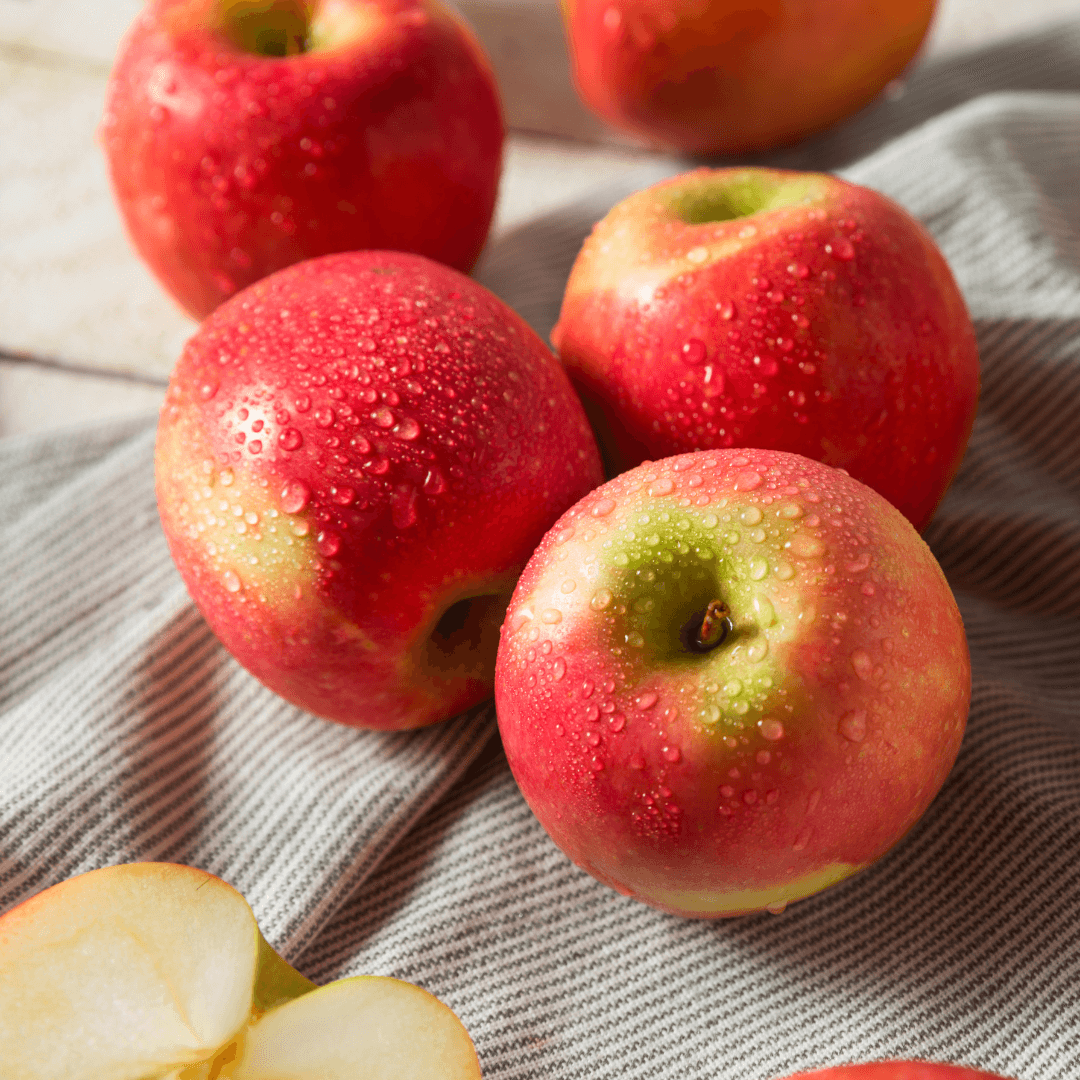
5Pink Lady

Also known as Cripps Pink, its official cultivar name, Pink Lady apples have a reddish-pink blush colour. This jack-of-all-trades apple has a good balance of acidity, sugar, and crunch, making it good for snacking, salads, cooking, and baking. It has a crisp bite and intense, sweet-tart flavour that holds up even when it’s baked into a pie. 

“These are all on the sweeter side, so if you chose to focus on just one apple, I’d suggest adding some lemon zest for contrast,” Kaminsky suggests.

VegNews.GoldenDeliciousApple.CanvaCanva

6Golden Delicious

Golden Delicious is one of the most popular cultivars in the US. This classic apple has speckled skin and a green-ish gold hue, sometimes with a faint orange blush. Although it’s implied in the name, it’s not a cousin of Red Delicious. It has a mild sweet-tart flavour with a crisp, juicy texture that makes it a popular apple for apple pie.

VegNews.JonagoldApple.CanvaCanva

7Jonagold

A cross between Golden Delicious and Jonathan apples, Jonagolds look the part. They have a golden yellow skin with flushes of muted red and a crisp texture with a flavour that’s sweeter than it is tart. But, it still contains enough acidity to make it a good apple for pie apple. In terms of size, Jonagolds are substantial, so you won’t need to buy too many—or, you can buy a lot and save them for snacking. It’s a pleasant eating apple, too.

Worst apples for apple pie

The apples to avoid in apple pie are ones where the flavour and texture don’t match up to what, in our opinion, the perfect vegan apple pie needs. 

The apples below don’t work for pies because they usually can’t handle long cooking times, Frigon explains. “If you try baking a pie with these, it could become overly soft and gummy,” she warns.

They become a grainy and flavourless mush that gets lost between the crusts. That isn’t to say that these are bad apples—they shine in other ways. Along with Rome, which Kaminsky recommends for apple butter instead, the apples you don’t want to use are:

VegNews.McIntoshApple.CanvaCanva

1McIntosh

These thick-skinned apples are often ovular and lop-sided with a colouring that consists of green and muted blush. It is dense and juicy with a mealy, but crisp texture. But because of this, it tends to turn to mush when used in baked goods and its sweet and tangy flavour is lost. 

McIntosh apples are good for snacking, salads, oatmeal, vegan stuffing, applesauce, and puréeing. Use the apple purée in vegan baked goods like this Spiced Apple Cake, which features warming notes of cinnamon, nutmeg, and ginger.

VegNews.RedDeliciousApple.CanvaCanva

2Red Delicious

Say the word “apple,” and most Americans likely picture Red Delicious in their head. Red Delicious apples have tough, vibrant red skin, long shelf-life, and a tall, conical shape. They have a firm bite and a mild, lightly crisp flesh. 

Unfortunately, its popularity is declining. Many people complain that it lacks flavour. Still, Red Delicious has its fans, who enjoy it for snacking and salads. However, it gets lost in baked goods—so skip it if you’re making vegan apple pie.

VegNews.FuijiApple.CanvaCanva

3Fuji

Green with pink speckles, crunchy, refreshing, and juicy, Fuji is considered one of the best eating apples. But, as previously mentioned, when it’s on its own, Fuji tastes watery and sad in vegan apple pie. 

Mix Fuji with a crunchy apple, like Honeycrisp—Kaminsky’s personal favourite—if you want to cut down on costs. Otherwise, save Fuji for snacking, salads, and pairing with vegan wine and cheese. 

VegNews.GalaApple.CanvaCanva

4Gala

Gala is one of the most popular varieties in the US.  It has speckled red skin and yellow spots, plus a complex flavour that’s sweet with floral and vanilla notes. This makes it an amazing apple for snacking, juicing, and salads, but it tends to get a little too grainy when it’s baked. However, that texture is wonderful in these doughy vegan maple apple cinnamon rolls.

Now, you’re armed with the knowledge of what makes a good apple for apple pie. Use that when you next bake an apple pie or these shortcut apple pie turnovers, which are made with accidentally vegan puff pastry. Of course, no vegan apple pie is complete without a scoop of dairy-free vanilla ice cream.

Friday, July 10, 2026

Will Amy's Kitchen ever go fully vegan? The founders on discontinued favourites, secret new products and more

From creators.yahoo.com

By Robin Raven

Rachel and Andy Berliner opened up about the vegan pot pie fans keep asking for, new products in development, ultra-processed food and the future of the organic brand they built from their kitchen


This story is based on the author's exclusive interview with Amy's Kitchen co-founders Rachel and Andy Berliner.

Nearly four decades before "plant-based" became a buzzword, Rachel and Andy Berliner were standing in their kitchen making vegetable pot pies by hand. Today, Amy's Kitchen is one of the largest family-owned organic food brands in the United States, was just named Organic Company of the Year at Expo West, and uses more than 100 million pounds of organic ingredients every year across 141 products.

In an exclusive interview, the founders got candid about the vegan products customers are begging them to bring back, whether the company will ever go fully vegan, and the new vegan items they're keeping under wraps for now.

It all started with a pot pie and a baby on the way

In the early days, Amy's Kitchen was a true family effort, with Andy and Rachel Berliner cooking at home alongside their young daughter Amy   (Amy's Kitchen)

The Amy's Kitchen origin story began when Rachel was pregnant with daughter Amy. She was on bed rest when Andy went searching for an organic, vegetarian meal that actually tasted good at their local natural grocery store. Nothing measured up, so the couple went back to their own kitchen and got to work on a vegetable pot pie.

"Those first pies were made by hand, and it really was a family effort," Rachel recalled. Her mother, Ellie, helped develop that first original recipe, and the family had modest ambitions. "At the time, we thought maybe we would be a small company making pot pies. We had no idea it would become what Amy's is today."

The first hint that they'd struck a nerve came in the mail. "The first sign that it meant something to people was the handwritten letters that started coming in from customers. And honestly, those letters meant so much to us and inspired us to keep going," Rachel shared.

Andy remembered just how much the early years demanded. "The early years required everything from our family." Their home became part of the business, the kitchen became a test kitchen, and their barn was eventually converted into an office. "We were not building something to sell. We were building something we wanted to last."

Is the vegan vegetable pot pie coming back?

Amy's Kitchen founders Rachel and Andy Berliner with their daughter Amy, the brand's namesake, who serves as a board member and strategic voice guiding the company's next generation   (Amy's Kitchen)

Ask Amy's most devoted vegan fans about their biggest heartbreak, and one answer comes up again and again: the discontinued vegan version of the original vegetable pot pie. I'm among the vegans who savoured every bite of that pot pie every time I made it, and I personally want it back, too. The Berliners have heard the pleas loud and clear.

"The pot pie will always be emotional for us because it is where Amy's began," Rachel said. "We have heard from people who miss the vegan version, and we take that seriously. When people tell us a product matters to them, especially something as personal as comfort food, we listen."

She confirmed it tops the list of most-requested comebacks. "The vegan vegetable pot pie is certainly one we hear about often." Products like the Vegan Rice Mac & Cheeze have also shown the company how deeply people connect with specific recipes once they become part of a routine.

So what actually happens internally when a beloved vegan product disappears? "It is never only one number," Rachel explained. Sales matter because freezer space is limited and ingredients can be hard to source, but the team also weighs customer letters, social comments, retailer feedback, and whether a product still fills an important need.

The vegan community has directly changed Amy's recipes before. The company's Roasted Vegetable Pizza crust used to be made with honey. "When customers reached out and asked us if we could remove the honey to make it vegan, we replaced it with agave. It allowed us to support our vegan consumer, while still making sure our food tasted great for everyone," Rachel noted.

That feedback loop proved itself again when Amy's brought back the original vegan Cheddar-style cheeze recipe in its Rice Mac & Cheeze after fans made their disappointment known. "It reminded us that these products are not just meals to people. They become routines, comfort foods, safe foods, and family favourites," Rachel reflected.

Will Amy's Kitchen ever go completely vegan?

Amy's now offers more than 80 vegan options, from pizzas and burritos to Pad Thai and Vegan Rice Mac & Cheeze  (Amy's Kitchen)  

With more than 80 vegan options already on shelves, plenty of fans wonder if the vegetarian company will eventually go all the way vegan. Rachel offered a thoughtful answer rather than a hard no.

"We do not see vegan and vegetarian as competing ideas. We see them as part of the same larger mission: helping more people eat organic, meatless meals that taste good and easy to prepare," she said.

Andy pointed out that the founders themselves lean heavily plant-based. "We both eat a predominately plant-based diet about 90% of the time, so we are absolutely still committed to our vegan consumers." At the same time, many Amy's dishes were simply never meant to contain dairy in the first place, including the Roasted Sweet Potato & Coconut Curry, Pad Thai, Chinese Noodles & Veggies, and Asian Dumplings.

"So the goal is not to make vegan food feel niche. The goal is to make vegan food feel delicious, familiar and easy, whether someone is fully vegan or just interested in having a meal without dairy," Andy added.

That inclusive approach matters commercially, too. The Good Food Institute reported that global plant-based retail sales reached an estimated $28.9 billion in 2025, even as U.S. plant-based sales dipped for a second straight year. Andy addressed those category headwinds directly. "The broader plant-based category has had some ups and downs, but people have not stopped wanting convenient, meatless, ingredient-conscious meals." He argued that "the products that will keep winning are the ones that do not ask shoppers to compromise on taste or comfort."

Why is vegan cheese so hard to get right?

Anyone who's tried a disappointing dairy-free pizza knows the struggle; the melt, the stretch, and the flavour isn't always great for vegan cheeses. Rachel didn't sugarcoat the challenge behind Amy's signature "cheeze."

"Vegan cheeze is difficult because you are asking plant-based ingredients to behave like dairy, and dairy has very specific qualities," she acknowledged. The team looks at flavour first, then texture, melt, reheating, and how a product holds up from freezer to plate. "We are proud of the progress we have made, but we still see it as a work in progress. That is part of cooking. You keep tasting, improving, and listening."

The popular Vegan Cheeze Pizza Snacks show where that work is paying off, but Andy sees a bigger prize than the snack aisle. "Our Vegan Cheeze Pizza Snacks are very popular, but we do not think the vegan opportunity is limited to snacks." He added, "The biggest opportunity is making vegan food feel less like an alternative and more like something everyone at the table wants to eat."

The secret new vegan products coming in 2026

The Berliners are teasing something big, even if they won't spill the details yet. The focus is proving that convenient vegan food can be made with high-quality, organic ingredients, and without ultra-processed shortcuts.

"We have a few new vegan products in development that we think capture that balance beautifully. We can't reveal them just yet, but I think our customers are going to love what's coming," they revealed.

That anti-shortcut philosophy is having a moment. As scrutiny of ultra-processed foods intensifies, Amy's joined the Non-UPF Verified program, a third-party certification developed by the Non-GMO Project that evaluates not just what's in a food but how it's actually made.

"It means someone outside of Amy's is looking not only at the ingredient list, but also at how the food is made," Andy explained. Most of Amy's products are already Non-UPF Verified across frozen meals, burritos, soups, chili, beans, pizzas, and snacks. "Unlike other companies that are scrambling to change their formulas, we didn't have to change a thing."

He framed the broader cultural shift as validation of a 40-year bet. "We have spent nearly 40 years trying to prove that convenience, quality and integrity do not have to be trade-offs." From the beginning, the approach has meant "no shortcuts, no synthetic flavours, and food we would feel good serving our own family."

What does USDA Organic actually mean right now?

Rachel Berliner, who grew up eating organic from her family's garden, says the USDA Organic seal remains one of the most meaningful food standards available    (Amy's Kitchen)

As mentioned above, Amy's was just named Organic Company of the Year at Expo West by Organic Voices and The Organic Center, recognition tied to a $76 billion organic sector that keeps growing even as the certification faces political scrutiny. Andy came to the seal's defence without hesitation.

"Organic is not just a marketing word. It is a federal standard with rules, documentation, audits and certification behind it," he emphasized. That's backed up by the USDA's National Organic Program, which requires verification by accredited certifying agents, annual inspections, and detailed recordkeeping before any product can carry the seal.

Amy's history with the standard runs deep. The company was organic before national certification existed and advocated alongside other movement leaders for its creation. Andy's message to confused shoppers was direct: "Keep asking questions, but do not dismiss the seal. USDA Organic is still one of the most meaningful food standards we have."

Amy's is coming to Costco, and Gen Z is paying attention

Amy's organic frozen meals are reaching more shoppers than ever, with the brand expanding into more than 150 Costco warehouses    (Amy's Kitchen)

Amy's just landed a major expansion into more than 150 Costco warehouses, starting in Los Angeles, the Bay Area, and Texas. It follows a year in which the company brought organic meals into 45 million new households, with vegan products playing a key role in how people discover the brand.

"Often there is only one member of the family that is vegetarian or vegan and the rest of the family discovers Amy's through them," Andy observed.

The customer base spans generations, too. Rachel described decades-long loyalists who still write letters alongside younger shoppers who care about ingredients, transparency, animal welfare, and climate. "What connects those groups is that they want food they can trust without having to cook everything from scratch."

The company has also faced hard moments, including worker concerns at its facilities. Andy addressed that chapter head-on, describing more regular safety risk assessments, stronger communication, and more ways for employees to shape their work environment. "In 2024, we exceeded our company-wide safety incident reduction goal and brought our recordable rate below 2, which is 43% lower than industry average in specialty frozen food."

Asked what they'd tell their 1987 selves, Rachel kept it playful. "Keep going. People are going to need more than pot pies." Then she turned sincere. "We learned very early that if people are asking for better food, you go back to the kitchen."

Andy summed up the road ahead in one sentence that doubles as a promise to every vegan fan waiting on that pot pie. "The next chapter is about protecting what made Amy's special, while ensuring we evolve for the next generation."

https://creators.yahoo.com/lifestyle/story/will-amys-kitchen-ever-go-fully-vegan-the-founders-on-discontinued-favorites-secret-new-products-and-more-221800094.html