Linda McCartney Foods has announced the launch of a gluten-free recipe for its popular vegan mince product, Vegemince™.
Available now, Linda McCartney Foods’ Gluten Free Vegemince™ delivers the same flavour and nutritional value, while supporting schools in catering for an increased number of allergen requirements to serve more pupils without compromise.
The mince is already in line with government school food standards in England and is now gluten-free
The product is already widely used in catering, supporting school menus in line with government school food standards in England, which require schools to offer a non-dairy protein on three or more days each week.
The Gluten Free Vegemince™ is high in protein and low in sugar. The recipe does not contain egg, a common allergen in meat-free alternatives and one that is more prevalent in children.
Vegemince™ continues to be significantly more cost-effective than beef mince, allowing caterers to offer familiar and child-friendly dishes, such as chilli and spaghetti bolognese, while managing food costs and budget restraints.
Rebecca Fairbairn, marketing and strategy director at Linda McCartney Foods, says: “As the original meat-free pioneer, Linda McCartney Foods remains a brand that caterers and consumers trust, combining great taste, strong nutritional credentials and dependable performance in busy kitchens. Vegemince™ is the nation’s best-tasting mince and already a well-established product in foodservice. Moving to a gluten-free recipe allows caterers to serve a broader range of dietary requirements without changing how they cook or serve it.”
The Linda McCartney Foods range for schools goes beyond vegan and allergy dietary requirements; the delicious products can be part of a meat-reducing diet available for vegans, vegetarians and meat-eaters alike. The Gluten Free Vegemince™ complements the existing line of trusted frozen products under the Linda McCartney® brand.
The product is available in 10 x 1kg foodservice packs and available nationwide via catering wholesalers. For additional details emaillindamccartneyfoodservice@hain.com.
This new walnut-powered vegan mince offers a natural, high-fibre and unprocessed alternative to meat substitutes. Find out where to buy it here
The meat alternatives market has often been criticised for being too processed, but one heritage health brand is offering a different approach with a walnut mince alternative.
Whitworths, a brand best known for its nuts and dried fruit, has launched Nutty Kitchen Supermince, which it describes as the UK’s first unprocessed plant-based mince.
Unlike many substitutes that rely on long ingredient lists, Supermince is made with just three core ingredients: Californian walnuts, lentils and red quinoa. Designed to replicate the texture of traditional mince, it’s minimally processed, high in fibre and a source of plant-based protein.
The new walnut-based mince is available in four flavours: Original, Mexican, Italian, and Indian. It’s seasoned with natural herbs and spices, and is said to cook just like traditional beef mince.
Phil Gowland, Commercial Director at Whitworths, said the launch responds to shopper frustrations with products that “feel over-processed or fall short on taste and texture”, calling the walnut mince a “delicious step” towards making healthy, unprocessed foods more accessible.
“It’s simple, unprocessed, natural and bursting with essential nutrients we all need on a daily basis whilst still delivering that meaty texture people love,” he added.”
Healthy plant-based mince with nutritional benefits
Whitworths Nutty Kitchen Supermince offers plenty of enticing nutritional benefits. Along with being a good source of protein, it’s also high in fibre, a nutrient most people in the UK currently underconsume.
Regular walnut intake is also linked with supporting heart health by helping maintain blood vessel elasticity.
The simple three-ingredient base of Supermince is complemented by an authentic mix of herbs and spices in certain variants, with the aim of delivering flavour without unnecessary additives.
The result, according to Whitworths, is a product that combines functionality, taste and nutrition in a way that stands apart from many existing options in the meat-free aisle.
Whitworths Nutty Kitchen Supermince range
The new range includes four varieties, each priced at £3.20 for a 200g pack. The available flavours are:
Original: An unseasoned version, designed as a versatile base for any recipe.
Mexican: Adds cumin, cayenne and garlic for a zesty kick, ready to use in tacos, burritos, chilli, and more.
Italian: Blends oregano, nutmeg and red wine powder for use in classic Mediterranean dishes.
Indian: Combines lentils, quinoa and walnuts with turmeric, cardamom and Kashmiri chilli. Ideal for quick curries, wraps, or serving with rice.
With a naturally ‘meaty’ bite and the ability to cook like traditional mince, the range aims to make it easier for shoppers to incorporate plant-based choices into everyday meals. From tacos and curries to Bolognese or chilli, the products are pitched as simple swaps that can help reduce meat consumption without losing texture or taste.
The Original, Mexican, and Italian flavours are now available on Ocado, with the Indian flavour launching at the end of September. The Original flavour will also be available on Gousto from January 2026.
Lab-grown meat. Cultivated meat. Clean meat. Cultured meat. Cell-based meat. Nobody—including the industry itself—is sure what to call it.
It’s simulated muscle tissue created with a scaffolding of proteins and other materials supporting real animal cells. The companies developing these products aim to create foods that will satisfy the cravings of meat eaters without harming animals and with less environmental impact.
Lab-grown meat has been the next big thing in food since 2008, when PETA announced a $1 million prize for the first cultured chicken cells. Companies have been spending billions of dollars to create what they hope will be a smash hit—a new category that they say will be the way of the future.
Despite some regulatory unease—few places have approved lab-grown meat, and some have actually banned it—interest is global. So, what are the top lab-grown meats, and when are they going to be widely available?
The Top Lab-Grown Meats
Good Meat by Eat Just
It’s not known how many billions of dollars have been invested in lab-grown meat around the world, but it’s most likely that San Francisco’s Eat Just is the best funded.
With over $3 billion in investments (some of it for non-lab-grown upgrades for animal-abusing foods like their popular Just Egg), its Good Meat brand’s cultivated chicken is made using a proprietary process for cultivating animal cells in bioreactors—tanks where genetically modified microbes churn out proteins coded by animal DNA.
Eat Just has brought a product to market, a cultivated chicken available in Singapore, which one food critic called “actually pretty tasty.” So far, there has been only limited promotional distribution in the United States, with some test marketing underway.
Eat Just
Aleph Farms
Aleph Farms isn’t messing around: Their flagship product is a steak designed to simulate the experience of cooking and eating cow flesh.
Working with fertilized egg cells from a cow named Lucy, the company is developing a cultivated meat that promises more than 90% reductions in land use, greenhouse gas emissions, and pollution compared with flesh taken from dead animals.
Not only does Wildtype already have a product on the market in the United States, but the company has broken out of the cultivated-cow-and-chicken-tissue box with a cultured salmon flesh designed to meet the exacting standards of raw dishes like sushi and sashimi.
Commercial fishers haul smart, social marine animals out of the ocean, often with industrial equipment that leaves them gasping for oxygen before they are killed by the weight of the other bodies on top of them. More fish are killed for food than any other kind of animal.
Instead, at its “fishery” in San Francisco, Wildtype grows salmon cells in vats. You can try it at a few select restaurants in the United States.
Umami Bioworks
This Singapore company cultivates flesh from marine animals who are favoured in Asian cuisines. Many kinds of sea life are ripped from their ocean homes only to suffocate to death on the deck of a boat while their loved ones are left wondering what just happened.
Umami’s technology combines 3D printing with cell culture to create simulated marine animal flesh that diners find appealing.
And it’s not limited to human diners: in 2023, Umami Bioworks announced a collaboration to create the planet’s first cat food with cultured fish cells in it.
Umami Bioworks
Is Lab-Grown Meat Vegan?
Cultured meats occupy a new niche that did not exist when the concept of being vegan was articulated in 1944. It occupies a grey zone where animal tissue is grown without living, breathing animals suffering and dying.
Some of the inputs into lab-grown flesh can be animal-derived, including cow hormones or protein from fish or other animals. As for animal testing, lab-grown flesh is not required by U.S. law to be tested on animals, and all of the companies above have committed to not test on animals anywhere in the world, unless explicitly required by law, as part of PETA’s Eat Without Experiments program.
Today, workers in the meat, dairy, and egg industries breed and trap billions of animals, such as chickens and cows, and don’t give them a chance to live satisfying lives before sending them to be slaughtered in massive death factories. Fishers and hunters steal tens of billions more from their natural homes, making them suffer intense pain and destroying the ecosystems they are ripped from.
That’s why lab-grown meat is so promising. If these companies can scale efficiently and bring products to market comparable in taste and price to animal flesh, they will massively reduce suffering on this planet and contribute significantly to reducing the negative climate impacts of raising animals to kill and eat. Billions of animals will be spared painful existences and violent deaths.
Plant-based hot dogs are a summer staple for many people, but vegan meat alternatives aren’t for everyone. For those looking to grill something more wholesome, without losing the joy of a classic cookout, Jill Dalton has a solution. The creator of the Whole Food Plant Based Cooking Show recently shared her secret to making oil-free carrot hot dogs.
Dalton, who has run her YouTube channel with her husband Jeff for over a decade, says this is one of her earliest recipes – and one that deserves more attention. “It’s so incredibly simple and it’s super affordable,” she explains. A whole bag of organic carrots costs less than a pack of processed hot dogs, and you’re swapping sodium and saturated fat for fibre and beta carotene. “You’re not getting any of that garbage that’s in hot dogs. You’re getting carrots, fibre, beta carotene, all those vitamins and nutrients – and it tastes delicious.”
Carrot dogs offer a nutritious, budget-friendly alternative to traditional hot dogs - Media Credit: YouTube/Whole Food Plant Based Cooking Show
Prepping the carrots
To start, Dalton selects six carrots and trims them to match the length of her buns. After peeling, she recommends rounding the ends for a more traditional hot dog look, which is especially helpful for kids or picky eaters.
The carrots are then boiled for eight to 10 minutes, and Dalton explains that you want to keep testing them with a fork so that you don’t overcook them. “You want to cook them until when you push that fork in, it still has a little bit of give to it,” she says. Overcooking makes them fall apart on the grill, so the texture should stay firm in the centre.
Making the marinade
Dalton’s secret is all in the marinade. She blends a smoky, tangy mixture using pantry staples like Dijon mustard, onion powder, apple cider vinegar, liquid smoke, and a bit of water. Dalton suggests using smoked paprika as a substitute if you don’t have liquid smoke on hand. For a subtle hint of sweetness, she adds a couple of dates, although she notes that this part is optional.
Once blended, the marinade is poured over the cooked carrots, which are placed in a container just long enough to submerge them fully. While overnight marinating is ideal for maximum flavour, Dalton notes that even four to five hours in the fridge will do the trick if you’re short on time.
Time to grill
YouTube/Whole Food Plant Based Cooking ShowVegan carrot dogs are an excellent BBQ staple
After marinating, the carrots can be grilled in a cast iron or carbon steel skillet – no oil needed. She recommends to avoid stainless steel when using no oil because the food can stick. “We’re just going to cook them for a few minutes until they feel nice and tender,” Dalton says, basting them with leftover marinade while turning to deepen the flavour.
As for serving? It’s all about the toppings. Dalton loads hers with ketchup, spicy horseradish mustard, and pickled jalapeños. “You are going to love it,” she says with a smile, taking a bite.
Jill Dalton’s carrot dogs prove that plant-based, oil-free, and healthy doesn’t have to mean boring. With a smoky marinade, satisfying texture, and bold toppings, these veggie dogs are ready for the spotlight.
For more whole food, plant-based, oil-free recipes, check out Dalton’s YouTube channel.
Meat-eaters find most plant-based alternatives inferior to animal protein in taste and texture, but some industry-leading products show how to bridge the gap.
Vegan meat alternatives have a taste and texture problem, and it is what’s keeping omnivores and flexitarians away, according to sensory testing by Nectar, a non-profit initiative focused on accelerating alternative protein transition through taste.
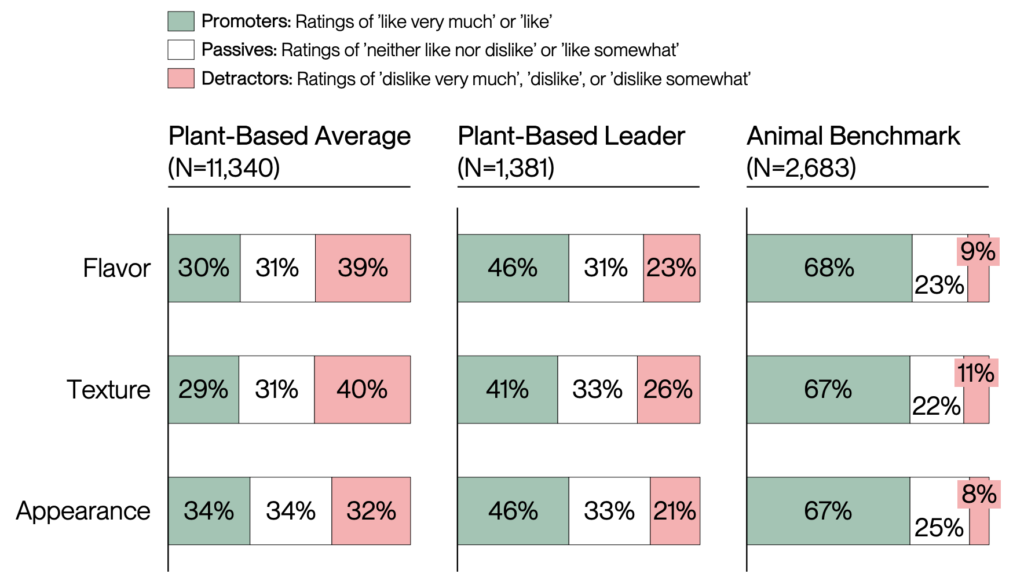
In its second annual Taste of the Industry report, the organisation conducted a blind test of 122 plant-based analogues with over 2,600 meat-eaters. Only 30% of participants liked the average meat-free product, compared to the 68% who liked conventional meat. Across all 14 categories, 46% said they ‘liked’ or ‘liked very much’ the leading vegan products.
Courtesy: Nectar
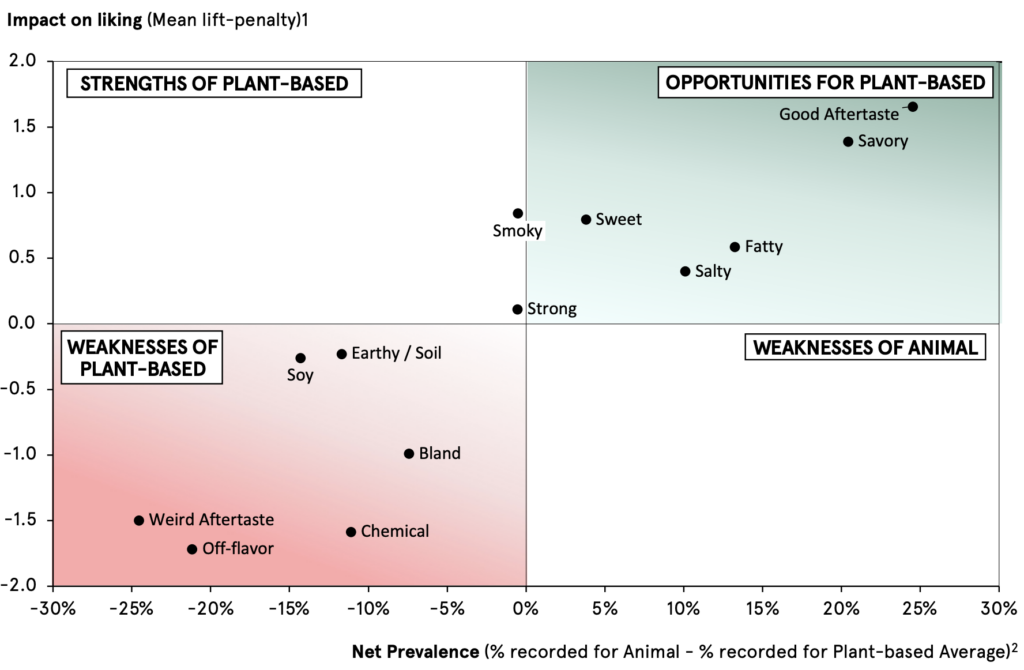
Off-flavours, a weird aftertaste, mushiness, and off-colours were some of the biggest weaknesses identified in the tested products. On the plus side, 20 of the plant-based leaders were rated the same or better than their animal-derived counterparts by at least half the taste-testers, providing an R&D roadmap for the rest of the industry.
Investment in R&D offers strong returns – Nectar’s research found that the leading products in each category capture a 28% market share, versus just 18% for other offerings. In fact, for every 5% increase in the share of consumers rating plant-based meat as the same or better than conventional meat, sales of the former grew by $1.5M.
Plant-based burgers, nuggets and fillets most appealing to meat-eaters
Courtesy: Nectar
The analysis revealed that meat-eaters tend to find vegan burgers, nuggets and meatballs more appealing than bacon or hot dog analogues – the better-performing categories have five to 15 times higher market penetration.
“These leader products are outperforming average products primarily in flavour,” says Nectar director Caroline Cotto. “Also, plant-based chicken as a category is winning in R&D over pork and beef, with no chicken products showing a big gap in liking between the average plant-based product and the leader product.”
“Our research shows that the biggest opportunity for plant-based products to catch up to their animal counterparts is on texture. For some categories, like nuggets, burgers, turkey, etc, mimicking texture is significantly easier than for other categories, like bacon, bratwurst, and whole-cut steak,” she says.
“The balance of fattiness and chewiness in bacon, the snap of a bratwurst casing, and the tender but firm chew of whole-cut steak are all textural elements that require further R&D if plant-based products want to meet omnivore consumers’ expectations in these categories,” adds Cotto.
Courtesy: Nectar
While the analysis didn’t look at chopped steak products like the ones offered by Beyond Meat (and recently Impossible Foods), for whole cuts, reducing the off-flavour and aftertaste, mushy texture, and dryness and toughness are the biggest opportunities.
At the same time, the research suggested that people prefer unbreaded chicken fillets over strips or chunks. “One of the biggest R&D opportunities across all categories was juiciness [or] tenderness,” explains Cotto. “That played out in this category clearly where perhaps the smaller pieces have more problems retaining their moisture.” Fillets were rated as juicy or tender about 1.5 times more.
Further, strips and chunks were found to have weird aftertastes or off-flavours more frequently than fillets, which Cotto says could be because Nectar tested some of the lower-performing brands instead of industry leaders here.
The best plant-based meat brands, according to meat-eaters
Courtesy: Nectar
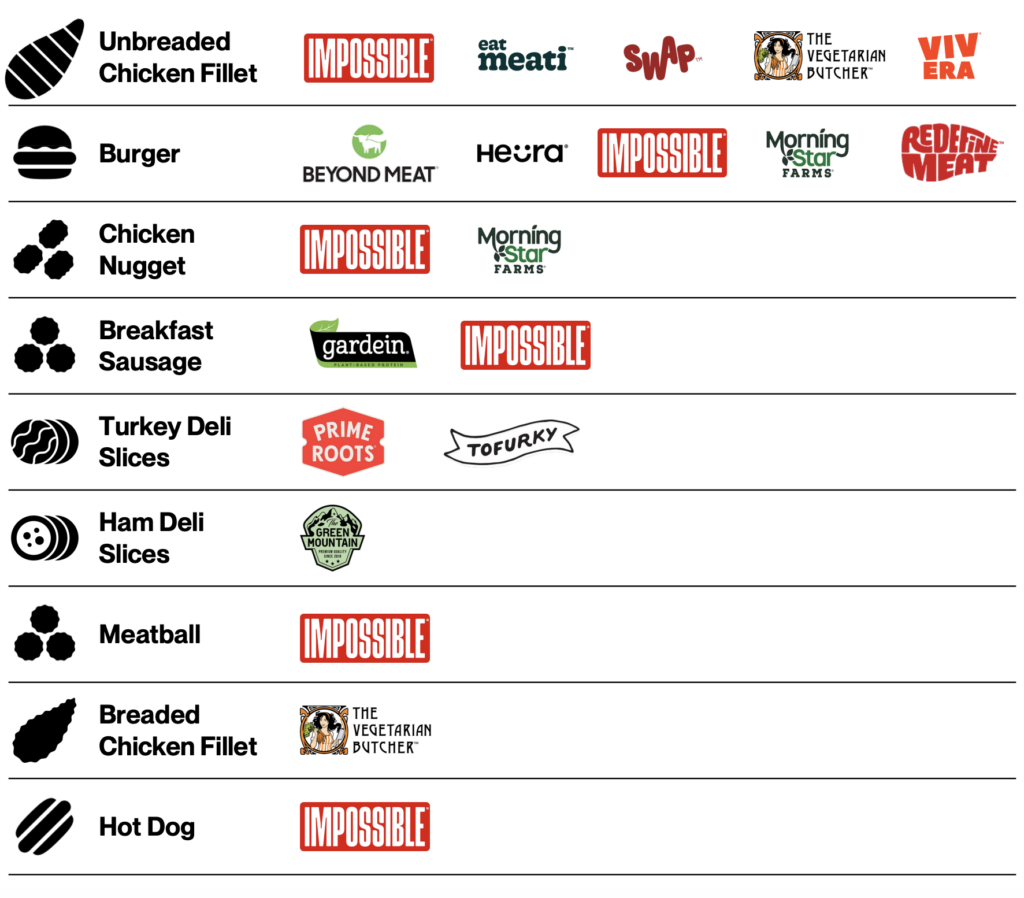
Nectar is also launching the Tasty Awards to celebrate innovation in the category, with the winners announced at a ceremony in San Francisco today. They honour brands that were found to be the most-liked in its tests, with products that over half of omnivores say taste the same or better than animal protein.
A total of 13 companies won an award across the categories, with Impossible Foods the biggest winner (with wins in six categories). Brands seem to be performing the best with burgers and unbreaded chicken fillets, categories where five companies won an award each.
This includes Heura, Meati Foods, and Swap – a sign that consumers are perhaps more inclined towards ‘clean’ labels and short ingredient lists. However, Cotto clarifies that the actual base ingredients don’t have a large impact on purchase intent.
“Our research found that coconut oil had the best consumer perception, over seed oils like canola or sunflower, but relatively no impact on taste,” she explains. “Mushrooms and mycelium were conceptually appealing ingredients to consumers, leading to a positive change in purchase intent, but products with these ingredients actually had lower overall liking ratings.”
Courtesy: Nectar
Cotto suggests that “taste parity is on the horizon”, but “no plant-based products in this year’s study” achieved parity with or outperformed an animal product. She reiterates that texture innovation is the most important lever for plant-based leaders to catch up with animal proteins.
“Plant-based products were described as juicy 62% less often than the animal, leading to decreases in liking of 1.1 points – increasing tenderness and reducing mushiness are meaningful secondary priorities,” she says.
Meat-free offerings were found to be savoury 35% less often and have a weird aftertaste or off-flavour five to six times more often than animal proteins. “These differences were associated with a 1.5- to two-point liking gap between animal and plant-based products,” says Cotto, noting that flavour is the “biggest opportunity for plant-based as a whole to improve”.
“We think it’s important for the industry to raise the standard of the average plant-based product because the average product was generally disliked,” she says.