An increasing number of companies and supermarkets are producing everyday basics for families who are vegan or dairy-free
Shoppers can now purchase kid-friendly soy and oat milk products at Sainsbury’s.
The British supermarket chain sells its own private-label plant-based milk drinks for children one year old and up, fortified with essential vitamins and nutrients.
Sainsbury’s 1+ Years Soya Drink and 1+ Years Oat Drink feature added calcium, iodine, and iron, as well as vitamins A, D, B2, and B12. The soy version is also low in sugar and contains around 6.5g of protein and 1.1g of fibre per 250ml serving.
The majority of British parents and guardians would like to see more healthy vegan food options for kids - Media Credit: Plant Based News
A 2022 report by The Vegan Society found that 66.9 percent of UK parents and guardians with children under 15 would like to see more healthy vegan food options for kids. Nearly 40 percent would like to see more vegan food products specifically aimed at children, and over 68 percent said the food industry could do more to develop kid-focused options.
In 2025, Alpro launched a new range of products specifically for kids, including plant-based milk and yogurts. At the time, the company said that its Alpro Kids range contains 30 percent less sugar than comparable products and is fortified with calcium, vitamin D2, and other essential nutrients, such as iodine and vitamin B12.
In January of this year, the largest peer-reviewed study of its kind found that well-planned plant-based diets can aid children’s growth and support their heart health. In June, a separate study found that children and teenagers are more open to meat-free diets than adults, but can struggle to maintain them without familial support.
Roughly five percent of people in the UK are lactose intolerant, including kids.
Kids don’t eat enough plant-based foods
In July, a study found that kids and young people around the world are not eating enough nutritious, sustainable, plant-based foods. The authors noted that healthy foods such as beans, legumes, and other plants can help improve youth nutrition and contribute towards global Sustainable Development Goals like ending malnutrition.
According to Sainsbury’s, its oat and soy drinks for young kids can be part of a healthy, balanced diet from one year of age, but not as the main milk alternative for children under two. The products have an RRP of £1.70 per 1-litre carton.
Roughly speaking, there are two types of vegans and vegetarians: people who have no desire whatsoever for a meaty meat substitute, and people who no longer eat meat but don’t (always) want to miss out on the meat experience. I have good news for the latter group: Future Farm’s ‘plant-based meat’ is now also available in the Netherlands.
The Vegetarian Butcher and Beyond Meat have gained a formidable competitor: Future Farm wants to conquer the world with exact meat replicas in terms of texture and flavour, but made from plants. No animal suffering, less CO2 emissions: I’m hugely in favour. The plant-based products, including the flagship burger that conquered Brazil in a short time, are known for their good quality; the products are available at Marqt, among others.
More than 2 million burgers
The main ingredients in Future Farm’s meat substitutes are peas, soy, chickpeas and beetroot powder to mimic the colour of meat. For people who do enjoy meat and its characteristic texture and flavour, it’s an absolute must-try. I tried the minced meatballs—and they did not disappoint: this really is a meat experience from here to Brazil.
You pay €3.89 for two burgers
Deliciously juicy
The meaty texture, which is barely distinguishable from real meat, is particularly striking. This really is an excellent meat substitute, without compromising on flavour, texture or juiciness. Future Farm therefore focuses mainly on meat eaters and flexitarians, less so on vegans. The fact that the products are a hit in meat-loving Brazil (after the US, people here eat the most meat in the world) is evident from the fact that Future Farm sold more than 2 million (!) burgers there in its first eight months.
Transparency in the (meat) production chain
Founder Marcos Leta is now setting his sights on Europe: “The Netherlands is the first market we are entering in Europe, but it certainly won’t be the last. We firmly believe that Future Farm will become just as successful here as it is in South America. Especially now that corona has increased pressure for greater transparency in the (meat) production chain and the way meat-processing factories operate is under scrutiny. Demand for sustainable and flavourful alternatives will only increase. I expect that in twenty years we will consume almost no meat at all.”
If you’ve ever stared into the fridge after a long day and wished dinner could somehow make itself, Nisha Vora has a solution. The creator behind Rainbow Plant Life recently shared two vegan sheet pan dinners that require very little hands-on effort but still deliver the kind of flavour, texture, and presentation you would happily serve to company. For anyone who wants healthy food without juggling multiple pots and pans, these meals offer a compelling reminder that simple cooking does not have to mean boring cooking.
Vora is a Harvard graduate and former corporate lawyer who left the legal profession to pursue a plant-based lifestyle and career in food. Today, she is one of the most recognizable vegan recipe creators online, and her recipes are featured on New York Times Cooking. In this video, she not only demonstrates two of her favourite sheet pan meals but also shares a flexible formula that home cooks can use to create their own vegan sheet pan dinners. According to Vora, every successful sheet pan meal starts with a four-component formula: a protein, a vegetable, a sauce, and what she calls “something fun” to add contrast and excitement.
Crispy curried tofu and carrots with garam masala yogurt sauce
This Middle Eastern-inspired sheet pan meal includes roasted cauliflower, crispy chickpeas, and Medjool dates on a base of whipped tahini - Media Credit: YouTube / Rainbow Plant Life
The first dish combines crispy curried tofu, roasted carrots, red onions, and a creamy yogurt sauce flavoured with garam masala. Vora describes the result as a meal where “the carrots get tender and sweet, the tofu turns into these crunchy little nuggets, and the yogurt sauce ties it all together.”
For the protein, she uses extra-firm tofu. To help it crisp up in the oven, she slices a block lengthwise into four slabs before pressing it. Vora notes that tofu releases moisture more quickly when divided into smaller pieces. While she jokingly presses hers beneath a favourite cookbook, any heavy object can do the job. The goal is to remove as much moisture as possible because, as she explains, drier tofu develops a better texture in the oven.
While the tofu presses, she moves on to the vegetables. Rather than combining multiple vegetables with different cooking times, Vora prefers to focus on one primary vegetable. “I don’t want four or five different vegetables that have different cook times because that typically ends up in a sad, soggy mess,” she says.
Carrots are the star
For this recipe, carrots take centre stage. She keeps the skins on for texture, nutrition, and convenience. The carrots are sliced crosswise on a bias into roughly two-inch pieces. If the carrots are particularly thick, she recommends halving the wider sections lengthwise before slicing. Red onion wedges join the carrots on the tray, providing what Vora calls a complementary vegetable. As they roast, the onions become sweet and jammy while adding extra flavor with very little prep work.
The vegetables are tossed with olive oil, salt, and plenty of black pepper before being spread across a sheet pan. Vora emphasizes that everything should be arranged in a single layer. “If you overlap things, it’s just gonna steam, it’s not gonna roast,” she explains. Proper spacing allows ingredients to brown, caramelize, and develop texture.
Prepping the tofu for maximum crunch
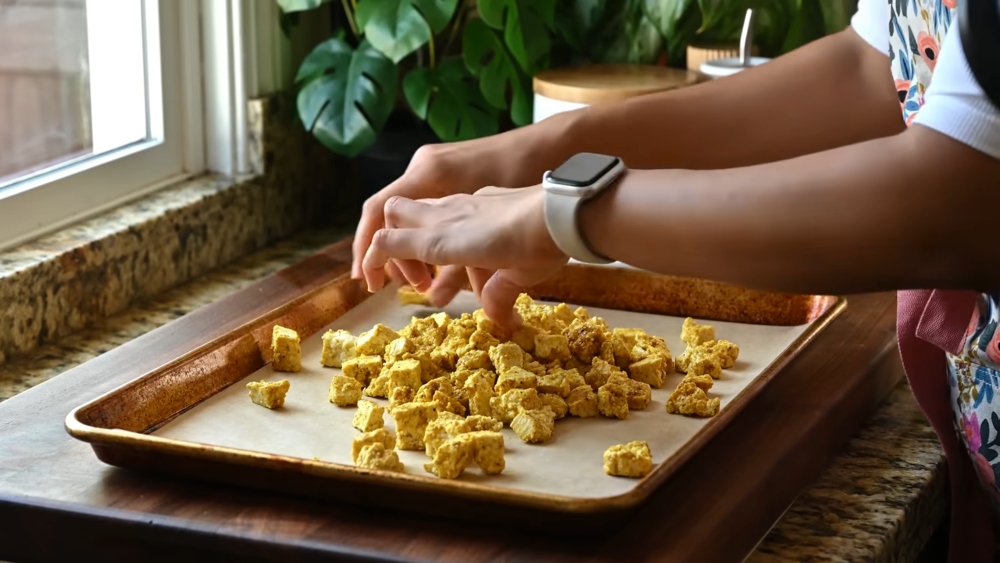
YouTube / Rainbow Plant LifeThe curry-spiced tofu must be evenly spaced on the sheet pan so that it turns crisp and golden
Once the tofu is pressed, Vora crumbles it into small, irregular pieces roughly the size of large blueberries. These jagged edges become one of the dish’s biggest advantages. “All these little craggy edges you see are going to absorb the spices and oil super well and crisp up beautifully in the oven,” she says.
The tofu is gently coated with olive oil, salt, pepper, curry powder, and potato starch. According to Vora, the starch is crucial because it creates a crispy outer shell during roasting. After spreading the tofu across a parchment-lined tray, both sheet pans head into a 425-degree oven. The tofu roasts on the upper rack while the vegetables cook below. Everything gets one toss halfway through before returning to the oven for another 15 minutes.
While the trays roast, Vora prepares a simple sauce in a bowl. Coconut yogurt is mixed with grated garlic, fresh ginger, garam masala, lemon juice, salt, and pepper. She explains that the spice blend complements both the sweetness of the carrots and the curry-coated tofu. If the yogurt lacks richness, she suggests adding a drizzle of olive oil. If it tastes overly tart, a pinch of sugar can soften the acidity.
The final element of her formula is “something fun.” In this case, it is a sliced serrano pepper. While simple, Vora says the pepper provides “this really fun, sexy, spicy heat” that contrasts with the sweeter elements of the meal.
To serve, she layers the roasted vegetables and crispy tofu over white rice before spooning over the yogurt sauce. Fresh cilantro, sliced chili, and a squeeze of lemon finish the dish.
Roasted cauliflower, chickpeas, and dates with whipped tahini
The second of Vora’s vegan sheet pan dinners uses the same framework but creates a completely different flavour profile. Inspired by Middle Eastern ingredients, the dish combines roasted cauliflower, crispy chickpeas, sweet Medjool dates, and a creamy whipped tahini base.
“This one is roasted cauliflower and chickpeas with whipped tahini and sticky torn dates,” Vora says. “It’s got this Middle Eastern-inspired flavour profile.”
For protein, she turns to canned chickpeas. After draining and rinsing them, she pats them dry with a dish towel to encourage crisping. The chickpeas are tossed with olive oil, salt, and pepper before being spread across a sheet pan.
The vegetable component starts with a large cauliflower. To avoid making a mess, Vora removes the tough central core from underneath before breaking the head into medium-sized florets. She recommends cutting through the stems whenever possible because flat surfaces brown more effectively on a sheet pan.
Six garlic cloves join the cauliflower. Rather than mincing them, she lightly crushes them with the flat side of a knife. Roasting transforms the cloves into soft, golden morsels with a mellow sweetness.
After coating the cauliflower and garlic in olive oil, salt, and pepper, Vora arranges everything on a second sheet pan. She advises placing florets flat-side down whenever possible and positioning larger pieces near the hotter outer edges of the tray.
Both pans roast at 425 degrees, with the chickpeas on the top rack and cauliflower below. This time, everything cooks undisturbed for 20 minutes before being checked.
Making the whipped tahini base
Meanwhile, Vora prepares the sauce. She whisks tahini together with lemon juice, grated garlic, Aleppo pepper, cumin, salt, and ice-cold water. The chilled water is particularly important. “The iced water helps the tahini whip up into something that’s fluffy and creamy at the same time,” she explains.
Instead of a pourable sauce, she aims for a thick spread that forms the base of the finished platter.
For the “something fun” element, Vora uses torn Medjool dates. The dates reinforce the Middle Eastern flavour profile while creating bursts of sweetness throughout the dish. As they roast, they become slightly caramelized and crisp around the edges.
After 20 minutes, the trays come out for a quick toss. The dates are added to the cauliflower tray before everything returns to the oven for another seven to 10 minutes. When finished, the cauliflower is browned and tender, the dates are lightly charred, and the chickpeas are golden and crisp.
To assemble, Vora spreads the whipped tahini across a serving platter before piling on the cauliflower, roasted garlic, dates, and chickpeas. Chopped parsley and a sprinkle of Aleppo pepper complete the dish.
A formula for stress-free dinners
Beyond the recipes themselves, the real takeaway from Vora’s video is the formula. By combining a protein, a vegetable, a simple sauce, and one exciting finishing ingredient, she creates meals that feel far more elaborate than the effort required. The approach keeps prep manageable, minimizes clean-up, and makes vegan sheet pan dinners adaptable to whatever ingredients happen to be in the kitchen.
As Vora puts it, the method delivers “very minimal effort and fuss.” For busy home cooks who still want satisfying, flavour-packed meals, that’s a formula worth remembering.
Pumpkin are a great source of plant-based protein, offering around 8 grams per ounce.
In addition to protein, pumpkin seeds are rich in healthy fats, fibre, zinc, and other nutrients that are beneficial for heart health and sleep.
Pumpkin seeds can be part of vegetarian and vegan diets, and they’re safe for most people with allergies.
From pinto beans to peanuts, there are lots of great plant-based protein options. But if you’re looking to add more to your protein to your diet without relying on meat, you can’t go wrong with pumpkin seeds.
For one, these small seeds pack a serious protein punch, with over 8 grams per ounce. And they can be roasted as a snack, incorporated into baked goods, or mixed into your morning bowl of oatmeal, making pumpkin seeds a tasty and simple way to boost your protein intake.
But pumpkin seeds also have a unique nutritional makeup—so there are even more reasons why they’re a great plant-based protein choice.
Pumpkin seeds are high in protein, and they can also help with heart health and sleep. banusevim / Getty Images
1. They’re Packed With Nutrients
Pumpkin seeds are an excellent source of protein, which helps build and repair your body’s tissues. But along with their high protein content, pumpkin seeds are rich in:
Healthy fats
Fibre
Iron
Magnesium
Zinc
Together, these nutrients can support your bone, digestive, and heart health.
2. They’re Vegetarian and Vegan Friendly
It can be challenging to find healthful protein sources if you follow a plant-based diet. Pumpkin seeds provide all the essential amino acids your body needs, making them a complete protein option for vegetarians and vegans. Amino acids are the building blocks of protein.
You can easily incorporate pumpkin seeds into vegan and vegetarian recipes, such as smoothies, salads, or stir-fries.
3. They’re Hypoallergenic
Pumpkin seeds are considered hypoallergenic, meaning they are unlikely to cause allergic reactions in most people. This makes pumpkin seeds a suitable choice for people with allergies to other plant-based protein sources, like nuts and soy.
While pumpkin seed allergy is rare, it is possible. To stay safe, choose pumpkin seeds from trusted sources and check labels to avoid cross-contamination with common allergens.
4. They May Help With Sleep
Pumpkin seeds contain tryptophan, an amino acid your body uses to make serotonin and melatonin. These hormones play a role in sleep: Serotonin helps regulate sleep processes in the brain, and melatonin regulates your sleep-wake cycle.
Pumpkin seeds are also rich in magnesium, a mineral that can support relaxation. Eating pumpkin seeds in the evening may help you fall asleep more easily and improve your sleep quality throughout the night.
5. They Support Heart Health
Pumpkin seeds provide nutrients that support your heart health. Magnesium regulates blood pressure, and zinc is an anti-inflammatory that improves blood flow throughout your body. The seeds are also full of healthy unsaturated fats, which can help maintain healthy cholesterol levels.
How To Add Pumpkin Seeds to Your Diet
Pumpkin seeds are versatile and can be easily added to snacks and meals:
Roast them with salt or spices for a crunchy snack on the go.
Sprinkle them over salads, yogurt, or oatmeal for extra texture and protein.
Blend them into fruit or veggie smoothies for a protein boost.
Mix them into homemade granola or trail mix for a nutritious treat.
Add them to baked goods like muffins, breads, or cookies.
Stir them into soups, stir-fries, or stews just before serving.
Hundreds of popular vegan and vegetarian foods may contain an unwanted extra ingredient: toxins naturally produced by fungi
A large survey of plant-based foods and beverages sold in the UK has found that mycotoxins, toxic compounds naturally produced by fungi, are widespread across vegetarian and vegan products.
Researchers analysed 212 plant-based meat alternatives (PMBAs) and plant-based beverages (PBBs) purchased from UK stores. Every product tested contained at least one of 19 mycotoxins, and some contained several.
The study was led by the University of Parma in Italy and co-authored by Cranfield University. Researchers examined a wide range of products commonly available to UK shoppers, including burgers, vegetarian chicken pieces, vegan sausages, and oat, almond and soy-based milks.
Scientists found fungal toxins in every one of 212 plant-based foods and drinks tested. Credit: Shutterstock
Why Mycotoxins Appear in Plant-Based Foods
Mycotoxins can be especially common in plant-based products because many of their ingredients, including grains, legumes and seeds, may be exposed to mould while they are being grown or stored.
Despite the widespread detection of mycotoxins, the levels measured in the UK products remained below recommended EU guideline levels. The researchers said this reflects the high quality standards maintained by the UK food industry.
Long-Term Exposure Could Still Matter
The concern is not necessarily the amount present in a single product. Previous research studies have indicated that repeated exposure to small amounts of mycotoxins can add up over time and may eventually create health concerns.
Eating individual plant-based products is therefore unlikely to cause problems on its own. However, the researchers say that a diet based entirely on plant foods could increase cumulative exposure to mycotoxins if that exposure is not properly managed. In severe cases, mycotoxin exposure has been associated with liver and kidney damage, suppression of the immune system, and cancer.
The findings provide new data that can be used to estimate dietary exposure and improve risk assessments for consumers in the UK.
Experts Call for Better Monitoring
Andrea Patriarca, Senior Lecturer in Mycology at Cranfield University, said:
"Mycotoxins occur naturally in foods and cannot be completely avoided. As consumers, we should not be frightened or deterred from enjoying a variety of products.
"However, a significant concern arises when new foods enter the market, as there are currently no established regulations to monitor mycotoxins. We collaborate closely with various sectors in the food industry, from farmers to food companies, to help implement effective mycotoxin management integrated within food safety standards. The data from our research helps food safety organisations in assessing risks, particularly in complex multi-ingredient products.
"We are currently collaborating with the University of Parma to evaluate the risks faced by the population based on different dietary habits. Our aim is to advise policymakers and raise awareness among vulnerable consumers."
The full research paper, "Mycotoxin contamination in plant-based beverages and meat alternatives: A survey of the UK market," is published in Food Control.
This work was carried out under the Horizon Europe FunShield4Med project (HORIZON-WIDERA-2021-ACCESS-03) Grant Agreement No 101079173 funded by the European Union.
“The term plant-based has become popular in recent years and its meaning has never been clearly defined,” explained Dr. Anna Herby, nutrition education specialist at the Physicians Committee for Responsible Medicine and co-author of the study. “The greatest benefits of a plant-based diet stem from completely avoiding animal products. As dietitians who promote this healthful dietary pattern, we wanted to understand how people interpret the terminology in order to more clearly communicate about it.”
Key findings of the study include:
56% said “plant-based” means vegan—avoiding all animal products.
35% said it means eating abundant plant foods while still eating some meat, dairy and eggs.
7% said they didn't know.
2% gave another answer.
Interpretation also varied significantly by demographic group: 63% of adults ages 65-94 equated plant-based with vegan, compared with 51% of 18-to-34-year-olds.
Photo: Adobe Stock
The study analysis drew on the results of a survey of 2,202 U.S. adults conducted in July 2025 that was designed and executed by Morning Consult following the Best Practices for Survey Research of the American Association of Public Opinion Research.
“Defining ‘plant-based’ as excluding all animal products could make it easier for consumers to make confident decisions about food products by knowing that the term means there are no animal products,” said study co-author Shannon Menhardt, MS, a registered dietitian with the Barnard Medical Center. “A consistent definition could also make research findings and dietary recommendations easier to interpret and help provide clearer messaging for health professionals, patients, and the media.”
Founded in 1985, the Physicians Committee for Responsible Medicine is a non-profit organization that promotes preventive medicine, conducts clinical research, and encourages higher standards for ethics and effectiveness in education and research.