The New Zealand Vegetarian Society and the Vegan Society of Aotearoa have submitted a petition to the Ministry for Primary Industries calling for clear and uniform labelling of vegetarian and vegan products.
According to the organisations, there are several items on the market in New Zealand with misleading labelling, with marketers using terms like “plant-based,” “less dairy” and “vegan.”
This lack of transparency is concerning for allergy sufferers, Jews and Muslims, vegans and vegetarians, as customers can’t grasp what is in their food without carefully reading the ingredient list.
“Clear and honest labelling is not just a matter of consumer rights, but a step towards a more transparent and ethical food industry,” said Ina Babic, spokesperson for the NZ Vegetarian Society (NZVS).
“The NZVS also offers Vegan Certification and Vegetarian Approval for products, which consumers should look out for. With the current lack of legislation, these trademarks provide much-needed assurance that products meet strict criteria, helping to protect consumers from misleading labels.”
The petition states that the terms “vegan” and “vegetarian” should be used where appropriate and that phrases like “less dairy” should be avoided. The term “plant-based” should only be used for entirely plant-based items.
The NZ Vegetarian Society also adds customers tend to make purchases based on eye-catching packaging designs, and this lack of clarity leads consumers to believe that the products are free of allergies and animal substances.
The petition’s goal in campaigning for enforceable labelling standards is to reduce misunderstanding and ensure transparency, allowing consumers to make more informed decisions, the two organisations shared.
Ferrero has heard the pleas of our vegans and lactose-intolerant gangs and has, at long last, announced a completely plant-based version of Nutella.
The chocolate hazelnut spread will roll out across select European countries, likely in Italy or Germany where Ferrero has already filed patents for the vegan spread.
The plant-based Nutella will hold a vegan certification and is very likely to taste nearly identical – original Nutella’s only animal product is skim milk powder, which accounts for around 8.7 percent of the recipe and could be substituted with any number of powdered milk alternatives.
The announcement came at Nielsen’s 2024 Linkontro event in Sardinia after rumours spread in response to Ferrero’s 2023 patent filing. Ferrero also collaborated with plant-based publication Green Queen to confirm the news, saying, “At Ferrero, we are always scouting and exploring new categories and emerging food trends.
“By leveraging innovative spirit and decades of expertise of our beloved global brands, we are now preparing to launch Nutella Plant-Based (in a few European countries) starting in autumn 2024.”
It’s not clear at time of writing if or when vegan Nutella will land in Australia but we’re happy to live in blissful optimism. In the meantime, you can scroll through TikTok for literally thousands of tutorials on how to make your own plant-based Nutella including everything from avocado to silken tofu.
Can vegans eat Nutella?
At the moment, no. Nutella contains a small amount of skim milk powder so it is not vegan. Australian-based Nutino is also made with skim milk powder so until plant-based Nutella hits our shores, you’re best off making your own.
Sodexo Live! implements an unprecedented plant-based, sustainable initiative at this year’s Olympic games
Expect to see a record-breaking amount of vegan options at the Paris Olympic and Paralympic Games. According to Sodexo Live!, 60% of all food and beverage across all sites for the public will be plant-based—including one fully vegetarian restaurant, La Concorde. And 30% of the items at Athletes’ Village will be vegan. To put things in perspective, France is preparing to serve 13 million meals during the games.
The meals range from plant-based versions of gametime classics like hot dogs to fancier offerings like Sweet Potato Za’atar with Hummus & Chimichurri.
80% of the Food Supply Sourced Locally
Not only will there be two times the amount of plant-based meals offered at the Olympics, but 80% of the total food supply will be sourced locally from France—supporting local communities and reducing carbon emissions on transporting ingredients. And instead of using disposable dishes, Sodexo Live! plans to introduce 47,000 reusable plates and cut down the amount of single-use plastic in half. This is the first time a sustainability effort as large as this one will be implemented into the main restaurant of an Olympic Village.
Paris Olympics to Prevent Food Waste
If you’re like us, and you read 13 million meals, you probably start to think about how much food will be wasted at the event. But the Paris Olympics team has already built a comprehensive plan to prevent food waste, and recover the waste that cannot be prevented. Unsold and unconsumed food will be given to charity, converted into animal feed, composted, or sent to anaerobic digestion plants.
All of these efforts are a part of the 2024 Paris Olympics goals to cut the carbon footprint of their catering in half. You can read more about their sustainable initiatives here.
The land of cheese, wine and cured meats hides some delicious plant-based eateries with signature Parisian flair, writes Adrianne Webster
Ah, Paris! Within its world-renowned culinary scene, locally produced cheeses, wines and meats are about as ubiquitous as the Eiffel Tower trinkets the street vendors are selling.
Walk along any rue and you’ll see dishes featuring French staples like brown butter, coq au vin and escargots. Red wine is served alongside, of course. And maybe a cigarette to finish everything off. But what’s on offer for those, like myself, who follow a vegan, orvégétalienne, diet?
After eight years as a vegan and researching the hell out of every chosen city I visit for where I’m going to eat, I’ll admit I was a bit nervous about journeying to the home of fromage.
But I was pleasantly surprised; my trip took me to quaint boulangeries offering a wide array of vegan-friendly baked goods, a high-end restaurant with innovative dishes, and my apartment’s kitchen to eat a plant-based burger after a particularly tiring day in the city, among other gorgeous spots.
Here’s where you should check out.
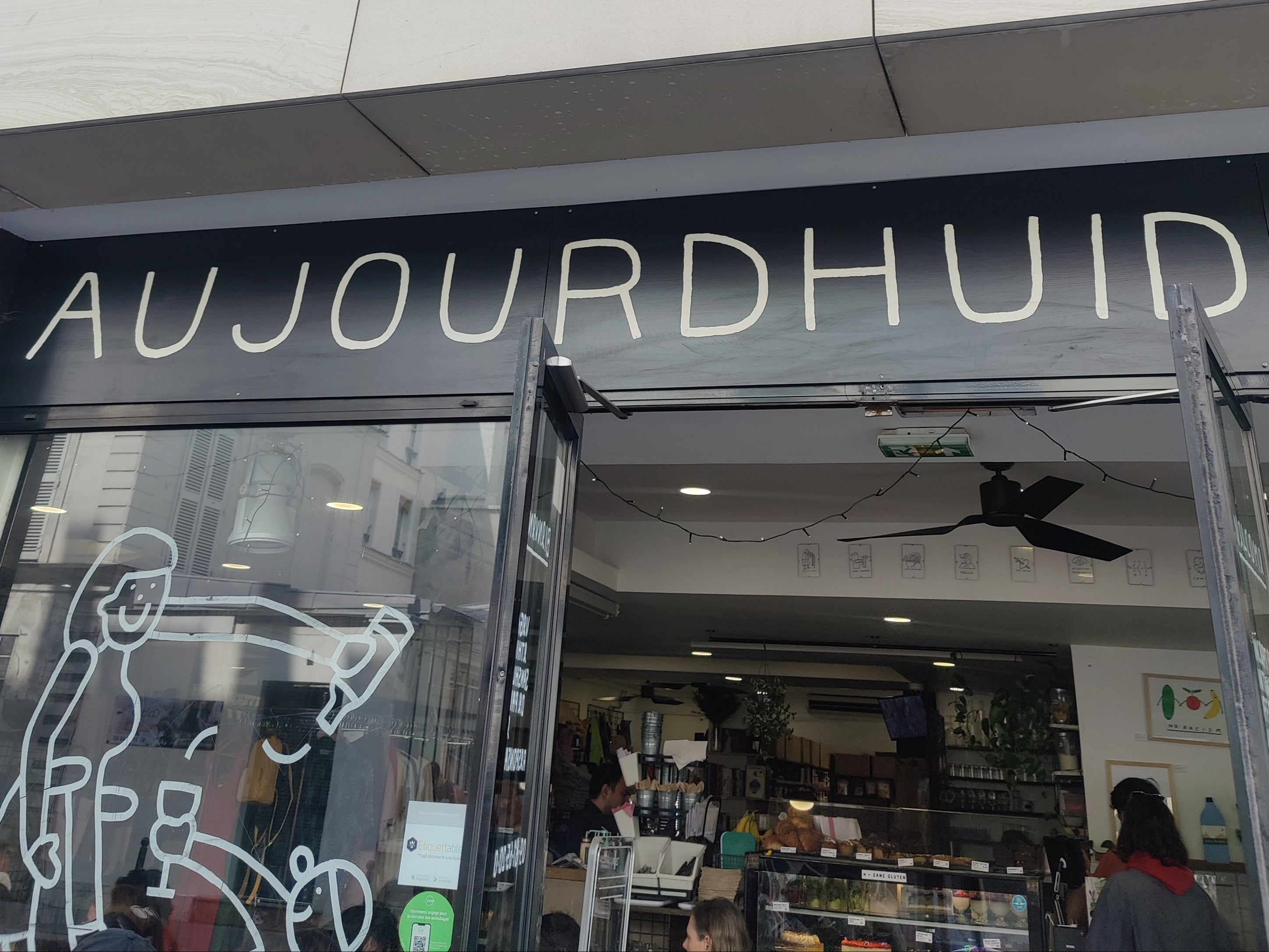
Aujourd’hui Demain
Best for: Chill weekend brunch vibes
Head for brunch at Aujourd’hui Demain (Adrianne Webster)
Location: 42 Rue du Chemin Vert, 11th arrondissement
A bakery slash cafe slash vegan clothing and food shop, Aujourd’hui Demain is just a five-minute walk from nearby Saint-Ambroise metro station and offers a laidback brunch or lunch scene with portions that’ll keep you full all day.
Situated in the Bastille area in the 11th arrondissement, the 100 per cent vegan eatery offers delights like fish and peas (battered tofu with peas and fries), a ‘cheddar’ burger, ramen, truffle mac and ‘cheese’... the list goes on. But as well as quantity, the quality’s there, too; the dishes were presented beautifully and the flavours were well-balanced.
I went for the quesadilla (not very French, but c’est la vie!), filled with vegan chilli and topped with herby chimichurri and a creme fraiche/sour cream concoction that finished it all off perfectly, alongside a tasty side salad.
We sat streetside to take in some Sunday morning people-watching, but inside you’ll find vegan-friendly bakery items, like the usual croissants and pain au chocolat, plus cakes that you can pre-order.
There’s a whole fashion shopping section too featuring vegan-friendly brands such as Matt + Nat, and a vegan mini-supermarket with pantry items, frozen goods and herbs and spices, as well as drinks. Club Mate fans, you’ll need to make a pitstop here.
Remember to make a reservation – there were lots of groups and couples having to wait on the street for a table.
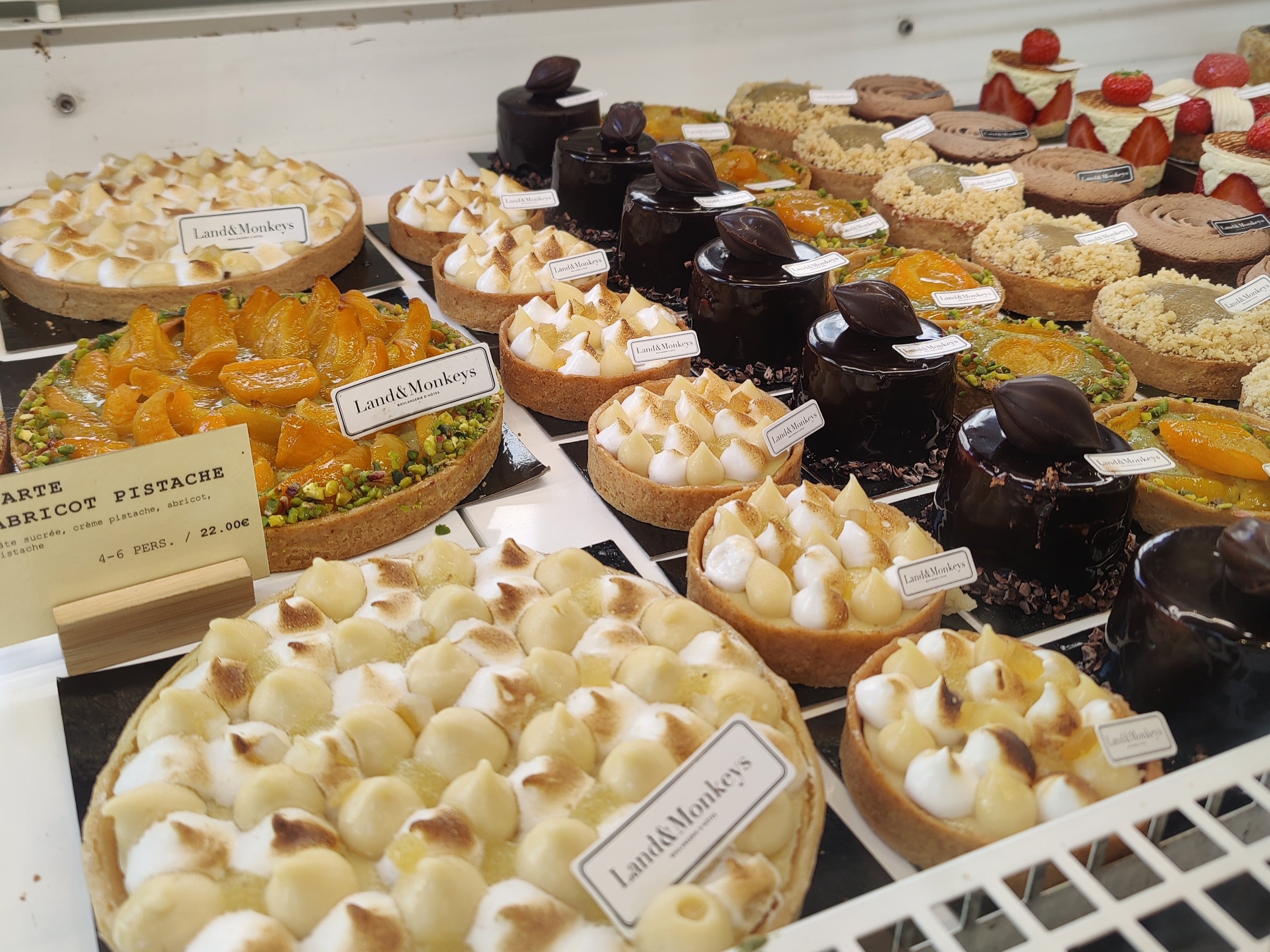
Land & Monkeys
Best for: Parisian pastries
Get a taste for plant-based pastries at Land & Monkeys (Adrianne Webster)
Locations: Beaumarchais, Place de Vosges, Amsterdam, Roquette, Pernety
A chance encounter with a fellow Scot who’d been living and working in Paris for five years clued us into Land & Monkeys, a 100 per cent vegan bakery chain with multiple locations across the city.
We were expecting a few croissants and some coffee, but discovered a cornucopia of cakes and pastries that were completely plant-based. Pain au chocolat, quiches, apricot and pistachio tarts, chocolate gateaux and cookies sat alongside ‘bacon and cheese’ and Mediterranean veggie baguettes if you fancied a little picnic in le parc.
The prices were affordable too, with a pain au chocolat costing just over €1; on the day we left Paris, we bought six to bring home. Because what’s a morning coffee without a pastry?
Le Potager De Charlotte
Best for: High-end eats
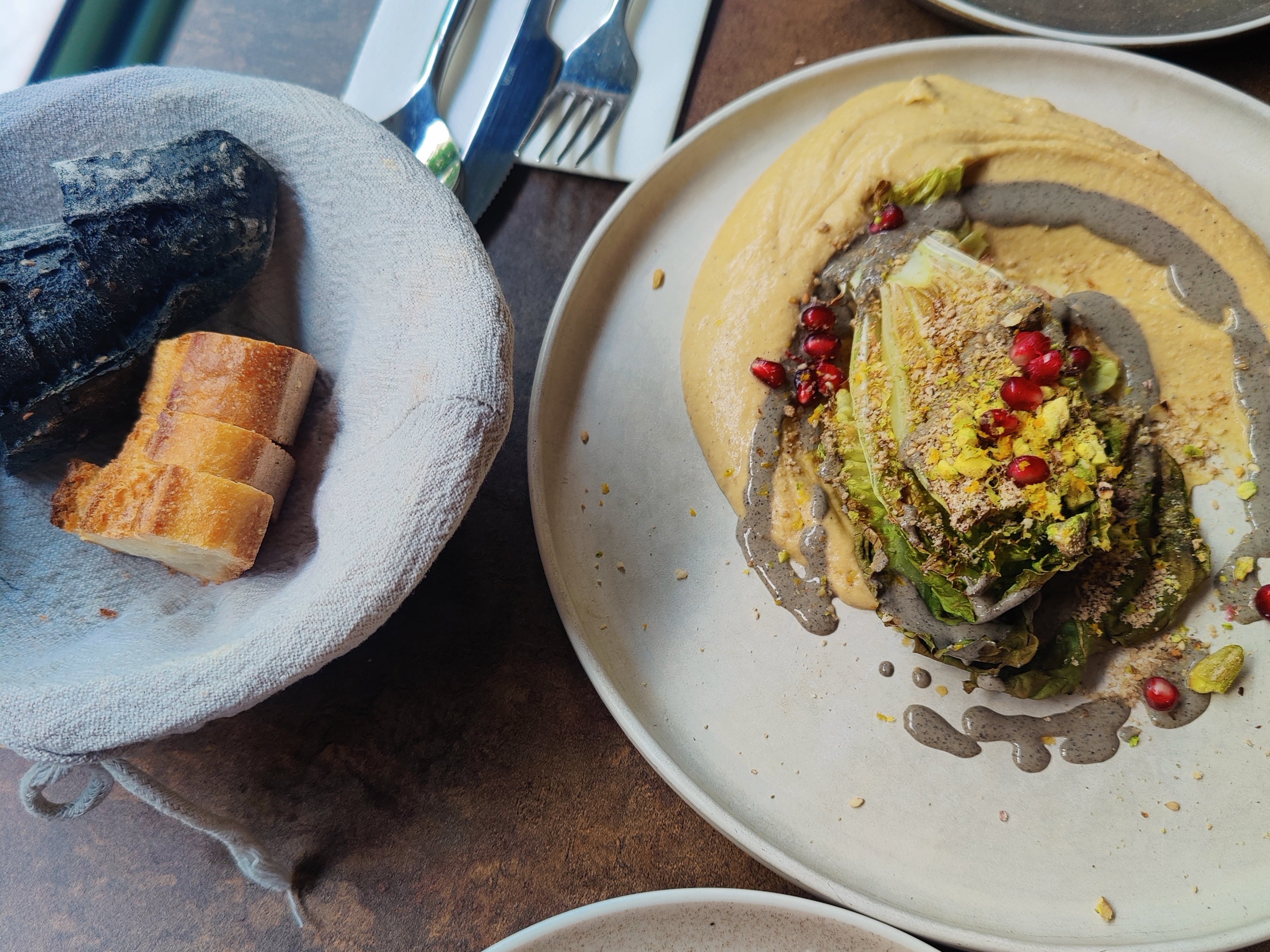
Hummus with black sesame cream, chopped pistachios and pomegranate (Adrianne Webster)
Locations: 17th and 9th arrondissement
The 17th arrondissement isn’t well-frequented by tourists, but it’s where you’ll find quaint wine bars spilling onto the street and gorgeous cafes and restaurants. And it’s also where you’ll find Le Potager De Charlotte, a gourmet vegan restaurant with a verdant interior that’s so cosy you’ll want to hole away all night with a bottle (or two) of red.
A starter of lemony hummus with black sesame cream, chopped pistachios and pop-in-the-mouth pomegranate, all mopped up with some delicious French bread, was followed by mains of rigatoni with balsamic and basil cream sauce, sunflower seeds, edamame beans and sun-dried tomatoes.
We took away a pot of chocolate mousse, served with edible flowers, raspberries, candied pecans and chocolate flakes, to eat by the Seine under the Eiffel Tower as the sun went down. Bliss.
It’s higher end, so do expect to pay a little more (but it’s worth it).
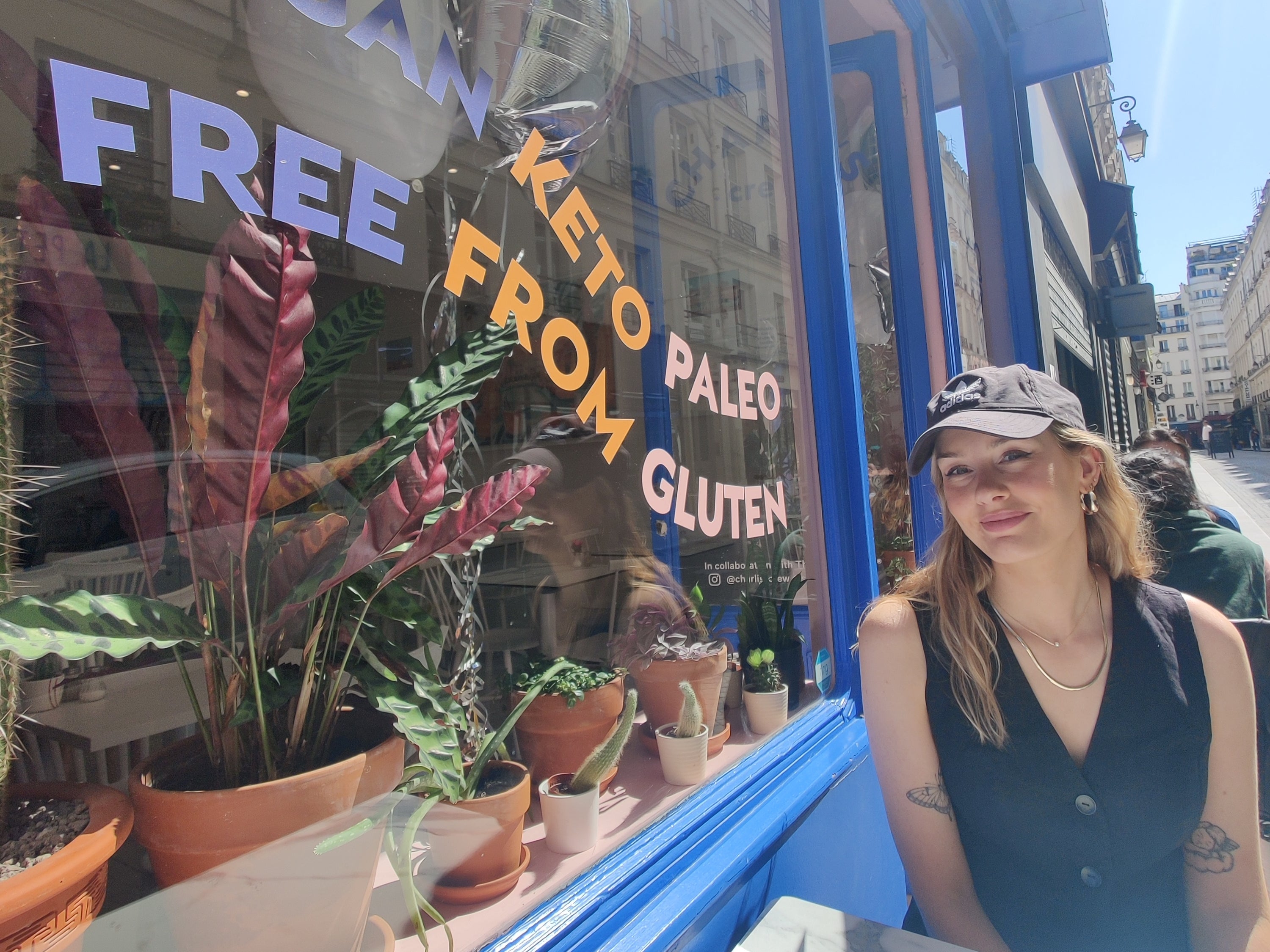
Charli’s Crew
Best for: Extra dietary requirements
Discover vegan, keto, paleo-friendly and gluten-free options at Charli’s Crew (Adrianne Webster)
Location: 14 Rue Mandar, 75002, 2nd arrondissement
On our way to the Louvre one day, we were walking down Rue Mandar when we happened across a joyful-looking cafe, Charli’s Crew, lit up by the sunshine, with a sticker in its windows saying “vegan”.
We took a seat outside and a waitress popped out to say hello – the fellow Scot I mentioned earlier. She explained near enough everything on the menu could be made vegan, and even made us a list of other eateries around the city to try.
On the menu you’ll find bowls, cakes and brunch bites, such as avocado toast, which comes served with vegan feta, nuts and edible flowers, plus tofu salad bowls, mac and cheese, plant burgers and scrambled tofu.
Some dishes can also be made keto and paleo-friendly and gluten-free.
Location: Multiple spots around the city, including near Luxembourg Gardens
Supermarket chain Monoprix is like our version of Tesco Express, and while not perfect by any measure – we didn’t manage to find vegan eats in every location – we did come across a vegan wrap with a substitute chicken, crunchy slaw and a creamy mayo which was great for filling up after doing a lot of walking around the city.
They also do good ready-made salad and salad bar options, such as a green lentil salad or mezze bowl with falafel, hummus and leaves. Grab some Lays and fruit and you’ve got a recipe for some great picnic in the park bites.
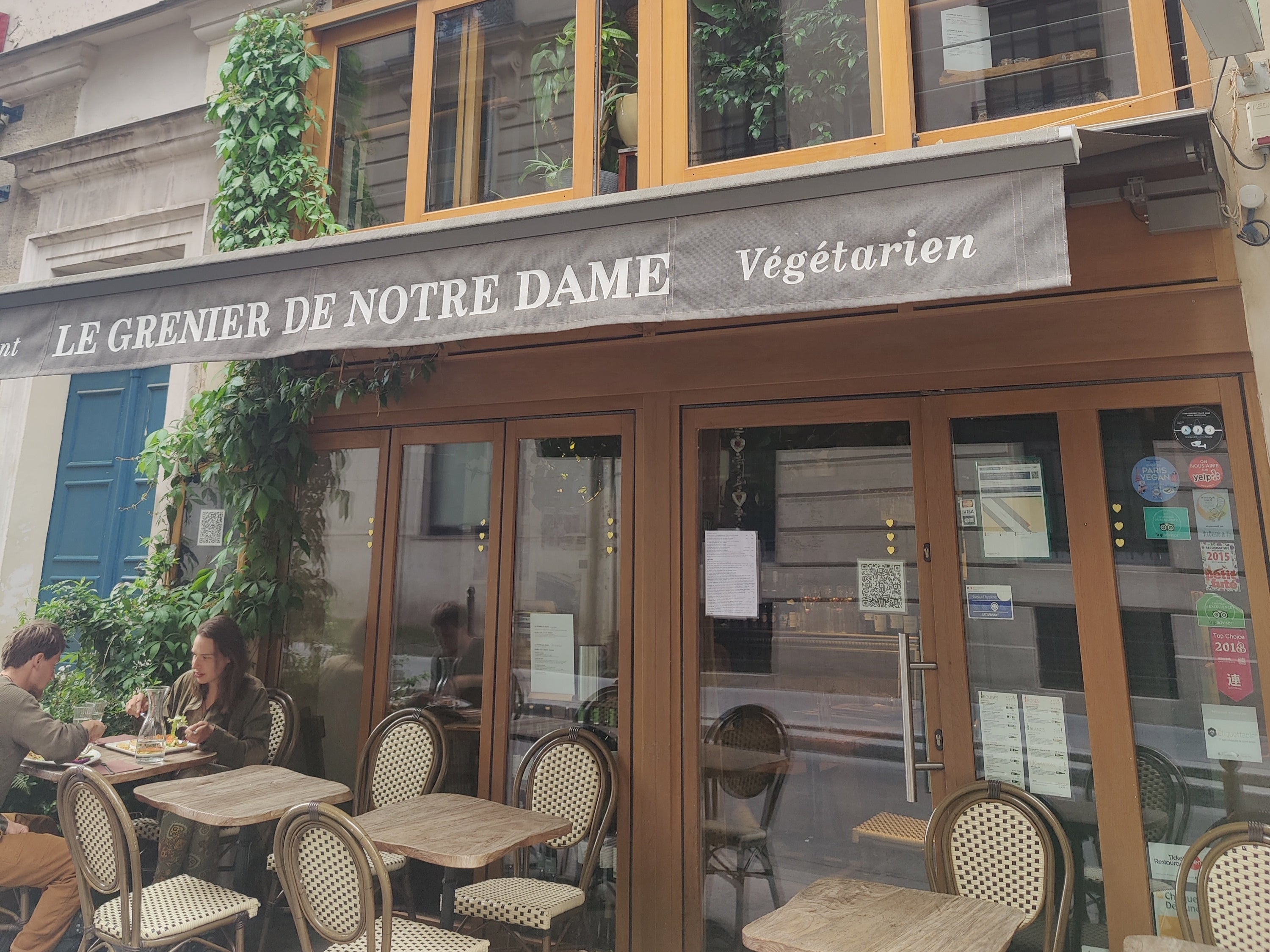
Le Grenier de Notre Dame
Best for: A romantic date night
A vegan spot in Paris’s Latin Quarter (Adrianne Webster)
Location: 18 Rue de la Bûcherie, 75005, 5th arrondissement
This spot in Paris’s Latin Quarter, literally just around the corner from the (still-closed) Notre Dame, is leafy and cosy – perfect for a romantic meal after exploring the sights.
It was the very first vegetarian cafe in France, launched in 1978, and serves dishes like lentil burgers, dauphinoise gratin, and chickpea ‘faux gras’, among others.
We opted for the burgers to takeaway – we wanted to eat in our apartment after a long day walking the city – and also got a chocolate brownie with chocolate ice cream for afters.
Overall, Paris has some top-notch veggie eateries, but you may need to organise your days around where you’ll be eating, as most vegan-friendly places won’t just be happened upon.
Plant Based World Expo, the biggest 100% plant-based trade event in Europe, unveils the Plant-Based Excellence Awards, a new comprehensive awards programme designed to recognise and celebrate those that champion excellence in the plant-based industry.
According to the organisers, the combination of judging the taste, presentation, and business viability of each product will provide a holistic view of its potential for commercial success. The Plant-Based Excellence Awards will score individual entries and award bronze, silver, gold, and platinum shields to products that demonstrate all-round excellence.
“Standing out from the crowd is essential for all brands and their products”
The Plant-Based Excellence Awards invite all businesses offering plant-based products to submit their products for judging. The definition given for a plant-based product is one that is “formulated without the use of animal ingredients or by-products, as an intentional ingredient or used during the manufacturing process”.
Distinguishing superior products in the marketplace
A live awards ceremony is set to take place at the event held on the 13th of November at ExCeL London when successful entrants will be crowned for scoring highest in their category. The awards will be presented before an audience of buyers, media, and members of the food and beverage industry, all eager to discover the latest in what plant-based foods have to offer, representing the vegan cream of the crop.
Marketing Director Abigail Stevens explains, “The plant-based food sector is a highly competitive market; from its rapid growth phase in the last few years, which saw an abundance of new brands and products being launched, to the corrective phase witnessed in the past year, with brands fighting to secure and keep listings.
“Standing out from the crowd is essential for all brands and their products. The Plant-Based Excellence Awards was created with this in mind – to help distinguish superior products available in the marketplace and reward the companies who are succeeding.”
Entries opened this month and will be open for five weeks, closing on 9th August 2024. Judging will commence in September, and the winners — who will be pre-informed in October — will be awarded a Bronze, Silver, Gold, or Platinum Plant-Based Excellence Award during the event in November.
The organisers state that it was crucial to keep costs down for entrants, and the fees are just £100+VAT per product per category. “It was important to us that these awards were accessible to all businesses from a cost perspective.
“As a result, our fees are very affordable, and we hope it allows smaller companies and start-ups to enter their ranges. Many of whom have brilliant products that deserve to be recognised, and it may help them get the attention they need to scale and thrive.”
The products in 17 categories which you can see here, will be judged and scored by panels of buyers and industry advisors including some of the hosted buyers at Plant Based World Expo Europe 2024.
Exhibitors at Plant Based World Expo can take advantage of one free product entry and a subsequent lower entry cost of £75+VAT per product per category.
A study published in the journal Foods has examined the factors that affect the willingness of Gen Z consumers to adopt plant-based diets.
The research questioned over 500 university students in Greece, India, and the UK. Most Greek and British students were responsible for their own meal planning, grocery shopping, and cooking, whereas Indian students tended to live with relatives and were less likely to prepare their own meals.
Almost half of Indian students (46.5%) were receptive to the idea of shifting to a plant-based diet, possibly due to the country’s strong tradition of vegetarianism. However, just 14.4% of Greeks and 19.6% of Brits were open to the idea.
Photo by Elevate on Unsplash
Taste and nutrition
39.4% of respondents thought that plant-based products were too expensive, while 32.8% believed they had an inferior taste. However, 39.9% said that some plant-based foods taste good, while 45.5% agreed that they are significantly healthier than their animal-based counterparts. 51.5% believed that anyone can easily adopt a plant-based diet.
The majority of students (65%) said plant-based diets were safe and healthy, while over half (54.2%) agreed that they were effective in the prevention and treatment of chronic diseases. But while 57.8% believed that animal products are not the only quality protein sources, almost half (47.7%) thought meat was a higher-quality protein source than plant-based products. Students were found to have insufficient knowledge regarding alternative proteins, indicating the need for nutrition campaigns to provide reassurance that plant-based foods contain enough protein.
Respondents who prepared their own meals were found to be more interested in nutrition and more receptive to novel foods. In Greece, students were much more likely to adopt plant-based diets when not living with their parents, possibly due to the strong connection between meat consumption and family gatherings in the country.
Image courtesy of Veggly
Gender and culinary ability
In India, female students and postgraduates were more likely to shift to a plant-based diet, while male students were discouraged by the stereotype that eating meat is masculine. Somewhat surprisingly, Indian and British students who considered themselves excellent cooks were less likely to adopt plant-based dietary patterns, perhaps because they were accustomed to cooking with animal ingredients.
In conclusion, factors such as improved health and well-being motivate Gen Z to transition to more plant-based diets, while dissatisfaction with taste and price can pose barriers to adoption. Convenience, familiarity, and nutrition concerns may also play a role. The researchers suggest that the food industry should emphasize the health and environmental benefits of plant-based foods to increase consumer acceptance.
The study comes after a poll conducted last year by health website Medical Inspiration Daily For Stronger Society (MIDSS) found that Gen Z is currently the largest driver of the US vegan market. 70% of those who identified as vegan in the poll said they intended to continue following the diet, while 60% said they are trying to educate those around them about the benefits.
“The idea that a plant-based diet is the best choice for both physical and mental health is gaining traction,” said MIDSS. “And while veganism might still seem a bit too extreme for much of the population, Gen Zers clearly prefer it more than any other generation. Their plant-based preferences are also changing the health and food landscape as we know it.”
From fertilizer to fining agents, here are the ways your wine may or may not be free of animal products
PHOTO: WESTEND61 / GETTY IMAGES
Even though the number of people in the United States who identify as vegan or vegetarian ranges between1–5%, demand for animal-free products is on the rise. Milk substitutes alone are more than abillion dollar industry, and 62% of American households regularlypurchase plant-based products.
Many winemakers now specifically market their products as vegan-friendly. That’s because even though wine is made with grapes, it’s not always vegan.
“Machine harvesting can disqualify wines from being considered vegan because it harvests all kinds of animals taking refuge in the vineyard canopy — insects, snails, snakes, and sometimes even mice and other small mammals,” says Fabien Machard de Gramont, winemaking consultant at One for All Winemaking. “Most of them are sorted out downstream, but the harvesting process would have most likely killed them at that point.”
This means that unless grapes are carefully hand-picked and sorted, it’s almost impossible to avoid accidental animal and insect by-products during the processing stage.
That’s just the beginning of what may potentially disqualify certain wines as vegan or vegetarian-friendly. For instance, many farmers use compost from animals to enrich their soil, which strict vegans may not accept.
But Machard de Gramont explains that the filtering process is typically where most wines actively utilize animal products. If the winemaker uses common fining agents such as gelatines, casein, or isinglass to clarify or soften the wine, it may no longer be vegan. However, he adds, the use of these once-standard agents is declining.
“Fortunately, many suppliers of enological products have started to produce vegan alternatives, like fining agents based on pea protein, potato protein, or even yeast and other fungus proteins,” says Machard de Gramont. “As it turns out, those solutions are just as efficient, and in some cases much more efficient, than their animal-based counterparts.”
Until recently, most winemakers around the world fined their products with egg whites, which bind to certain phenolic compounds thanks to their ionic charge, and can be used to help remove harsh tannins and other sediment. But as more consumers demand transparency in their products, including if consumables are vegan or vegetarian, many winemakers switched to using clay-based fining agents rather than egg whites.
Common animal derivatives used in winemaking
Egg whites (albumen)
Egg whites, called albumen, fall under a category of water-soluble protein called albumen. Egg whites are often used to clarify red wines and soften tannins, resulting in a smoother finish and rounder mouthfeel. This is not considered to be vegetarian or vegan-friendly.
Gelatine
Gelatine, which is collagen derived from boiling animal bones or skin, is typically used to reduce bitterness and astringency by binding to proteins and yeast, and can also help to clarify red and white wines. Like egg whites, wines that use gelatine are not considered to be vegetarian or vegan-friendly.
Casein
This milk-based protein is generally used to fine white wine and maintain colour with limited clarifying duties. Wine that uses casein in the fining process generally fall under a vegetarian, but not vegan diet.
Isinglass
Isinglass is also primarily used in white wine production, helping to clarify the wine and round out the flavour, but it’s not as effective in reducing phenolic astringency. Since isinglass is a type of gelatine derived from fish bladders, pescatarians and omnivores may imbibe, but not vegetarians or vegans.
What about natural wine?
The rise of unfiltered natural wine, which does not use any fining agents, has helped to minimize the use of animal products during the winemaking process. Still, because there is not a universal standard certification for vegan wine, knowing whether a wine is vegan or not can be a little confusing, says Machard de Gramont.
“Many wineries play on that to claim that they are not using any animal protein-based fining agents, and most people understand that they are not fining their wines,” he explains. “But the truth is that they do fine their wines, but are just using plant-based proteins to do it instead.”
Common non-animal derivatives used in winemaking
Plant-based protein
Proteins derived from plants like peas, soybeans, potatoes, and even pumpkins can help to clarify wines and remove phenolic compounds and tannins without the potential allergens of fish or other animal products.
Yeast
Inactivated yeasts can be used to smooth out wine’s mouthfeel and reduce potential bitterness or astringency in the final product.
Bentonite clay
As one of the most effective non-animal fining agents, this natural agent helps to absorb and diminish off-flavours and aromas, as well as clarifying wine through its negative electrostatic charge.
Activated charcoal
Because of its potent absorption qualities that can flatten taste and aroma, activated charcoal has limited uses. However, when used correctly under certain conditions, it can help to reduce the level of off-flavours and aromas in certain wines and stabilise colour.
There are a few vegan certifications winemakers can apply for, including Vegan.org, VegeCert, and BeVeg Certified, as well as international certifications like VeganAustralia or VeganMark in Europe.
Keep in mind that some of these agencies use different criteria to qualify for certification, so until there is a universally agreed-upon standard for what’s considered vegan or vegetarian, it can be difficult to know if the wine you’re drinking falls under your personal definition. Some retailers specifically label vegan wines, such as Trader Joe’s and Total Wine & More, as well as online guide Barnivoreand Vegan.org’s list of Certified Vegan Products. But if you’re unsure, the best option is to reach out and ask the winemaker directly.