Monday, December 5, 2022

Are you a struggling vegan?

From timesofindia.indiatimes.com

With increased awareness of the benefits of a plant-based diet, more people are choosing to eat vegan for their health, the planet and the animals. A study published in December 2021 reported that 65% of Indians are interested in trying a vegan diet. 

However, years of mental and physical conditioning make it difficult to transition to vegan without support, encouragement, knowledge about nutrition and skills like meal planning. The study also reported that inability to stick to the habit (21%), unavailability of meal plans and recipes (20%), and not able to find more vegan food while eating outside (18%) were top reasons for not transitioning to vegan.

So let’s break down these barriers that may be holding you from staying vegan.

You went vegan purely for health reasons – A whole foods plant-based diet has well-documented health benefits right from helping to reduce heart disease, type 2 diabetes, some cancers and aid weight loss. 

Choosing to go vegan purely for health reasons is a great way to get started. You will see some immediate positive results. Some of the most common reports from participants is that after 31 days vegan they experience an improvement in their digestion, skin, hair, sinuses and sleep. Participants also reported improvements in arthritis, chronic fatigue and energy levels. Some people report better mental clarity, others that their depression symptoms were relieved. Many find that sporting performance improves. 

These short-term changes can feel miraculous, but the real power of a whole food plant-based diet is over a longer period as that’s where the life-changing benefits really lie. To stick to veganism for a lifetime it’s worth exploring veganism beyond the nutritional benefits. 

When you become aware of the atrocities of mass-scale animal exploitation, and what it does to our planet, it makes it that much easier to say no to animal consumption over time. There is no need to overexpose ourselves to negative news, just enough to reinforce our commitment to eating vegan.

You lack support from family and friends– This is one of the main reasons people abandon a vegan diet. It can be exhausting, both physically and mentally to be the ‘odd one’ always having to cook separate meals, requesting an ‘offbeat’ dinner for yourself.    

It’s tempting to give up, maintain peace and eat the same as everyone on the table. It is hard to be vegan when you lack support from family, friends and colleagues. Go through the tips below to help you stay strong in such situations.  

Cook batch meals for yourself and refrigerate them to eat throughout the week. 

Alternatively, make meals that can be vegan, and let others add dairy/meat after separating yours first.

Introduce vegan days for your family to let them know how tasty the food can be and start seeing the benefits of veganism.  

Sign up to a support system and be a part of a global community of new vegans who are going through the same journey as you

Eating out struggles –Sometimes laziness gets the better of us. Before you know it, one poor choice leads to eating chicken two nights in a row and having a pizza for lunch.

The best way to combat this is to plan. List out all the places that offer vegan options for lunch during your lunch break, or pack in advance. These days, most food delivery platforms have a vegan filter, so just type ‘vegan’ in the search button!

If you’re a little particular, ask the cafe or restaurant to make something off the menu. Most places are happy to do it if they get notice or you request ingredients to be put together that they already have in other dishes.

Once you get more experience and educate yourself on the abundance of vegan-friendly foods available, it’ll be easier to make the right choices. 

You lack knowledge of a vegan lifestyle- Knowledge is critical to staying vegan. Watch, read, listen, talk to others, connect with like-minded people. Learn about the best plant-based sources of essential nutrients. Learn the art of meal planning. Recognise that many of the foods you eat- like roti, sabzi, dal, chawal- are already vegan! 

Putting plants at the centre of our meals does not mean we have to sacrifice pleasure or flavour. You get to choose from wholefoods, legumes, nuts, fruits, spices, herbs, and some of the 20,000 edible plants that exist in the world. We can experience an incredible improvement in our health while enjoying some wonderful new flavours.  

Don’t know what to cook –For those who don’t like spending time in the kitchen or tend to burn things to a crisp without meaning to, I can completely understand that transitioning your lifestyle to avoid meat, dairy, eggs, and honey would be tough. I went through that period, and I ate bread and peanut butter for lunch for two weeks straight. 

Now with so many cookbooks, recipe blogs and new products in mainstream stores, it’s hard to get stuck for ideas. Start slow, introduce new meals when you feel like you have some basics covered. Try new vegetables or cook those you’re familiar with in different ways. Try different grains.

There’s always so much to experiment with and test out. If someone else is cooking for you, spend a little time training them on what you eat and don’t. You will soon settle into a routine which suits your lifestyle. 

You started off trying to be a perfect vegan – This is a direct ticket to failure and disappointment. Prepare well and start small. You will have a good start if you have basic groceries, planned what you will eat for a week and have at least one friend supporting you. Even so, you will sometimes end up giving in to temptation or accidentally eating some dairy. When this happens, don’t consider it a failed attempt at eating vegan. You don’t need to start from scratch. We all have our slip-offs from time to time. We just need to chalk it down to experience and continue on our journey.

https://timesofindia.indiatimes.com/blogs/voices/are-you-a-struggling-vegan/  

Sunday, December 4, 2022

Veganism for Conscious Living

From newsgram.com

Sustainable, cruelty-free, antibiotic-free, ethically-produced, plant-based veganism which was a niche sector till recently is now gaining worldwide popularity 

Sustainable, cruelty-free, antibiotic-free, ethically-produced, plant-based veganism which was a niche sector till recently is now gaining worldwide popularity. As distinct from vegetarianism, veganism seeks to avoid the unnecessary disturbing or suffering of all living beings and is practiced as a diet, lifestyle, and fashion alternative with people choosing plant-based products over those made from or mandates testing on animals. Veganism was the minority of another minority class of vegetarians but is now enjoying the spotlight with the move towards conscious living gaining currency during the peak of the Covid-19 pandemic.

Initially, the term vegan was used to describe non-dairy vegetarians, but in 1951 the Vegan Society updated the definition to "exclude all forms of animal exploitation". The term vegan first surpassed "beef" as a search term in 2016. The global market share of plant-based foods is projected to reach US $10,892 million by the end of 2022 with a CAGR of 6.7%. Thus, "to the meat or not to meat?" is a question that begets its answer when you see non-meat choices as healthier, sustainable, ethical, and planet-friendly.

According to the Good Food Institute, sales of plant-based foods grew three times faster than overall food sales in 2021. In food, beauty products, and products used in everyday living, increasingly labels carrying the terms "organic", "cruelty-free", "climate-friendly", "lactose-free", and "vegan" are inviting curiosity.

With climate events rocking different geographies at different times, sustainability has gained traction in everyday living choices. Animal agriculture is the second largest contributor to greenhouse gas emissions after fossil fuels. It also leads to deforestation, water, and air pollution, and biodiversity loss. What's good for the planet is good for us as well. And in food, cosmetics, or fashion labels, one doesn't have to look too hard to find conscious living, vegan alternatives that celebrate the idea of harmonious co-existence. What's more, vegan food spans an inspiring, diverse palette of flavors now, and burgers, bakery, and snack fillings can be easily expanded to include vegan alternatives. Recently India's first D2C Unicorn, Licious made news by foraying into the plant-based meat market with the launch of UnCrave. Veganism has emerged as a million-dollar health industry. Beyond Meat, Oatly, and several other vegan businesses have created a buzz globally. The plant-based meat industry is going to be in $ 7 billion globally this year and is also giving birth to the flexitarian culture where people choose meats when there is no alternative, but happily make ethical choices when presented with alternatives.

With India facing an epidemic of non-communicable diseases (NCDs) like an increase in the incidence of diabetes, cancer, stroke, and heart disease, plant-based meats offer healthier alternatives. As per a WHO report, nearly 5.8 million people die from NCDs every year in India, in other words, 1 in 4 Indians has a risk of dying from an NCD before they reach the age of 70. Ingredients commonly found in plant-based food include legumes, quinoa, and vital wheat gluten, better known as seitan, so vegans don't miss out on their quota of proteins.

Nearly 42% of the Indian population avoids meats due to religious reasons. According to a UN FAO report, India accounts for the lowest rate of meat consumption globally. There were around 500 million vegetarians in India in 2020. However, only 1% of Hindus are strict vegans, so the total number of vegans in India is approximately five million but is set to zoom with growing consumer awareness.

Veganism promotes nut-based or soy milk instead of dairy milk. While most infants can digest lactose, many people begin to develop lactose intolerance, a reduced ability to digest lactose, as they age. (File Photo-IANS)
(File Photo-IANS)Veganism


Veganism promotes nut-based or soy milk instead of dairy milk. While most infants can digest lactose, many people begin to develop lactose intolerance, a reduced ability to digest lactose, as they age. A study by Sanjay Gandhi Post Graduate Institute of Medical Sciences concluded in 2015 that three out of four Indians are lactose intolerant. Medical experts say that the capacity to digest milk naturally decreases as we age, and vegan milk is thus healthier.

Veganism has thus outstretched the boundaries of vegetarianism, though a complete overhaul of dietary habits is a slow process. Bollywood megastars like Aamir Khan, Shahid Kapoor, Virat Kohli, and Alia Bhatt have been promoting and practicing vegan habits. Ritesh Deshmukh and Genelia D'souza are co-founders of Imagine Meats, a plant-based meat alternative brand. Virat Kohli and Anushka Sharma are now investors and brand ambassadors of the homegrown plant-based meat brand Blue Tribe.

The vegan trend might have initially been a fad, but it's winning fresh converts who see the obvious advantages of making ethical choices, saving health, biodiversity, and the planet. In India, bodies like the Plant Based Food Industry Association (PBFIA) are stressing the bigger picture of securing a plant-forward future, creating a network within the plant-based ecosystem to connect organizations, food handlers, start-ups, investors, and consumers.

In the FMCG sector, in cosmetics, personal care and hygiene, biodegradable cutlery, fashion brands, cleaning and cleansing products, and products for pet care, there are plenty of vegan choices that allow us a guilt-free life. Veganism is at the forefront of the sustainability battle, and the increasing demand for nutrition-dense plant-based solutions. It's all about living a life of compassion, and healthy choices. It's a personal choice, but the decision impacts us all. Given its vast array of benefits and the growing interest of consumers, veganism is going to be the next big market opportunity, on a scale similar to that of the IT sector. It's ethical, it is bound to win the day. (KB/IANS)

(The author is Chairperson, IFBA. Views expressed are personal)

https://www.newsgram.com/food/2022/12/04/veganism-for-conscious-living

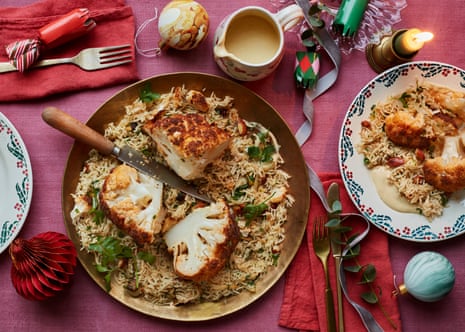
Meera Sodha’s vegan recipe for whole roast cauliflower and nut pilaf

From theguardian.com 

A vegan Christmas dinner recipe has to perform on many levels. It has to have some showmanship about it, so that it feels special enough to bring to the table. It has to stand alone, yet also sit alongside a traditional turkey dinner and all the trimmings, because that is, I think, how a lot of people still eat at Christmas. And, crucially, it shouldn’t overwhelm the cook, who will already be very busy. I hope this week’s recipe will deliver on all of these things, to ensure you have a joyful day both in the kitchen and at the table.

Whole roast cauliflower and nut pilaf

You could make the sauce and rice ahead, and warm up the rice just before serving, either in a microwave or by adding a few teaspoons of water to the rice pan, covering and gently reheating, before stirring through the herbs and serving. The cauliflower, however, is best fresh out of the oven, but if it has to come out early, it can sit for a while; give it a quick blast in the oven later, until crisp and hot.

Prep 15 min
Cook 1 hr 20 min
Serves 4

For the cauliflower
2 tsp ground cumin
½ tsp kashmiri chilli powder
½ tsp fine sea salt
2 tbsp 
rapeseed oil
1 large cauliflower
 (or 2 small ones), leaves removed (800g net)

For the pilaf
300g basmati rice
4 tbsp rapeseed oil
2 onions
, peeled and sliced
1 tsp fine sea salt
1 tsp ground cumin
1 tsp ground coriander
¼ tsp ground black pepper

50g shelled unsalted pistachios
50g whole almonds
, roughly chopped in half
20g fresh coriander, finely chopped
20g fresh parsley, finely chopped

For the tahini sauce
85g tahini
3 tbsp 
rapeseed oil
1 lemon
, juiced to get 2 tbsp
½ small garlic clove, peeled and grated
⅓ tsp fine sea salt

Heat the oven to 200C (180C fan)/390F/gas 6. In a small bowl, mix the cumin, chilli powder, half a teaspoon of salt and two tablespoons of oil until you have a smooth paste.

Cut the base of the core off the cauliflower, so it stands flat. Rub the whole cauliflower all over with the spice paste, then put it in a high-sided or lipped baking tray. Pour 100ml warm water around the cauliflower, roast for an hour, until golden on top and tender inside (check by prodding with a skewer or cake tester), then remove and set aside.

While the cauliflower is roasting, wash the rice really well in a sieve, until the water runs clear, then put in a bowl, pour over warm water to cover and leave to soak until needed.

Put four tablespoons of oil in a large saucepan with a tight-fitting lid, turn on the heat to medium, then sauté the onions with a teaspoon of salt, stirring occasionally, for 12 minutes, until soft and dark.

Add the spices, cook for a minute, then add the nuts and stir to coat. Drain the rice well, then add to the onions, give everything one more stir to distribute the nuts and onions through the rice, then add 450ml just-boiled water and clap on the lid. Bring to a boil, cook for a couple of minutes, then turn down to the lowest heat and cook for 12 minutes. Take off the heat and leave to steam and settle for 10 minutes – do not lift the lid.

While the rice settles, make the tahini sauce. Put everything in a jam jar or similar, add four tablespoons of cold water, then shake like a person possessed until you have an emulsified sauce: it should be like double cream and pourable; if it is too thick, add a smidge more water; too thin, more tahini paste. Check the seasoning and adjust the salt and lemon juice as necessary.

To serve, stir the chopped herbs through the rice, then tip out on to your best platter and top with the cauliflower head. Pour the tahini sauce into a pretty jug. Stick a sharp knife in the cauliflower and encourage guests to help themselves to rice, a wedge of cauliflower and a healthy pouring of tahini sauce.

Meera Sodha’s whole roast cauliflower and nut pilaf.Brings showmanship to the Christmas table: Meera Sodha’s whole roast cauliflower and nut pilaf. Photograph: Laura Edwards/The Guardian. Food and prop styling: Kitty Coles. Food assistant: El Kemp.

Fiona Beckett’s drinks match

Under £10
Little Pomona Table Cider £9.50 littlepomona.com, or 3 for £27 finecider.com, 7%. Cider is such an underrated pairing for food, and this one would be great with this pilau.

Over £10
Château de Berne ‘Inspiration’ RosĂ© 2021 £16.99 (or £14.99 on “mix six”) Majestic, 13%. Classic, pale, smooth Provence rosĂ© that would go well with gently spiced food such as this dish. Also available in magnum, which would be fun.

https://www.theguardian.com/food/2022/dec/03/meera-sodha-vegan-recipe-whole-roast-cauliflower-nut-pilaf

This festive vegan focaccia is surprisingly simple and a beautiful addition to your Christmas menu

From hulldailymail.co.uk

Intricately decorated focaccias are popular at parties, special celebrations and during the festive season, especially as an excellent partner to a Christmas cheeseboard

Baking bread is not just a life-skill but also an art form that delights and soothes. I always feel at peace when making bread, because I find the creation process therapeutic.

One of the easiest breads to make is the humble focaccia. The spongy, dimpled base may appear to be glamorous, and it is, but it is also very simple to make.

How do you take a perfectly gorgeous bread like focaccia and make it even more beautiful? I wasn't sure if this was possible, but when I discovered focaccia art, I knew I had to try it.

Focaccia art is simply bread embellished with edible decorations in the form of herbs and vegetables. The great thing about focaccia art, just like any art really, is that you can get creative and there's no wrong way to do it.

It doesn't matter whether you possess Monet or matchstick men level art skills. The focaccia base is your blank canvas and you can get as flamboyant as you like.

I used my regular focaccia recipe and went to town with the toppings. Try to add a few colourful ingredients that will make the colours on the bread pop.

Recipe for festive focaccia

Ingredients

500g strong bread flour

1 sachet instant yeast (7g)

1 tspn salt

8 tbsp olive oil (more to grease tin and drizzle over baked bread)

Toppings I used were PadrĂłn peppers, mini peppers, red and yellow cherry tomatoes, chives and sage leaves, but you can use scattered rosemary sprigs if you want to keep it classic.

Method

1. Add flour, yeast and salt to a free-standing mixer bowl fitted with a dough hook attachment.

2. Start the mixer, add 5 tbsp oil and gradually pour in 375ml tepid water.

3. Knead in the mixer for around 5 minutes till dough is soft and pliable.

4. Place in a lightly oiled bowl, cover and prove until doubled in size, which should take around 1 hour.

5. Place dough into a greased tin, stretch out to make a rough rectangle shape, and cover for a final proofing session for around 45 minutes.

6. Whilst the dough is getting its final rest, prep your toppings. I used tomato peel for flowers, chives for branches and sage for foliage.

7. Create a dimple effect by pressing your fingers around the dough (this is my favourite part, which is why I've included me poking bread in the video too!. Press toppings into the dough and sprinkle over salt. Using a pastry brush, gently cover the vegetables with the remaining olive oil, which will protect them from burning.

8. Bake at 200°C for 15-20 minutes when the dough is spongy to the touch. Slice in generous squares and serve warm as part of a grazing board.

https://www.hulldailymail.co.uk/whats-on/food-drink/festive-vegan-focaccia-surprisingly-simple-7864142

Saturday, December 3, 2022

Veganism is on the rise in Japan

From veganfoodandliving.com

As veganism gains momentum around the globe, Japan is set to be the next country to experience a boom in plant-based eating

Veganism is on the rise in Japan as alternative foods are becoming increasingly available, according to an article published by the Japan Times.

The piece noted that a growing number of eateries are provided animal-free alternatives to many traditional dishes.

There are a number of reasons for the growing availability of vegan options across Japan, including Tokyo being selected to host the 2020 Summer Olympics.

With the selection announcement being made in 2013, vegan meals started to emerge in ‘anticipation of visitors from abroad with various dietary practices’, the piece states.

Now, according to the Japan Vegan Society, ‘there isn’t a food that can’t be reproduced’.

Model and actress Mayumi Muroya, who heads the Society, says an enormous number of the country’s restaurants offer plant-based menus, saying she has visited some 3,500 such eateries.

She told the outlet: “Vegan meals are good for your health and the environment. I recommend people have fun and try them.”

Vegan alternatives in Japan

The article comes as market research reports predict significant growth in the meat alternative market in the country.

According to GlobalData, meat substitutes are set to ‘go mainstream in Japan’, with sales predicted to rise by five per cent compound annual growth rate between 2021 and 2026.

The report says that the high consumption of seafood in the country was previously a barrier to the growth of the meat alternative sector. However, it notes, the ‘onset of COVID-19 has turned the tide, with more health-conscious and experimental youth making vegan meat a part of their diets’.

                                                Johnny Greig via Getty Images

Vegan meat

Bobby Verghese, Consumer Analyst at GlobalData, said: “The availability of meatless meat options in retail stores during the COVID-19 pandemic accelerated consumer awareness and first-time purchases.

“The long shelf-life of meat substitutes attracted Japanese shoppers as they stocked their pantries to avoid frequent trips to grocery stores. The market gained momentum as more brands entered the fray and rolled out diverse product types, customized for Japanese palates.

“As the COVID-19 regulations were eased, and food service venues reopened in 2021, leading operators cashed in on the vegan trend, launching animal-free meat dishes, thereby popularizing meat substitutes.”

Whip up your own meat substitutes with our 21 vegan seitan recipes

https://www.veganfoodandliving.com/news/veganism-on-rise-japan/

Friday, December 2, 2022

Here's What Happens When 25,000 Women Go Vegan Together

From finance.yahoo.com

WASHINGTON, Nov. 30, 2022 /PRNewswire/ -- Award-winning public health nutritionist, 35-year vegan activist, and best-selling author Tracye McQuirter, MPH, recently held another free 21-Day Vegan Fresh Start program from September 18 - October 9, 2022 and the results were extraordinary.

This marks the fourth free 21-Day Vegan Fresh Start program as part of McQuirter's 10 Million Black Vegan Women Movement, a revolutionary public health intervention that is changing the health paradigm of Black women now and for generations to come.

The 21-Day Vegan Fresh Start continues to attract a sizable cohort of women, with 3,705 enrolling. Participants who responded to the post-program survey obtained remarkable health benefits from the 21-Day Vegan Fresh Start:

  • An astounding 77% of the respondents ate 80-100% of their meals completely vegan, tying the 2020 10K Vegan Fresh Start program for an all-time high.

  • The high intake of nutritious, plant-based foods contributed to weight loss for 72% of respondents, ranging from 1.2 to 15 pounds and improved general health for 71%.

  • Remarkably, 14% of respondents addressed specific health conditions as a result of program participation.

  • Other notable gains attributed to the program include: lowered blood pressure and cholesterol for 43% and 39% of the respondents, respectively.

  • A significant number of respondents (54%) reported having more energy, increased mental clarity (43%) and strengthened immunity (20%).

"I couldn't be happier with the results we saw after this program," said Tracye McQuirter, MPH. "We are truly changing the way Black women look at nutrition and health proving we really are what we eat. I encourage Black women looking to change their lives to check out 10MillionBlackVeganWomen.org/freshstart and join our incredible community."

Data shows the 21-Day Vegan Fresh Start effectively promotes, educates and prepares women to live a healthy vegan lifestyle. Amazingly, 64% of the respondents ate more vegetables, 60% enjoyed cooking more, 59% gained confidence in going vegan and an impressive number (43%) learned how to prepare meals. And it doesn't stop there, as a smaller, yet growing number of respondents (17%) experienced a greater commitment to the environment and 10% sensed a greater compassion for animals.

McQuirter's free 21-Day Vegan Fresh Start programs have helped thousands of Black women experience life-changing health benefits, including weight loss, lower blood pressure and cholesterol levels, improved mood and cognitive function, and more.

About Tracye McQuirter, MPH:

Tracye McQuirter is a transformative leader in the field of plant-based nutrition and Black women's health, and has been helping people go vegan for more than 30 years. McQuirter created 10 MIllion Black Vegan Women to change the paradigm of Black women's health. She is the author of Ageless Vegan and By Any Greens Necessary and created the first free African American Vegan Starter Guide. The New York Times cited her work as a key factor driving the rise in veganism among African Americans. McQuirter was also an advisor for the Black Women's Health Imperative and Spelman College, and an adjunct professor at the University of the District of Columbia Center for Nutrition, Diet, and Health. McQuirter has a Master's degree in Public Health Nutrition from New York University and a Bachelor's degree in Black Studies from Amherst College.

For more information, please visit: 10millionblackveganwomen.org/freshstart/.

https://finance.yahoo.com/news/heres-happens-25-000-women-144400336.html 

Thursday, December 1, 2022

NestlĂ© launches vegan ‘voie gras’ in European supermarkets

From veganfoodandliving.com

Voie gras, which is made entirely from plant-based ingredients, is launching for the first time in Spain and Switzerland, and is set to hit 100 Spanish Carrefour group stores

NestlĂ© is launching a vegan alternative to foie gras under its plant-based Garden Gourmet brand.

Its Voie Gras, which will launch in Switzerland before hitting the shelves of 100 Carrefour Group stores across Spain in coming weeks, is made entirely from plant-based ingredients.

According to Nestlé, this means it is the first product of its kind to reach large retailers.

Among the ingredients of Voie Gras as vegetable fats, soy protein, miso, yeast, toasted sesame, and mushroom powder as well as white truffle aroma oil. The product was created at the company’s R&D centre in Germany, after six-month of work by a team of scientists, food technologists and chefs.

Voie Gras

Ignacio RosĂ©s, Culinary Director of NestlĂ© Spain, said in a statement: “At Garden Gourmet we want to continue leading the flexitarian lifestyle. Spain is the second country with the highest consumption of foie gras worldwide.

“In recent years, however, its consumption has decreased due to greater concern for animal welfare, among other reasons.

“In this context, we have worked to be able to offer an alternative that is vegan and that will revolutionise the Spanish table this Christmas, the time of greatest consumption.”


Describing the creation process of the Voie Gras, he added: “We wanted to obtain the best sensory experience and we believe that we have achieved it.

“Voie Gras offers an incredible melting experience in the mouth and, thanks to the balance and combination of its ingredients, it has a flavour, appearance and texture so similar to foie that it offers the flexitarian consumer the same possibilities in the kitchen as the traditional product.”

Foie Gras controversy

Due to the cruelty involved, foie gras production is banned in the UK. However, as it is legal to import and sell it, numerous animal advocates are campaigning to have the product banned entirely.

Vegan charity PETA has a petition urging politicians to prohibit its importation and sale.

According to the organisation: “The production of foie gras is so horrendous that it’s illegal in the UK – yet our borders remain open to imports.

“This can be rectified with a sales and imports ban, which the overwhelming majority of Brits – 79 per cent – want to see.”

Not able to pick up a can of Voie Gras? Make this delicious vegan foie gras recipe at home instead

https://www.veganfoodandliving.com/news/nestle-launches-vegan-voie-gras/