From vegconomist.com
Liz Wheeler is Philanthropy Manager at Faunalytics, a non-profit research organization founded in 2000 and based in Olympia, Washington, that gives animal advocates and businesses free access to research. She started out in shelter medicine and veterinary practice, studied animal welfare and anthrozoology, and in 2022 founded Secondhand Stories Chicken Sanctuary.
In this interview, Wheeler explains how a Faunalytics study helped Canadian non-profit Tailored Food raise more than $270,000 for a new coalition, and why industry-funded nutrition research matters to plant-based companies. She also covers the organization’s 2027 research agenda and its Giving Season match of up to $50,000.

You describe capacity building as an important but often overlooked gap in animal advocacy. What does that gap look like in practice, and what happens when organizations work without good data?
Americans gave $617.2 billion to charity in 2025. The Stray Dog Institute estimates that just $259.6 million funds the entire farmed animal protection movement. Our constraint has never been determination. It’s capacity.
It can feel like David versus Goliath. Companies that harm animals spend millions on research to shape public opinion, while many advocacy organizations can’t afford even one staff member, let alone a research project. Without good data, strategies and tactics can miss the mark, and with resources this limited, we can’t afford to guess. We risk wasting time, energy, and potential impact. It’s why Faunalytics exists.
We give advocates and organizations sound, actionable research for free, so they can use evidence to change behaviour, corporate practice, and policy.
Could you share one or two examples from 2026 where your research changed how an organization worked?
This year, we’ve been conducting case studies to see how our research shapes the way organizations work. One of my favourites involves Tailored Food, a Canadian non-profit working on nutrition and food systems in over 40 countries. They long suspected that plant-based alternatives were losing out not because funders opposed them, but because no one was making the case in the rooms where decisions were made. Our study, Globalizing The Factory Farm, confirmed it. Global funders decide based on nutrition and food security, and they back people they already know and trust.
This evidence did two things at once. It gave Tailored Food the blueprint for the Affordable Nutrition Coalition, launched in August 2026 to redirect food systems funding toward plant-based and alternative protein solutions. It also gave them the credibility to fund it. Using our findings as the foundation of their pitch, they raised over $270,000 and hired a team of lobbyists, an advisor, and a coordinator.
They told us they don’t believe the Coalition would have gotten off the ground without independent research behind it. Hearing that is exactly why we do this work. Research matters most when it changes what happens next.
Why should the wider plant-based and alt-protein sector care about independent research infrastructure, not only advocacy groups?
Much of the research that shapes how people think about food is proprietary, funded by groups with a stake in the answer, or simply incomplete. A 2026 review of 500 nutrition studies found that studies with meat industry ties were 16 times more likely to reach favourable conclusions about meat than independent ones. Troublingly, 48% of industry-funded studies didn’t disclose the conflict of interest at all.
An earlier review of egg research found the same pattern: industry-funded studies were far more likely to report neutral or favourable conclusions about egg consumption. Even public data has gaps. When we analysed USDA slaughter data, we found state-level reporting missing in exactly the places where the effects of new welfare laws would be most visible.
Meanwhile, animal agriculture spends 190 times more on lobbying in the U.S. than plant-based and cultivated alternatives. Independent research evens the odds. It gives companies, investors, and policymakers evidence anyone can scrutinize. And because our research is free and open, a small start-up can work from the same evidence as a multinational.
Which studies are you planning for 2027, and why were they chosen?
Our 2027 research agenda reflects our most rigorous prioritization process yet. Our Community and Research Coordinator ran seven focus groups with advocates across our priority regions and topics. From a starting pool of 233 ideas, a six-stage vetting process narrowed the field to five new studies for the first half of the year. We’ll reassess a second set of six studies mid-year to stay responsive to advocates’ evolving needs in a fast-moving landscape.
Combined with three in-progress studies, we’ll publish international insights that help the movement work smarter outside the U.S., and messaging experiments that show which messages actually move people. One new study tracks what roughly 300,000 U.S. federal job cuts have meant for inspections, enforcement, and oversight of farmed animals and animals used in science. Another identifies which traits predict pro-animal champions in Congress, so advocates know where to focus. Abroad, we’re surveying 1,000 consumers in Beijing, Shanghai, and Shenzhen on farmed fish welfare, labelling, and willingness to pay, since China produces more than half the world’s farmed aquatic animals.
We’re also partnering with SVB on a national attitudes survey in Brazil, identifying which policy campaigns have worked in India, and working with Good Growth on a playbook for expanding advocacy into new countries. Finally, we’re testing what actually persuades people. We’ll find which pro-animal messages hold up best against common opposition attacks, and we’ll test whether Gen Z responds more to animal-focused messages or to frames like climate, health, and social justice.
Which of your 2026 findings matter most for companies and policymakers in the plant-based space?
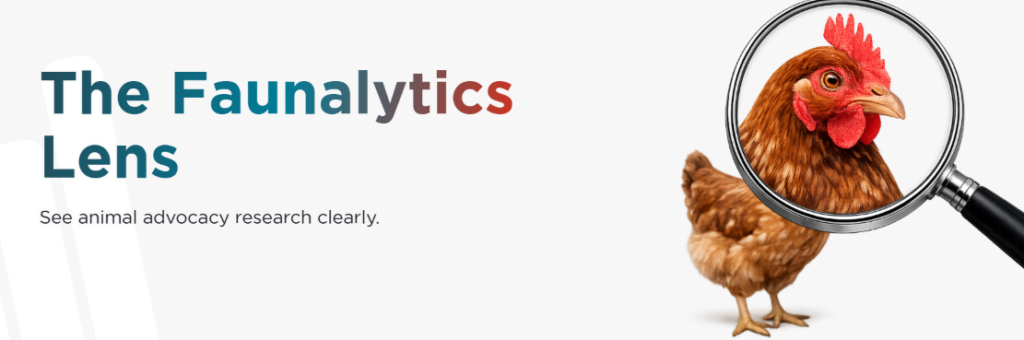
That’s a great question, and it depends on your goals. Faunalytics has published several original studies and hundreds of study summaries that offer valuable insights for companies and policymakers in the plant-based space. Questions like this are also a great prompt for Faunalytics’ new AI tool, The Lens, which can discuss any animal advocacy topic and provide data-driven insights tailored to your needs. Every response includes citations and highlights research gaps where more data is needed.
For example, when I asked The Lens what data could help an alt-protein company decide what to develop next, it recommended our Animal Product Impact Scales. APIS estimates animal lives and days of suffering per serving, per kilogram, and at the national level. It matters for procurement too. Food policies focused only on climate can make swapping beef for chicken or fish look like progress, but smaller animals mean far more lives affected per kilogram. Several U.S. cities have already used APIS to shape their plant-based procurement policies. I hope companies and policymakers will give the Lens a try, especially since it flags gaps in the research, which is something we’re always keeping our eyes on.
What do your direct support services include, and who uses them most?
One of my favourite parts about working with Faunalytics is how excited our team gets about research. We’re nerds, and proudly so. If you have a research question, we want to hear it, and we want to help. It’s what our free Office Hours are for. Advocates and organizations get one-on-one time with our researchers, at no cost. Need the right stat for a pitch, help designing a survey, or a second pair of eyes on your results? We’ve got you. The people who reach out are a pretty great mix: campaign groups, sanctuaries, research fellows, even legal experts. More and more, they’re coming from all over the world, from India to Taiwan to Belgium.
Is there demand you can’t currently meet? What would more funding allow you to do?
Absolutely. Of the 35 strongest research ideas on our shortlist, current resources let us take on only about a dozen. The rest are questions advocates told us they need answered, and right now they wait. The same is true beyond research. Advocates keep asking for more hands-on support, so we’re planning new services that help organizations build data into their campaigns from the start.
More funding would let us hire additional researchers and analysts to take on more of that shortlist. It would also help us rebuild our website around The Lens, so evidence is easier for both people and AI tools to find and cite. And it would let us explore ideas like a shared home for the movement’s best datasets.
And this is where readers can help. This Giving Season, every gift to Faunalytics will be matched, up to $50,000, so every dollar goes twice as far for animals.
Looking ahead to 2027, what is the one thing you most want to achieve?
Getting the movement’s research organizations working together. When we spoke with 16 researchers from 13 animal protection organizations, every one agreed the movement needs better coordination. Right now, studies get duplicated while important questions go unanswered because no one can see the full picture.
In 2027, we’ll host a convening of movement research organizations to change that. The goal is simple: stronger communication, fewer duplicated efforts, and a shared view of which high-impact questions remain open and who is best placed to answer them. For a movement this short on resources, making every research dollar count is one of the biggest wins we can deliver.

No comments:
Post a Comment