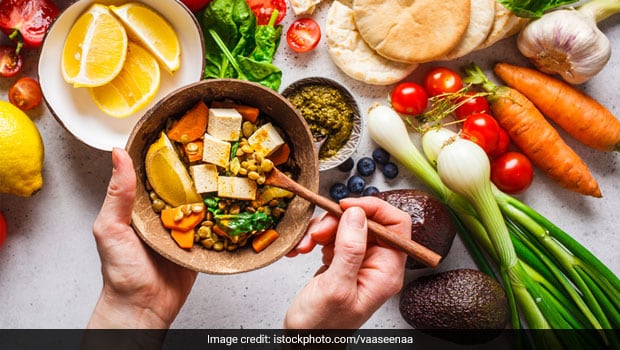
A vegan diet includes the consumption of plant-based foods. Here are some vegan-friendly foods that are loaded with omega-3 fatty acids you can add to your diet
A vegan diet focuses on the consumption of plant-based products. Following a vegan diet can offer you multiple health benefits. It can help in weight loss, lower your blood sugar levels, reduce the risk of heart disease and much more. When following a vegan diet, it is essential to find the right replacement of foods that can help you achieve all the essential nutrients in the right quantity. Similarly, omega-3 fatty acids are usually found in animal-based foods. But it is extremely crucial to add an adequate amount of omega-3 fatty acids to your diet. Here are some sources of omega-3 you can add to your vegan diet.
Following a vegan diet can help you maintain a healthy weight
Soumita Biswas who is a Chief Nutritionist at Aster RV Hospital says "While the vegan diet has been declared to be safe, there is a health risk if people do not find the right replacements for certain nutrients which they were otherwise obtaining from animal-based sources or dairy. Specific supplements can also be taken post consultation with a nutritionist. As long as the individual eats a balanced diet where they are getting all the required nutrients, it is safe."
How to increase your omega-3 intake when following a vegan diet
Importance of omega-3 fatty acids
Omega-3 fatty acids are beneficial to your mental health in several ways. According to studies, it can help you reduce the symptoms of depression and anxiety. These healthy fats also play a role in improving eye health. One of the popular health benefits of omega-3 fatty acids includes better heart function. Adding optimum levels of omega-3 fatty acids is linked with a reduced risk of heart disease as it helps in controlling risk factors such as high blood pressure, bad cholesterol levels, inflammation and others.
Vegan sources of omega-3 fatty acids
You can start by adding food sources of omega-3 fatty acids in optimum quantities. Some of the best food sources include- chia seeds, Brussels sprouts, walnuts, hemp seeds, flaxseeds, soybean oil and kidney beans.
Daily requirement of omega-3 fatty acids
An adult male requires 1.6 grams of omega-3 daily while a female requires 1.1 grams daily.
You should take supplements of omega-3 fatty acids only when prescribed by an expert.
(Soumita Biswas is a Chief Nutritionist at Aster RV Hospital)
Disclaimer: This content including advice provides generic information only. It is in no way a substitute for qualified medical opinion. Always consult a specialist or your own doctor for more information. NDTV does not claim responsibility for this information.
American Vice President Kamala Harris, who is ‘dabbling in veganism’, sampled vegan tacos at vegan Las Vegas restaurant Tacotarian following a recommendation from Senator Cory Booker.
VP Kamala Harris is reportedly ‘dabbling in veganism’ and recently visited a vegan taco restaurant to sample their food.
The politician dropped into Las Vegas vegan restaurant Tacotarian along with Second Gentleman of the US Doug Emhoff.
According to reports, the Vice President made an unscheduled stop at the restaurant as she was in town as part of a cross-country tour to raise awareness about the $1.9 trillion American Rescue Plan.
Since Las Vegas is one of the hardest-hit cities from the pandemic, the city was the first stop on the politician’s “Hope is Here” tour.
At the restaurant, Harris ordered two mushroom asada tacos, two super tacos, and two carne asada tacos. The staff completed the meal by throwing in some ‘desserts for free’.
Harris came to the restaurant after learning about the place from her friend and colleague Senator Cory Booker (D-NJ) – a Tacotarian regular.
Tacotarian
Taking to Instagram, Tacotarian wrote: “We were just sitting there and someone came up and said ‘hey I’m from the Whitehouse and the Vice President is on her way here’.
“Thank you so much for stopping in today and for being so kind in talking with us, our staff, and our customers.”
Tacotarian co-owner Kristen Corral revealed that the VP was kind and genuinely interested in chatting with everyone.
Corral added that Harris informed the ones present that she is ‘dabbling with veganism and only eating meat after 6 pm’.
Thanking Senator Cory Booker for supporting their taco eatery and giving the VP the recommendation, Tacotarian further said: “We’ve been so lucky in our journey thus far and we can’t wait to see what our future holds.
Kamala Harris’ stance on meat
While Harris is trying to follow a more plant-focused diet, she has already faced pressure to promote plant-based diets in order to tackle food insecurity, chronic diseases, racial and gender-oriented structural inequality, and climate crisis.
At a CNN town hall back in 2019, Harris, who has been encouraging Americans to reduce their consumption of meat, was asked whether she would support adjusting the dietary guidelines to reduce the amount of red meat.
Harris replied: “I love cheeseburgers from time to time, I just do. But [we must also consider] what we do in terms of creating incentives that we will eat in a healthy way, that we will encourage moderation, and that we will be educated about the effect of our eating habits on our environment.
“We have to do a much better job with that and the government has to do a much better job with that.”
Judging by the headlines, you may believe that veganism is all about soya burgers and meat free chicken nuggets, however, Kirsty’s, one of the nation’s favourite free-from brands, have found that classic meals minus the meat also have their part to play in the rise of veganism.
The meteoric rise of meat free products continues to show no sign of stopping in 2021, and like many food manufacturers Kirsty’s have seen some enormous growth figures for their vegan meals in particular.
Kirsty Henshaw, founder of Kirsty’s comments: “The popularity of vegan products is ever growing, especially over the last year and this is evident in the dramatic rise in sales of our Lentil Cottage Pie where sales are up 2000% YOY.”
However, this is only part of the story, more surprisingly Kirsty’s vegan meals are outperforming their non-vegan equivalents by 15%.
Kirsty continues: “Our Cottage Pie has been our best-selling meal for nearly 10 years, it really is a household staple that our customers love, however this January our Lentil Cottage Pie has been outselling it’s classic counterpart by 15% as it seems people are looking to reduce their meat consumption in easy ways.”
Kirsty Henshaw, founder and managing director of Kirsty's
Kirsty Henshaw, who started the brand Kirsty’s after finding out her son was allergic to nuts and intolerant to gluten and dairy, believes that the sales of vegan products and free-from products will continue to rise throughout 2021.
Kirsty said: “Although I personally eat a pescatarian diet, we aren’t solely a vegan brand, instead we believe in offering customers easy ways to reduce their meat consumption, and being that our products are always dairy free, this means we are often ‘accidentally’ vegan.
“Many vegan products seem to be aimed at the under 30’s, but actually we know that the over 50’s are one of the key driving forces in the growth of the flexitarian. The over 50’s don’t want fast-food options they want their favourite meals, just without the meat.”
The rise in popularity of these homely meat free alternative meals led to Kirsty’s recently introducing the vegan friendly Lentil Lasagne to their range, which has already been as popular as Kirsty’s classic free-from Rich Beef Lasagne.
During this year customers can expect to see several other new products developed by Kirsty’s on the shelves and these new introductions will include vegan meals. This was made possible after Kirsty’s recently invested £2M in a new factory that will help the brand focus on new product development and achieve their target of doubling the size of the business within three years.
When my vegan mum told me she won’t be taking the coronavirus vaccine because it was tested on animals, I was understandably shocked.
Besides health fears and government conspiracies, I hadn’t realised that the fact it was trialled on animals would be enough to convince some not to have the jab. She argued that without enough of us standing up against animal exploitation, testing will sadly continue. It’s upsetting to hear my mum say that she won’t be taking the vaccine because coronavirus has already taken over 100,000 lives in the UK and I would never want my mum to become part of those figures by choosing not to have the shot.
As a vegan myself, I completely understand her point but I’ve decided that I will get immunised. Although I am statistically less at risk of becoming seriously ill from coronavirus, having the dose will help prevent me from endangering those who are. Plus, as a university student, my life has been completely turned upside down by national restrictions: the vaccine offers a way out.
When I first became a vegan, it wasn’t easy giving up milk chocolate and halloumi fries, however, the minor inconveniences of not having dairy and meat products were overcome by the benefits of adopting a plant-based lifestyle.
Not only does it decrease your risk of developing illnesses such as heart disease and diabetes, but it is also the single biggest way to reduce your environmental impact. When the first successful trials for a coronavirus jab were announced in November last year, I didn’t question whether the vaccine had been tested on animals. Sadly, I automatically knew that to be the case.
Despite the fact it went against my beliefs to not contribute to animal suffering, I was immediately confident in my decision to have the jab because it was the safest and most promising path back to normality.
Although there’s been extensive developments in recent years in vegan-friendly products and an additional 40% increase of Brits adopting plant-based diets in the past 12 months according to Finder UK, modern medicine is yet to catch up.
Animal testing is still one of the first points of call in biomedical research and in such a global crisis as the coronavirus pandemic, I knew the moral conundrum of animal testing was probably the last thing on scientists’ minds.
Even though I have a firm objection to animal experimentation, I have always been resolute in my decision to have the jab. I recognise that, to end the pandemic that has blighted our lives for the past year, a nationwide taking of the vaccine is vital.
However, this doesn’t mean it was a decision I made lightly. Animal testing has always been a controversial subject. The UK has strict laws that require potential new medicines to be tested on animals before they can be safely trialled on human volunteers. Regulations – such as those enforced by the Animals (Scientific Procedures) Act 1986 – are also in place to promote more humane testing on animals, including specific training for researchers and safeguarding protected animals.
But what does humane actually mean? In 2019, over 3.4million mice, dogs, monkeys, and other animals were experimented on, according to the latest Government figures. That number is likely to be even higher once statistics for the coronavirus vaccine trials have been published.
Specifically, the animal trials for the coronavirus vaccine use mice, monkeys and ferrets – with some of the testing involving keeping the animals in labs and injecting them with the virus to observe the course of the disease. These animals have been bred – and in the case of the mice, genetically engineered – for the purpose of scientific research, and can live their short lives in the confines of a laboratory cage – living in unfamiliar and stressful environments, transported between buildings, and sometimes living in unclean conditions. This is one of the main arguments against animal testing – treating animals as commodities to use and dispose of at our wish, rather than as sentient creatures who have a right to freedom.
So while I may be taking the vaccine, I can empathise with those vegans – like my mum – opting not to.
But in my opinion, while taking the vaccine is rightfully a choice, we must weigh up the potential consequences that not taking the jab may have. Not only will you be at an increased risk of catching and spreading the virus, but the impact that your illness would have on your loved ones is incomparable.
Although vegans believe in causing the least harm possible through their lifestyle choices, unfortunately, no one can lead a completely innocent life.
The decision to not take the jab may also lead to many people becoming seriously ill and dying from the virus. Peta has also stated that refusing to take the vaccine will not prevent any animals from being harmed in medical testing.
To end the pandemic that has blighted our lives for the past year, a nationwide taking of the vaccine is vital (Picture: Cerys Turner)
According to The Vegan Society, over 500,000 people signed up for Veganuary this January, and that number is likely only to increase in the years to come as we become more aware of the impact our diet has on both our health and the environment.
With this, more people will be exposed to the awful reality behind animal testing, and just like how support for the fur trade has dropped due to exposure of its cruel practices, perhaps we will see the tide turn in favour of a more ethical substitute to using animals in medical research too.
We don’t need to look far into the future to envision an alternative to animal testing. Despite the common perception, there are already many options beginning to grow in prominence: computer modelling, trials on human volunteers and in vitro – human cells grown in a state-of-the-art system – are just a few examples.
The government made a commitment in 2010 to reduce the amount of animals used in scientific research – a decision that suggests that they recognise that animal testing is not only inhumane but also capable of substitution. However, over 10 years on, the UK remains one of the highest lab animal users in Europe.
It is sad that so many of us are forced to sacrifice our beliefs to continue this archaic practice. However, we need to see the bigger picture: as a vegan, choosing not to take the vaccine will have a far more significant impact on your loved ones and those around you than it will on the medical community.
If you are a vegan questioning whether or not take the jab, remember – there is no such thing as being a ‘bad vegan’. Your health comes first.
If you have decided to be vegan from now, then there are certain things that you need to keep in mind. So, here are the pointers that will keep you healthy in your vegan diet
Veganism is currently a new trend where you completely consume only plant-based products. It even excludes dairy items. While there are many health benefits in getting vegan, it also has its own adverse effects. As you are completely restricting your intake of meat, eggs and dairy products, you lack many nutrients which are only possible from an animal-based diet. So, are you planning to go vegan? If yes, then here are certain things you should consider before going vegan.
B12 supplement
Vitamin B12 is available in animal’s body naturally. So, if you limit your intake of animal-based foods, then you lack B12 in your body. So, vegans should take Vitamin B12 supplement regularly to get this nutrient for overall well-being. This vitamin keeps your nerve and blood cells healthy.
As you are going to stop having fish, eggs, meat, you are going to lack a huge portion of protein in your body. So, you should include some plant-based foods that are rich in protein so that they can compensate for the portion. Best vegan sources of protein are soy, lentils, beans, quinoa, cottage cheese, etc.
No junk foods
Just because you are limiting animal-based foods, that doesn’t mean you can have lot of bread and pasta as much as you want. They will only increase hunger and your weight making you grumpy.
Limit your intake of soy
Soy is a great substitute for meat, but excessive consumption of this item might have adverse effects on you. So, be conscious about it. The best sources of soy are tofu, tempeh, soy milk and miso. So, include these in your vegan diet.
The entire process will take time
You cannot be fully vegan overnight. This will take a lot of time to be completely vegan and stop having all animal-based products. So, start slowly by having more veggies and less meat in your meals and then gradually proceed.
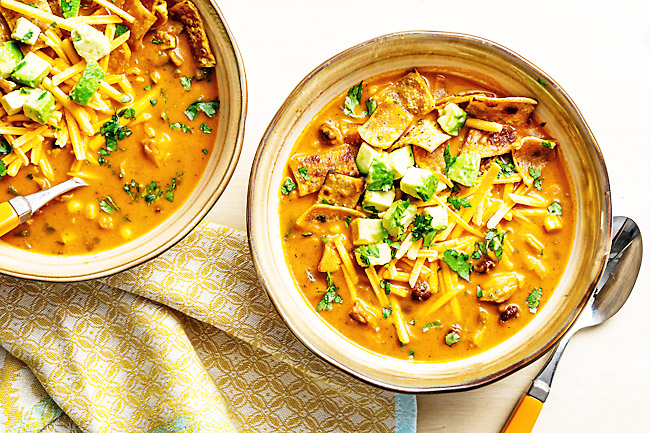
THE WASHINGTON POST – Eddie Garza said his tortilla soup is an easier version of the one his grandmother made when he was growing up in South Texas, with one significant swap: He uses mushrooms instead of chicken.
But if you know (and therefore love) tortilla soup, you know that the chicken is really not the star, anyhow. The way I see it, there are two stars – the broth and the toppings you stir into it. The most important of the latter is the tortillas (so important the soup is named for them), which add body and heft the way, say, noodles or rice would. They go on crunchy, and that keeps them from losing their texture and falling apart when you stir them in.
The broth, meanwhile, is the backbone, and it should be deeply flavoured and a little smoky.
Garza’s one-pot recipe, from his new book The 30-Day Vegan Meal Plan for Beginners, gets that flavour from a little adobo sauce from canned chipotles that you blend into the base of tomatoes and aromatic vegetables. You brown mushrooms in the same pot with spices, then simmer them in the broth before stirring in some corn, cilantro and lime juice shortly before serving. The recipe is such a breeze to put together, it surprised me that it resulted in such complex flavours. I made one addition – a can’s worth of black beans for protein.
Given that I’ve been trying to help my husband watch his sodium intake lately, I also followed one of Garza’s suggested alternatives, to pan-fry corn tortillas instead of using store-bought chips. It adds only 10 minutes to an already-quick recipe – and its makes the soup not only delicious but something I’ll make again and again.
Mushroom and black bean tortilla Soup. PHOTO: THE WASHINGTON POST
MUSHROOM AND BLACK BEAN TORTILLA SOUP
Active time: 25 minutes | Total time: 45 minutes
Four servings
Eddie Garza’s veganised version of the tortilla soup his Mexican grandmother made uses silky oyster mushrooms, which bring rich umami. We added black beans for more protein.
Storage Notes: The soup, without toppings, can be refrigerated for up to one week or frozen for up to six months. Reheat (after defrosting, if needed) on the stovetop before adding toppings immediately before serving.
INGREDIENTS
3 tablespoons vegetable oil, divided, plus more as needed
4 (6-inch) corn tortillas, cut into 1-inch strips
1/2 small yellow onion (3 ounces), chopped
1 medium carrot (3 ounces), scrubbed and chopped
1 celery rib (2 ounces), chopped
2 garlic cloves, chopped
One (15-ounce) can no-salt-added diced tomatoes, with juices
2 tablespoons adobo sauce (from canned chipotles in adobo)
8 ounces fresh oyster mushrooms (may substitute maitake, shiitakes or buttons), trimmed and cut or torn into bite-size pieces
1 teaspoon ground cumin
1 teaspoon dried oregano, preferably Mexican
1 teaspoon ground black pepper
1/2 teaspoon fine sea salt, plus more as needed
4 cups homemade or no-salt-added vegetable broth
One (15-ounce) can no-salt-added black beans (1 1/2 cups), drained and rinsed
1 cup frozen corn kernels
1/2 cup plus 2 tablespoons chopped fresh cilantro, divided
2 tablespoons fresh lime juice, plus more as needed
1/2 cup shredded vegan cheese of your choice, such as Violife
1 Hass avocado, halved, pitted and cut into wedges
DIRECTIONS
In a large soup pot or Dutch oven over medium-high heat, heat one tablespoon of oil until shimmering. Working in batches if needed to avoid overcrowding, add enough corn tortilla strips to fit in one layer without overlapping, and fry until golden and crisp, about two minutes per side. Using a slotted spoon or tongs, transfer the strips to a plate lined with a clean dish towel to absorb extra oil, and repeat with the remaining strips, adding more oil if needed.
In the same pot over medium-high heat, heat another one tablespoon of oil until shimmering. Add the onion, carrot, celery and garlic and saute until soft, five to seven minutes. Transfer to a blender, add the tomatoes with their juices and adobo sauce, and blend until smooth.
In the same pot over medium-high heat, heat the remaining one tablespoon of oil until shimmering. Add the mushrooms and cook, stirring occasionally, until they start to brown, five to seven minutes.
Add the cumin, oregano, pepper and salt. Cook, stirring, until fragrant, 15 seconds. Pour in the tomato mixture from the blender and bring to a boil. Reduce the heat so the liquid is simmering, and cook for about five minutes.
Add the broth, increase the heat to high, and bring to a boil. Reduce the heat so that the liquid is simmering and cook, uncovered, until the flavours have melded, about 15 minutes. Add the beans, corn, half cup of cilantro and the lime juice. Cook until the corn is heated through, about two minutes. Taste, and add more salt and lime juice, if needed.
Divide among serving bowls and top each serving with tortilla strips, cheese, avocado and the remaining cilantro. Serve hot.
A new global survey involving more than 8,500 participants across over 100 countries reveals that animal welfare is the top reason motivating people to go vegan. While nearly 90% of respondents cited animal welfare, more people are now also going vegan due to sustainability reasons, as consumers begin to couple their diet to their environmental impact.
The global survey, conducted by leading plant-based dating app Veggly, explores the top motivators for people to switch to a vegan diet. Of the over 8,500 vegans from across 104 countries were polled in the research through the Veggly mobile app platform, around 9 in 10 (89%) said animal welfare was their “key reason” for cutting all animal products from their diet.
Veggly told Green Queen Media that the most significant demographic trend they found was that women were 5.43% more likely to opt for animal welfare as their primary reason to go vegan compared to men.
Commenting on the finding, Alex Felipelli, founder of Veggly, said: “There are many excellent reasons to go vegan, so we have found it fascinating to see which motivations are the most popular. We are very pleased to see animal welfare is number one as veganism ultimately gives a voice to the voiceless.”
Environmental and climate change reasons came in second, with almost two thirds of vegans (64%) saying that sustainability was their motivating factor. Analysts believe that this figure is likely to continue growing amid the growing focus on the connection between the impact of animal agriculture on the planet, especially in the wake of the coronavirus pandemic.
Sustainability and health reasons driving more people to go vegan as well. (Image Source: Getty)
Health was also rising in popularity as a reason to go vegan, with over half (53%) citing nutrition, immunity and other health factors for why they chose to ditch meat and dairy. The researchers also believe that health will majorly push more people to adopt veganism in the future, given the strong scientific data demonstrating the negative health outcomes associated with meat intake, and conversely, the positive impacts linked to plant-based whole food diets.
“At the same time, we can see both environmental and health reasons are strong factors as well. A vegan diet is clearly the best thing for the planet and your health, so it’s no surprise they are also popular reasons,” said Felipelli.
Other reasons why people went vegan include food conservation and the cost savings associated with a plant-based diet, though these trailed far behind the top three reasons, with just approximately 16% and 6% of respondents citing these factors respectively.
The results are mirrored by a Hong Kong-based poll conducted by Green Queen Media, which found that the top motivator for people to make a shift away from meat and dairy was animal welfare and ethics, with 44% of the flexitarians, vegetarians and vegans surveyed citing it as their primary reason.
Flexitarianism is taking off globally, driving up plant-based sales all over the world in the past year. (Image Source: Asda)
Sustainability-related concerns were the second most important factor, with nearly a quarter (24%) saying they are making dietary changes for the environment, closely followed by health and nutrition (23%).
While veganism is steadily growing in popularity, the city’s plant-based demand seems to be most driven by flexitarianism, which is taking off amongst the mainstream population. Previous survey findings that showed almost a quarter of all Hong Kong residents, though not making the full switch to veganism, are now actively looking to reduce their meat intake ever since the pandemic struck.
In Europe, research has also shown that the strongest growth has been recorded amongst flexitarians, with more than 20% of people in the region self-identifying in the category, while the number of vegans have doubled.