Sunday, September 4, 2022

Is Honey Vegan, And Is It Ethical? The Not-So-Sweet Truth

From plantbasednews.org

Bees are highly social and cooperative insects. They have a unique and complex form of communication based on sight, motion, and scent that even scientists don’t fully understand.

Bees communicate with each other through intricate “dance” movements. And research has shown that they are capable of abstract thinking, as well as distinguishing their family members from other bees in the hive.

But bees are perhaps best known for their honey.

Nature’s sweet sauce comes with unique properties. It appears in everything from cakes to cheese to tea (it was even once used as an ingredient in embalming fluid). Honey is linked to a host of health benefits, as it contains antioxidants that have been proven to help lower blood pressure.

But what exactly is honey? Are bees harmed to make it? And is it vegan?

Since honey comes from an animal, it is not considered vegan. As The Vegan Society states, “honey is made by bees for bees.” Just like cow’s milk and chicken eggs, the natural production of honey is not intended for human consumption. (Scroll to the bottom of the article for some of the best vegan honey alternatives.)

How and why do bees make honey?

A bee collects pollen from a flower
Adobe StockBees collect nectar to make honey

Bees feed on pollen and nectar, but honey is their single source of food during the winter months. Alison Benjamin is the co-author of A World Without Bees and Good Bee: A Celebration Of Bees And How To Save Them. She explains: “When there are no flowers or it’s too cold to get to them, the bees will starve.”

And so, they collect nectar from flowering plants to make honey, which is then stored inside the hive for a rainy day (literally). “Nectar is the carbohydrates that fuel their flight. Pollen provides the protein they feed to their larvae so that they can develop into strong, healthy adult bees,” Benjamin explains.

A honeybee will visit up to 1,500 flowers to collect enough nectar to fill their stomach. When returning to the hive, the bee regurgitates and chews the nectar, turning it from complex to simple sugars.

This process is repeated thousands of times throughout the spring and summer. Yet a single bee produces just a twelfth of a teaspoon of honey in their lifetime – and every ounce is “fundamental” to their hive, according to the The Vegan Society. (Notably, it takes the pollination of two million flowers – and around 55,000 miles of bee flights – to produce a single pound of honey.)

“It is not an individual bee that the honey is feeding but the colony – made up of a queen and about 10,000 worker bees in the winter,” Benjamin explains.

How do bees help the environment?

The weeks and miles of work put in by bees benefits the ecosystem, too.

“When bees visit the flowers for their food, they transport some of the pollen from the male part to the female part of the flower, allowing it to reproduce seeds and fruits which is why they are so important for agriculture and the ecosystem,” Benjamin says.

“They pollinate one in every three mouthfuls we eat, as well as nuts, berries, and seeds for birds and mammals in the food chain, and the trees and other vegetation on the planet that sequesters carbon in the atmosphere.”

A bee collecting pollen from some purple flowers outside
Kosolovskyi Vasyl / Adobe StockBees pollinate around one-third of the world’s food

Indeed, bees pollinate all manners of fruit including apples, cherries, blueberries, and cranberries. Blueberries and cherries are 90 percent dependent on bees, and almonds require 100 percent honeybee pollination at bloom time.

This is a contentious topic in itself; millions of honeybees are transported around the US to pollinate almond trees, according to Scientific American. The same practices are used to pollinate avocados.

Benjamin warns that forcing bees to gather pollen nectar from “vast swaths of a single crop deprives them of the far more diverse and nourishing diet provided by wild habitats.” Transferring the animals also “continually boomerangs honeybees between times of plenty and borderline starvation,” she notes.

A world without bees

It’s not just our food; pollinators play critical roles everywhere we look. “When we look at the benefit of pollinators to our natural world, the numbers are staggering,” maintains the Xerces Society, an environmental non-profit. “Pollinators keep plant communities healthy and productive … A nature walk or stroll through a garden would be a very different experience without pollinators.”

Professor Johanne Brunet, of the University of Wisconsin-Madison, shares a similar view. “Humans depend on plants and plants depend on pollinators,” Brunet says. “A balance must be maintained in order to sustain life on earth and protect human survival and health.”

Why are bee populations declining?

Tractor spraying pesticides over crops on a farm
Adobe StockInsecticides are poisoning millions of pollinating insects, like bees, every year

There are more than 20,000 species of bees and more than 90 million beehives across the world, according to Statista. But bee populations are dwindling.

Out of the 2,000 wild bee species in Europe, one in 10 is facing extinction, The Soil Association states. And globally, an estimated one in six bee species is regionally extinct, whilst more than 40 percent are vulnerable to extinction.

Pesticides are one factor driving this decline; the insecticide neonicotinoid is thought to be the leading cause of falling bee populations. In fact, research shows the chemical can now be found inside honey itself.

Mass bee deaths

Whilst investigating for her book, Benjamin discovered millions of honeybees had died due to pesticides, parasites, and poor nutrition. This is, in part, due to the intensive farming methods adopted by humans. “In the US, large-scale beekeepers regularly report at least a third of their colonies die each year,” Benjamin notes.

“Lack of nutritious food is also a problem because the bees will be transported to one monoculture after another to pollinate – often thousands of miles apart in the US – but it’s not providing them with a healthy diet, so this again will also make them weak.”

Oftentimes, beekeepers replace the honey they remove from a hive with a sugar substitute. This practice prompts honeybees to overwork themselves to replace the missing honey. Meanwhile, the sugar replacement lacks the nutrients, fats, and vitamins in honey that bees need to be healthy.

Is honey production cruel?

PETA UK’s director, Elisa Allen, maintains that the honey industry “abuses bees for profit.”

“They’re subjected to genetic manipulation, their hives are smoked out, and their wings and legs are torn off as they’re pushed out of the way, all so that humans can steal their honey – which is their fuel and their life’s work and rightly belongs to them, not us,” Allen says.

“Many beekeepers use inhumane methods to ensure their own safety and to reach production quotas, including cutting off the queen bee’s wings so that she can’t leave the colony and killing drones to extract semen in order to inseminate the queen.”

Honeybees swarm around a queen bee in a hive
Michal Bednarek / Adobe StockMany bees are mistreated or killed in the honey industry

Royal jelly, also called “bee milk,” is a substance similar to gelatine that is used in cosmetics. It’s harvested from the glands of queen honeybees. Benjamin says this is the “most cruelly produced” product as it can only be produced on an industrial scale by bees “treated purely as royal jelly machines.”

11 vegan substitutes for honey

There are lots of natural honey substitutes out there. You can also purchase vegan honey products online. Read on for 11 swaps for honey that are bee-free but just as sweet as the real thing.

1. Maple syrup

Tapped from maple trees, this sap is a sweet-tooth’s delight. Bake with it, top your pancakes with it, or add it to your favourite marinades for sweet perfection.

There are plenty of options available online, like Kirkland Signature’s Canadian Maple Syrup, or Buckwud’s organic maple syrup.

2. Agave nectar

Agave nectar comes from agave plants, which are succulents native to Mexico. It has a neutral flavour and works like honey in many recipes. The syrup contains less glucose than refined sugars and is the perfect way to sweeten a cup of tea.

The Groovy Food Company produces a wide range of agave nectars, with flavours like BlueberryCinnamonStrawberry, and Vanilla.

3. Rice syrup

A sweet and sticky natural sweetener made from whole grain brown rice, rice syrup is a macrobiotic staple. The flavour may be too strong for tea or atop pancakes, but use it just like you would honey in recipes.

It has a higher glycaemic index than most other sweeteners, and can be purchased online.

4. Barley malt

Like brown rice syrup, barley malt is the concentrated sweetener from whole grain barley. It’s great in baked goods, too.

5. Coconut nectar

A tray of vegan Coconut oil flapjacks
The Coconut CompanyCoconut flapjacks made from coconut nectar

This nectar comes from the sap of coconut trees. Minimally processed, it is widely considered purer than syrups made from coconut sugar. You can find coconut nectar made by The Coconut Company here.

Add it to dried fruit, dates, and oats to make these vegan Coconut Flapjacks.

6. Date syrup

Dates are frequently used in cakes and sweet treats. Additionally, they can be made into syrup by soaking, boiling, and sieving. Biona makes an organic date syrup, or try your hand at making your own using Lazy Cat Kitchen’s recipe.

7. Molasses

A naturally rich source of plant-based iron, molasses is exceptionally sweet. It’s got a strong bite to it, too, making its flavour distinct. Use in your favourite baking recipes, but ideally halve it with another more neutral sweetener like rice syrup or agave nectar.

8. Sorghum syrup

Sorghum syrup is made from the grassy sorghum plant and resembles molasses. It can be used to add sweetness to baked goods.

9. Vegan honea

A hand is holding a jar of Plant Based Artisan Vegan Honea, above a bowl of blueberries
Vegan honea is an alternative which often contain prebiotics, which can help improve gut health

Honea is often made from natural flavourings including apple juice, lemon juice, and molasses. Some vegan honea products – such as those developed by Plant-Based Artisan – are made with prebiotics proven to support gut health. 

10. Fruit syrups

Concentrated fruit syrups can work as honey substitutes in baking recipes. Or, mixed with maple for a sweet topping to your pancakes, waffles, or French toast.

11. Raw sugar

Swapping out liquid honey with raw sugar in baked goods takes a bit of finessing but can be done. You typically just need to up your liquid content.

https://plantbasednews.org/culture/ethics/is-honey-vegan-the-not-so-sweet-truth/ 

Meera Sodha’s vegan recipe for tamarind tofu with noodles, herbs and pickles

From theguardian.com

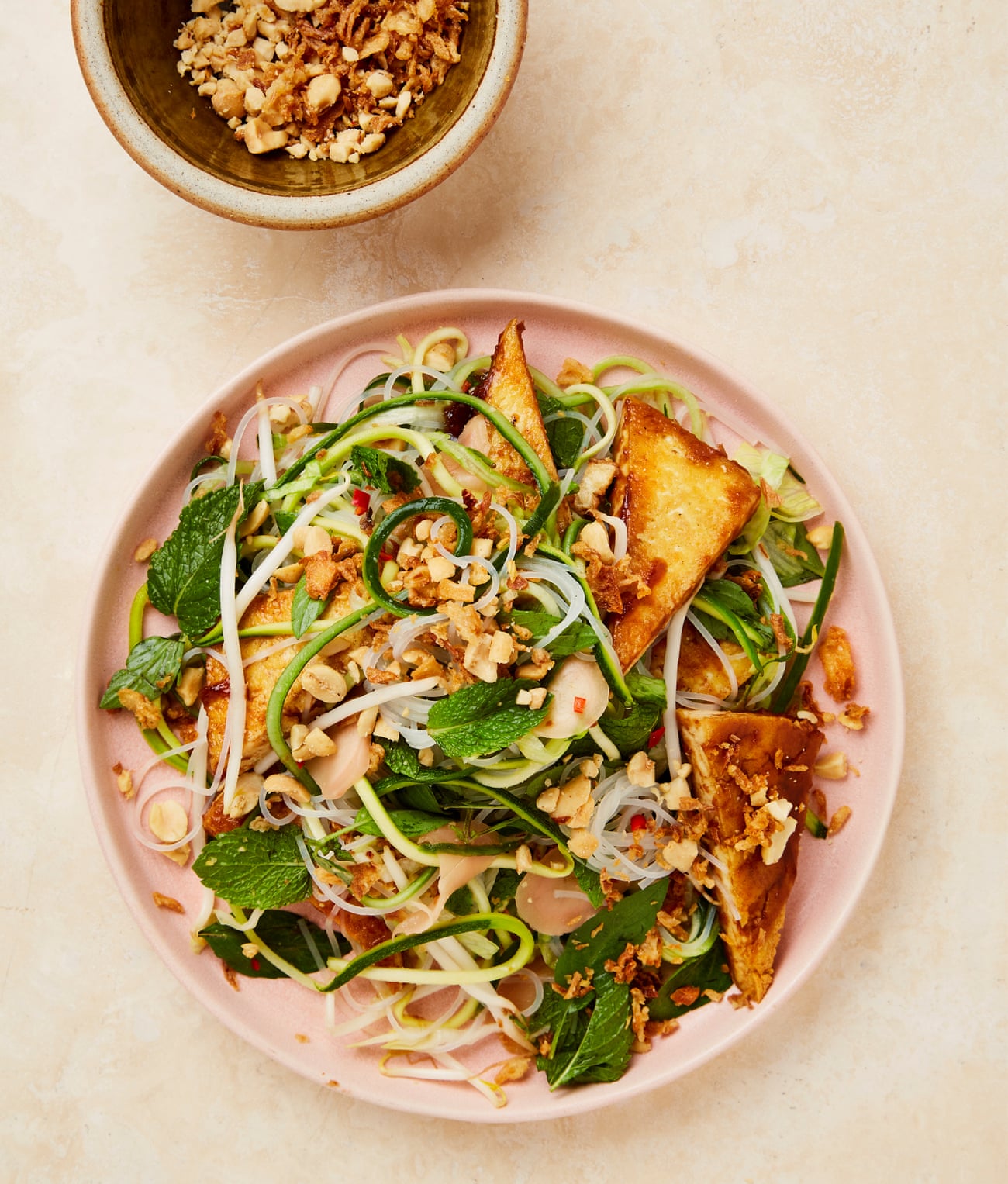
A medley of soft and crunchy summer vegetables, fried tofu and glass noodles in a punchy lime dressing 

I recently came back from Thailand into a steaming-hot British summer, and instantly missed the incredible array of perfect hot-weather salads for which Thailand is famous. I needed to scratch the itch, and what stayed with me most were the hot, salty, sweet and sour dressings and the multitude of textures in a single dish. In today’s recipe, I’ve used lots of soft and crunchy summer vegetables alongside robust glass noodles and a punchy, sweet lime sauce. The tamarind tofu is a bonus – and it works very well, too – but you could easily make this without it.

Tamarind tofu with noodles, herbs and pickles

Don’t be afraid of mung bean glass noodles; they are the most sympathetic of all the noodles for the home cook. Alongside the sushi ginger, they can be found at Chinese and south-east Asian supermarkets and online. Remember that not all vegetarian and vegan fish sauces are equal – Thai Taste makes a very good one – and feel free to sub in whichever greens you have already.

Prep 15 min
Cook 35 min
Serves 4

For the tofu
2 x 280g blocks firm tofu, cut into 1cm slices, and then into triangles
3 tbsp tamarind paste
2 tbsp brown rice syrup
½ tsp fine sea salt
Rapeseed oil

For the salad
150g courgette, cut with a julienne peeler
150g cucumber, cut with a julienne peeler
150g beansprouts
100g iceberg lettuce
, shredded
25g pickled sushi ginger
30g mixed mint and Thai basil leaves
30g fried onions, shop bought or homemade
65g salted peanuts, crushed
100g dried mung bean noodles

For the dressing
1½ tbsp vegan fish sauce
1½ tbsp brown rice syrup
2-3 bird’s eye chillies
, finely chopped
1½ tbsp lime juice
¼ tsp salt

Pat dry the tofu with kitchen paper (so it doesn’t spit when fried) and put a fresh sheet of kitchen paper on a plate near the hob. Make up a glaze in a small bowl by whisking the tamarind, brown rice syrup and salt with two tablespoons of water, then put to one side.

Heat a layer of oil in a non-stick frying pan and, when it’s very hot, add half the tofu in a single layer. Fry for six to seven minutes, turning once halfway, until golden brown on both sides, then transfer to the paper-lined plate to drain, and repeat with the remaining tofu.

Turn down the heat and remove most of the oil from the pan – you don’t want more than a tablespoon left in – then pour in the tamarind glaze and return all the tofu to the pan. Cook for about three minutes, so the glaze bubbles over the tofu, and turn the pieces so they’re all coated and glossy. When there’s little glaze/moisture left in the pan, take off the heat and leave to cool.

Make up the dressing by combining the vegan fish sauce, brown rice syrup, chillies, lime and salt. Cook the noodles according to packet instructions, rinse under cold water, then drain really well.

Only assemble just before serving. Put all the salad ingredients except the fried onions, peanuts and noodles in a bowl. Add the cooked noodles and dressing, and toss (the easiest way to do this is with your hands, pulling the ingredients up from the bottom of the bowl). Toss through the tofu and half each of the peanuts and fried onions, then distribute across four plates. Top with the remaining peanuts and fried onions, and serve.


Meera Sodha's tamarind tofu with noodles, herbs and pickles.Meera Sodha’s tamarind tofu with noodles, herbs and pickles. Photograph: Louise Hagger/The Guardian. Food styling: Emily Kydd. Prop styling: Jennifer Kay. Food assistant: Susanna Unsworth

https://www.theguardian.com/food/2022/sep/03/vegan-recipe-tamarind-tofu-noodles-herbs-pickles-meera-sodha

Saturday, September 3, 2022

A Vegan Tikkā Recipe from a Chicagoland Doctor with an Indian Cookbook

From interactive.wttw.com

Many people picked up hobbies while they were stuck inside during the first year or so of the pandemic. Sheil Shukla wasn’t idling away at home—he’s a doctor—and his hobby led to a published cookbook, with recipes developed, written, and photographed by him. “In part, it was a creative outlet during the pandemic,” he says. “I was working in the hospital and the ICUs during the heat of COVID, and I was looking for something to put my creative energy toward, and that naturally came in the form of a cookbook.”

Plant-Based India, which was published in August, is that cookbook. It contains vegan Indian recipes drawn both from Shukla’s childhood as the son of immigrant Gujarati parents in Milwaukee and from his own development of recipes over the past few years. “As a son of immigrants from India, it was important for me to document a lot of the recipes from my family,” he explains.

Growing up, Shukla’s mother and paternal grandmother primarily cooked vegetarian Gujarati foods, but it was the rare Americanized meals such as chicken tenders or spaghetti that Shukla and his brother most looked forward to. It was only while attending college in Chicago that Shukla himself learned to cook, from phone calls home and videos—and that’s when he also began to crave the Gujarati food he had once dismissed. Plant-Based India is dedicated to both his grandmother and his parents.

Shukla became vegan in 2015 and started a blog and Instagram to share his creations, photographed by him. He studied molecular biology and graphic design as an undergraduate, wanting to continue an artistic education while also working towards a career in medicine. “The graphic design background is kind of what drew me to photography,” he explains.

As he trained to become a doctor—he now practices as an internal medicine physician in the north-western suburb of Glenview—he became interested in incorporating nutrition and diet into medical practice more thoroughly than is typical. “My general words of advice to most of my patients is, we kind of already know the foods that are good for us,” he says. “We don’t necessarily need to overthink it. We know that vegetables are good for us. We know that whole grains are protective against heart disease. We know that excessive amounts of red meat can be harmful. A lot of this stuff is pretty innately understood among most people.”

Plant-Based India simply helps encourage that innately understood healthy eating. “The overarching goal is to get people to eat more fruits, vegetables, whole grains,” Shukla says. “What I can do to make it more approachable is create images that look delicious and recipes that are inviting.”

Indian recipes were a natural place to start, not only because they reflect Shukla’s heritage, but also because many of them are already vegetarian or are built off healthful ingredients such as fresh produce and whole spices. Adapting some recipes to be vegan might involve substituting plant-based protein for meat and non-dairy yogurt for yogurt, as in the Tofu Tikkā recipe from Plant-Based India below, which approximates the char of a tandoor oven in a conventional oven. Others took more testing and ingenuity, such as Mattar Tofu.

“I probably spent the most time developing that,” he says. Mattar Tofu is a “classic North Indian dish” featuring peas and the soft cheese paneer in a creamy gravy, and happens to be Shukla’s wife’s favourite Indian dish. His version replaces the paneer with tofu and thickens the gravy with homemade cashew cream instead of dairy. “That was a recipe where I was like, ‘OK, I think I have some experience here which other people might not have,” he says.

And yes, his wife likes his version. In fact, Shukla is now the designated cook for family gatherings, even over his own parents.

While his recipes are vegan and healthful, he doesn’t sacrifice flavour or fidelity to tradition for nutrition. “It comes down to an inclusive diet, in the sense that you’re putting in all the good stuff, so if you need some of the bad stuff to balance things out, some moderation is okay,” he explains. “The recipes in the book are most reflective of how I cook for myself and my family. It’s most true to that, as opposed to being so strict and unrealistic for myself.”

So how does he find the time to cook for his family, develop and photograph new recipes, and work as a physician? “As long as I’m doing what I love, it’s not really a time issue,” he says. “I can always make time for the things I really enjoy and want to do.”

        Sheil Shukla's Tofu Tikkā is a vegan adaptation of a common Indian dish. Photo: Sheil Shukla

Tofu Tikkā

Tikkā is a northern Indian dish involving marinated protein or vegetables cooked in a tandoor, or clay oven. My version is made with marinated tofu baked on skewers in a conventional oven to mimic the traditional cooking vessel, which adds a char and smokiness to the dish. Using smoked paprika further pays tribute to the traditional cooking technique. This tikkā is best served hot with cooling Mint Cucumber Rāitā (find the recipe in Plant-Based India) or Mint Cilantro Chutney (find the recipe in Plant-Based India) and is delicious in lettuce wraps as well. For lettuce wraps, dice the tofu and vegetables into smaller pieces after cooking and fill the lettuce leaves just before serving. Note that this recipe requires an overnight marinade to maximize flavour, so be sure to plan ahead!

Ingredients

2/3 cup (160 g) unsweetened plain non-dairy yogurt
3 tbsp tomato paste
6 garlic cloves, grated (about 1 1/2 tablespoons)
1 tbsp grated ginger
2 tsp fresh lime juice (about 1/4 lime)
2 tsp garam masālā
1 tsp smoked paprika
1 tsp salt
1/2 tsp ground turmeric
1/2 tsp ground red chili
1/2 tsp black salt
One 14-ounce block extra-firm tofu, drained and pressed for 1 hour, cut into 1-inch cubes
1/2 medium red onion, cut into 1-inch chunks
1 to 2 bell peppers (any colour), cut into 1-inch cubes
A generous pinch of chat masala
Roughly chopped cilantro or mint
Lemon or lime wedges

Directions

1. In a large mixing bowl, whisk together the yogurt, tomato paste, garlic, ginger, lime juice, garam masālā, paprika, salt, turmeric, red chili, and black salt. Adjust seasoning to taste. The mixture should be pungent, spicy, and salty.

2. Add the tofu, onion, and bell pepper to the mixing bowl and stir gently until each piece is well coated. Transfer to an airtight container and refrigerate overnight, or up to 24 hours.

3. When ready to cook, preheat the oven to 450°F. Remove the mixture from the refrigerator and stir, then skewer onto 4 to 6 stainless-steel or bamboo skewers. If using bamboo skewers, they must first be soaked in water for 1 hour. Alternate the tofu, pepper, and onion on the skewers. Reserve any remaining marinade.

4. Line the bottom of a 9 x 9 x 2-inch square baking dish with foil (for easier clean-up). Balance the skewers on top of the baking dish rims so the tofu is touching neither the bottom of the nor its neighbour.

5. Bake the tofu skewers for 15 minutes, until starting to brown in spots. Remove from the oven, brush with the remaining marinade, rotate each skewer 180 degrees, then return to the oven for an additional 10 minutes, until browning in spots again. If desired, broil for a minute or two to obtain a char reminiscent of tandoor cooking.

6. Remove from the oven and sprinkle with chāt masālā to taste and chopped cilantro. Serve hot with lemon wedges and rāitā if desired.

https://interactive.wttw.com/playlist/2022/09/02/sheil-shukla-tofu-tikka 

Best Vegan Fast Food Chains in the U.S.

From greenerideal.com

The United States has long been a stronghold of the fast-food industry, with chains like McDonald’s and Burger King dominating the landscape. However, there has been a growing trend toward vegan fast food in recent years.

Several factors have led to this growth, including the increasing popularity of plant-based diets and the growing awareness of the environmental and ecological impacts of meat production.

Vegan fast-food joints such as Veggie Grill have been cropping up in major cities across the country and proving popular with customers looking for healthier, more sustainable options.

With the fast-food industry estimated to be worth $200 billion in the U.S. alone, it seems likely that vegan options will continue to gain ground in the coming years. Here are several of the best vegan fast-food chains in the U.S., listed in no particular order.


1. Veggie Grill

vegan fast food chains food samples

Founded in 2006, Veggie Grill is a vegan fast-food chain with more than 30 locations across the United States. The restaurant is known for its delicious, plant-based dishes and unique features, such as a “veganizer” option that allows customers to veganize any menu item.

Popular dishes include the V.G. Ultimate Cheeseburger, the Santa Fe Crispy Chickin’ Plate, and the Carne Asada Steak Plate. In addition to its delicious food, Veggie Grill is also committed to sustainability and offers several Eco-friendly features, such as reusable to-go containers and compostable packaging.


2. Plant Power Fast Food

Plant Power Fast Food is a popular vegan fast-food chain with locations in California and Oregon. The chain was founded in 2016 by Mitch Wallis, Zach Vouga, and Jeffrey Harris to provide delicious and convenient plant-based meals to the growing number of people interested in veganism.

This fast-food chain offers a variety of burgers, wraps, bowls, and salads made with plant-based meats and cheeses. The menu also features a selection of sides, including french fries, onion rings, and soft serve ice cream. In addition to its regular menu, Plant Power Fast Food also offers a rotating selection of seasonal specials.

Some of the most popular items on the menu include the “Big Zac” burger, the “Buffalo Mac” wrap, and the “BBQ Bacon” salad. Plant Power Fast Food has been praised for its delicious food, friendly staff, and casual atmosphere. The chain has also been recognized for its commitment to environmental sustainability, as renewable energy sources power all its locations.


3. Native Foods Café

native vegan foods

Native Foods Café is a popular vegan fast-food chain that offers a variety of plant-based dishes. The menu includes burgers, sandwiches, wraps, bowls, salads, and soups, all made with fresh ingredients.

The chain is also known for its relaxed atmosphere and friendly service. Customers can expect to find a welcoming environment at any of the Native Foods Cafes. Whether they are looking for a quick meal or a leisurely dining experience, they will be sure to find it at Native Foods Café.

Thanks to its delicious food and inviting atmosphere, Native Foods Café has become a popular destination for vegans and non-vegans alike.


4. Next Level Burger

Next Level Burger is a vegan fast-food chain with locations across the United States. The restaurant was founded in 2014 and aims to provide delicious, plant-based food options for everyone.

All of the restaurant’s dishes are made with 100% organic and non-GMO ingredients, and they offer a wide variety of burgers, sandwiches, salads, and sides.

In addition to their excellent food, Next Level Burger is committed to sustainability and offers several unique features like compostable packaging and energy-efficient construction. So whether you’re looking for a delicious vegan meal or want to support a sustainable business, Next Level Burger is a perfect choice.


The rise of veganism

rise of fast food veganism

According to a report by Grand View Research, the global vegan fast food market is expected to reach $24.3 billion by 2027, growing at a compound annual rate of 7.8 percent during the forecast period (2020-2027).

The increasing popularity of plant-based diets is a significant factor driving market growth. In addition, the rising health consciousness and ethical concerns among consumers are also contributing to the growing demand for vegan fast foods.

A study by The Economist found the trend toward veganism was most pronounced among young people, with 18-34-year-olds being the most likely to purchase vegan fast food.

This is in line with other studies which have found that Generation Z is the most likely to adopt veganism, with a recent poll finding that 29 percent of Americans between the ages of 18 and 24 are interested in trying a plant-based diet.

The increasing popularity of vegan fast food is thus part of a broader trend towards plant-based eating, which is being driven by younger generations.

The increasing availability of vegan fast-food options is another key factor driving the market growth. Many fast-food chains, such as McDonald’s and Dunkin’ Donuts, now offer vegan options such as plant-based burgers and sandwiches.

COVID-19 also had an impact on the vegan fast-food market. With many people working from home and avoiding restaurants, there has been an increase in demand for delivery and takeaway options.

This has led to a surge in business for vegan fast-food brands that offer delivery or takeaway services. In addition, the COVID-19 pandemic has also raised awareness of the importance of boosting immunity, which has led to a growing interest in plant-based diets.

https://greenerideal.com/food/best-vegan-fast-food-chains-in-the-us/ 

Greggs expands its plant-based menu with its new Vegan Southern Fried Chicken Baguette and Bean and CheeZe Toastie

From veganfoodandliving.com

The new vegan Greggs options are available in the bakery's 2,200 UK stores from today

Greggs has added two new hot vegan sandwich options to its plant-based menu – with both available from stores nationwide today.

The high street bakery, which boasts some 2,200 outlets across the UK, debuted its first vegan option – a meatless version of its popular sausage roll – in January 2019.

Since then, Greggs has become a firm favourite among meat-free diners, who will be excited to learn about its latest offerings.

The new options include the Vegan Southern Fried Chicken Baguette and the Vegan Bean and CheeZe Toastie.

And a further dish is set to follow: from September 15, vegan fans of Greggs’ Southern Fried Chicken Goujons can try out its new plant-based alternative.

Vegan Greggs options

In a statement sent to Vegan Food & Living, a Greggs spokesperson said: “Our Southern Fried Chicken Baguette has got a brand-new vegan pal. Yep that’s right, we’ve re-invented our fiery classic but this time with chicken-free goujons.

“Made with a freshly baked crunchy baguette, packed with our tasty vegan goujons and topped with mature Cheddar vegan cheeZe flavour slices, sliced red onion and a generous helping of our infamous chipotle chilli sauce. What more could you want?”


Describing the Vegan Bean and CheeZe Toastie, they added: “We’ve made a mouth-watering cheeZey beany toastie to sink your teeth into. 

“Made with grated vegan cheeZe and classic baked beans. It’s a treat for the mouth, as well as the soul.”


And of the goujons, they said: “Crunchy on the outside, tender on the inside, our vegan goujons are a taste sensation. Made with tasty meat-free filling and coated in lightly spiced southern fried breadcrumbs. Pair with one of our sweet chilli dips for a top-tier tasty treat.”


Greggs’ new vegan sandwiches are available now, costing £3.40 and £3.05 respectively. Its plant-based goujons, which will launch on September 15, are priced at £3. All options can be made into a meal with a drink and potato wedges for £4.70.

https://www.veganfoodandliving.com/news/greggs-launches-vegan-southern-fried-chicken-baguette-bean-cheeze-toastie/

Friday, September 2, 2022

Vegan in the cost of living crisis

From theecologist.org

By Brendan Montague

How to buy high protein vegan foods at the supermarket on a tight budget 

The cost of living crisis is really starting to bite: in the UK we may be heading towards a winter of no heating and no eating. There are thousands of families who are already there. Vegan food often costs more than food based on animal products, so will people have to resort to eating meat to get through this economic crisis? 

The British Retail Consortium warned yesterday that food inflation across the UK reached 9.3 percent in August – the highest inflation rate since the global economic crisis of 2008. The price increases for fresh foods are even worse, reaching 10.5 percent. “Ambient food” such as tinned beans and dried pasta also increased in price, to 7.8 percent. 

Vegan diets have often been criticised as being more expensive than meat-based or vegetarian diets: as a luxury only available to the middle class and those living in highly industrialised countries.

Cheapest

Families are already facing a staggering 18 percent increase in inflation across the board next year. So is it possible to live on a healthy, balanced vegan diet when a weekly shop that costs £100 will all of a sudden cost £110 – or even more?

The other major concern with veganism is that people might not get the nutrients they need. I recently discovered that I was not eating enough protein, an essential part of the diet that supports good physical and mental health.

Protein is often the most expensive kind of food, with sugar and fats dominating cheaper supermarket options. So how can we ensure we get enough vegan protein without breaking the bank? I deployed my decades of journalism experience to find out. 

My investigation was not undercover. It did not take me to strange and wonderful places. I was cat-sitting for a friend in the seaside town of Bournemouth, Dorset.

So I simply visited the local Co-op with a very specific question: where can I get cheap protein that is not milk, fish or meat? This I broke down into three further queries: 1. What is the cheapest protein? 2. What is high in protein but low in calories? and 3. What are the cheapest calories I can buy? 

Superfood

The methodology is really simple. Food today comes with nutritional information, and obviously everything comes at a price. I simply had to do a quick shop, get the stuff home, and then do some basic maths – or, more accurately, type some formulas into a spreadsheet. I also photographed some packs of milk, chicken and pork so that I could get the information I needed without breaking my ‘mostly vegan’ rule. 

I did specifically seek out higher-protein vegan foods during the shop. The aim was to find out whether this was possible and not to create some kind of scientific study about whether vegan food in general has as much protein as meat.

Note that when I say ‘calorie’ I am referring to the kilocalorie (kcal) of the product, which is actually 1,000 calories of energy but is commonly referred to as ‘calories’. I have rounded the figures for ease of comparison.

My results were broadly reassuring. It is very possible to buy vegan food that is at least as rich in protein as animal products – and often cheaper. What I found surprising and very welcome was that basic vegan foods performed as well as the fancy new meat substitutes that have started to dominate our section of supermarket shelves. 

I also found that the Huel powder I buy (see below) – the Black Edition Chocolate Flavour – is no more expensive than regular food when looking at the protein you get, while the protein-to-calorie ratio was in a different league. But if you really want a superfood, you should rely on the thing that vegans have been saying since the term ‘vegan’ was first invented: lentils are great.

Stocked

The Dried Red Split Lentils from the local Co-op proved to be the cheapest form of protein-rich food that I found in my everyday shop. By my calculations, you get 69 grams of protein for every £1 you spend.

The closest runner-up was again a basic, old-fashioned vegan food. Whole Earth’s Crunchy Organic Peanut Butter packs 26 grams of protein into every £1. In terms of vegan food, Batchelor’s Original Mushy Peas and Heinz Beanz came next, with 22 grams.

Vegans who know what they are doing will not be surprised that lentils, peas and peanuts are so rich in protein. They are all legumes. Legumes also include chickpeas, soybeans and the beans used in baked beans. I now remember people saying that as a vegan I should eat lots of legumes, but as there is no section of that name at the supermarket, I guess that advice seemed too abstract for my harried mind.

The one product I have included in this short survey despite not buying it locally is Huel, a relatively new “nutritionally complete powdered food”. Huel is stocked as a drink in the Co-op, but I buy it in powder form direct from the company, delivered in two cumbersome, expensive, 1.5kg packets. I have it for breakfast. What this research has shown me is that when buying for protein, Huel is actually cheaper than pork, chicken and fish – at 21 grams for a quid.

The league of high-protein-and-low-cost foods is then dominated by animals. I found that Co-op- branded Organic Fresh Semi-skimmed Milk contains 24 grams of protein for each £1 of product. The Co-op’s British Chicken Breast Fillets provide 21 grams, and Mackerel Fillets in Tomato Sauce (tinned) have 18 grams, while Richmond Thick Pork Sausages give you 16 grams. Fresh fish – in this case the Co-op’s farmed Salmon Fillets – is more expensive, with less than nine grams.

Supermarkets

This makes no sense, because animals eat far more protein – very often legumes – than they produce in meat. This use of natural resources should be reflected in the price.

But the cost of making animal protein has been massively reduced by cruel factory farming, misplaced subsidies and economies of scale. If anyone reading this believes in the free market, you need to start lobbying for the massive government support for the meat industry to stop now. 

What was still surprising to me, though, was that meat did not massively outperform vegan foods when it came to the cost of eating protein. Bog standard Co-op Easy Cook Long Grain Brown Rice packed 16 grams of protein into £1 of produce. This is very nearly the same as Richmond Thick Pork Sausages. When you think protein, do you think rice? I certainly didn’t. Chickpeas are also great – coming in at just under 16 grams.

Tofu, the thing vegans are constantly being told to eat for protein, will get you 15 grams of protein for £1 spent on the basic product from The Tofoo Co. Then we have less packed but still worth buying products such as Co-op Houmous, at eight grams; Co-op Closed Cup Mushrooms will get you less than three grams of protein per £1.

There are also the more recent, more processed vegan products that have been specially formulated to have high protein content. These have been manufactured to taste and look like meat. They are being placed by supermarkets next to beefburgers and pork sausages more often these days. These products are a good choice for vegans but also appeal to meat eaters who don’t want high-fat, high-calorie products in their or their children’s meals. 


Protein

The products stocked by the Co-op in Bournemouth include The Incredible Burger, which has 15 grams of protein in every £1 of spend; Better Naked Evolution Burgers, which come pretty close with 11 grams, and Alpro’s Plain Yoghurt Alternative, which will give you precisely 10 grams of protein for the same money. 

Surprisingly, Quorn Vegan Smoky Ham Free Slices have less than six grams of protein for every £1 you have to spend, according to my figures. Quorn was meant to be a scientific breakthrough, creating a whole new protein from fungus. But as we can see, when it comes to how much Quorn products will cost you at the till, they are only just a bit more than twice as protein-filled as your ‘common or garden’ mushroom.

For a vegan diet to be healthy it needs to have enough protein – but not too much fat and sugar. Protein makes calories, and excess protein is converted by our bodies into sugar and stored as fat. The problem is that cheaper foods often include some protein but much more fat and carbohydrates (starch and sugar). Increasing protein in the diet can thus also mean increasing calories to an unhealthy level.

The Harvard University School of Public Health discusses the fact that foods eaten for protein always contain other things – including fat in varying amounts. Its experts advise that the nature of this “protein package” determines your health outcome. It is also worth noting that in the United States and other heavily industrialised countries, most people eat too much meat – and therefore actually eat too much protein.

The leading item for high-protein and lower-calorie meals in my study is Co-op British Chicken Breast Fillets, which I calculate provide 0.23 grams of protein for every calorie. This is followed by Quorn Vegan Smoky Ham Free Slices, with 0.14 grams of protein per calorie but less than half the calories.

Ratios

After that comes the mighty mushroom, with 0.13 grams of protein per calorie. The next three items on my list are all vegan: Naked Vegan Tofu from The Tofoo Co., at 0.1 grams, and then black-label Huel and Heinz Beanz, both slightly lower but rounding to 0.1 grams. 

What this first finding proves to me is that vegan food can provide protein without being unhealthy. This is true of old-fashioned legumes and the other vegetables, as well as the more processed recent vegan alternatives. 

I found that fresh salmon fillets have 0.08 grams of protein per calorie, with the mackerel almost identical despite being tinned. Alpro’s Plain Yoghurt Alternative and Better Naked’s Evolution Burgers – more recent additions to vegan choices – come next with just under 0.08 grams. 

This is higher than both the semi-skimmed milk (0.07 grams) and the pork sausages (0.05 grams), which are surprisingly low down in our league table. Rice, houmous and gluten-free bread come last. The fact that the league table ends with gluten-free bread should not be a surprise, as gluten is a protein.

The differences between these products are small. The real lesson here is that old-fashioned vegan choices can have high protein-to-calorie ratios – better indeed than meat. And this has always been the case. 

Organic

The severity of the cost of living crisis will mean that many parents will be focused on just making sure their children get enough calories, or at least as many as the family can afford. Avoiding fat and sugar might be a luxury for the wealthy 10 percent of the UK population who are not facing fuel poverty in the coming months.

Vegan food can buy you some calories at a low cost. Interestingly, lentils again perform very well. Indeed, for £1 you are buying 971 calories. It seems therefore that lentils remain the cheapest, most protein-rich and healthiest food that I could find during a run around the nearest supermarket. 

Vegan foods – both old and newfangled – work out cheaper for calories than animal products. Brown rice provides 631 calories for £1. Crunchy peanut butter – something most children already like – gets you 562 calories. So the jar might be expensive, but it is value for money. 

Likewise, that tin of mushy peas gets you 326 calories and the Co-op Chick Peas in Water get you 316 calories per £1. Of the more ‘invented’ vegan foods, the Huel powder delivers 209 calories for the same money, The Incredible Burger has 207 calories, Evolution Burgers have 148 calories and the Quorn slices have 42 calories.

How does this compare with meat and animal products? Well, organic semi-skimmed milk came fifth on my list, at 344 calories for every £1 spent. We can assume that “full fat” milk would have more calories, and that non-organic milk would be cheaper. The pork sausages came next, with 328 calories for a quid.

Anarchic

There are a good few vegan choices on the list before you come to the next item – the Mackerel Fillets in Tomato Sauce offer 210 calories. This is just above Huel. The fancier, less fatty meats – salmon and chicken breast – only delivered 104 and 91 calories respectively per £1 spent. Vegan food is cheaper per calorie than the higher end of the meat market. 

The findings of this small study are clear. There is no need to abandon a vegan diet as a result of the cost of living crisis. Some might find they need to give up the healthier meat options because of the increase in prices, and would be well advised to head for high-protein vegan options rather than cheap fillers. 

As a final methodological note it is worth saying that there are different kinds of protein, with different kinds of amino acid. The body requires more than 20 different amino acids and is able to manufacture 13 of these, requiring us to obtain the rest from our diet. This small survey does not look at the kinds of protein in the products – indeed, this information is not available on food labels in the UK. 

Vegans can be assured that quinoa, soya, buckwheat and many other products are complete in terms of protein, but they might want to research further to ensure they are not lacking specific nutrients in their diet. But more importantly, vegans need to find ways beyond their food choices in which they can create a world that is habitable for humans and other animals alike. 

But in any case, individual shopping choices will not get us and our families out of this crisis. The causes of the increase in prices are the war in Ukraine and the end of cheap Russian fossil fuel supplies; the gouging and price hikes from major oil companies and other industries; the damage to crops and supply chains from climate breakdown. And the root cause of all these problems is capitalism: an anarchic system seeking profit with almost no concern about the actual welfare and nutrition of the world population.

How to calculate the cost of protein and calories in your foods.

Calorie per £1:

Number of calories per 100g divided by 100 = Number of calories per gram

Number of calories per gram multiplied by grams in a pack = number of calories in a pack

Number of calories per pack divided by the cost of the pack in pence = calories per penny 

Calories per penny multiplied by 100 = calories per £1 

Protein per £1:

Protein per 100g divided by 100 = protein per gram

Protein per gram multiplied by grams per pack = protein per pack

Protein per pack divided by the cost of the pack in pence = protein per penny 

Protein per penny multiplied by 100 = protein per £1 

Protein per calorie:

Protein per 100 grams divided by the number of calories per 100 grams.

https://theecologist.org/2022/sep/01/vegan-cost-living-crisis