From vegconomist.com
A sweeping new analysis of plant-based dietary trends has found that the vast majority of global veganism data is drawn from a narrow slice of the world’s population, raising questions about how reliably the industry can assess demand beyond Western markets.
The data gap nobody is talking about
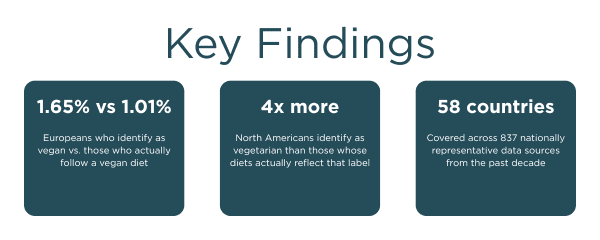
Published yesterday, the Faunalytics report is the largest synthesis of vegetarian and vegan dietary data attempted to date, drawing on 837 nationally representative sources across 58 countries between 2015 and 2025. Its central finding is a structural one: 87% of nationally representative veganism data comes from Europe and North America, two regions that together account for roughly 16% of the global population. No comparable data exists for Sub-Saharan Africa or South Asia, which together represent close to 40% of humanity.
That absence matters for anyone trying to size the global plant-based opportunity. Much of the industry’s market narrative, including assumptions about growth trajectories and consumer readiness, rests on a dataset that is geographically skewed by design.
Where growth is occurring, it is incremental. In Europe, where the data is most complete, veganism has grown at approximately 0.1% per year over the past decade.
What people say versus what they eat
The report also documents a consistent gap between self-identification and actual dietary behaviour. In North America, 3.24% of respondents claim to follow a vegetarian diet, while dietary intake data suggests only 0.75% genuinely abstain from meat. Similar disparities appear across other regions.
The report frames this not only as a measurement problem but as a potential lever for advocates and brands. “This gap isn’t just a data problem, it’s an opportunity,” it notes, adding that people who aspire to a plant-based identity but have not fully adopted the diet may be especially receptive to targeted support and messaging.
This identity-behaviour mismatch is a recurring challenge in plant-based market research, and one that has led to overstated demand estimates in past industry reports. Producers and investors relying on self-reported consumer surveys without cross-referencing intake data risk misreading actual market depth.

A fragmented definitional landscape
A further complication is terminological. The report found dozens of distinct definitions for “vegetarian,” “vegan,” and “flexitarian” across the surveyed literature, making cross-regional and cross-temporal comparisons unreliable. Without standardized definitions, growth figures from one country or study cannot be meaningfully stacked against those from another.
Faunalytics calls on researchers to expand data collection in underrepresented regions, pair self-identification surveys with dietary intake measures, and apply greater definitional consistency. For advocates and industry participants, the report urges caution when citing vegan statistics and warns against treating European growth trends as globally representative.

No comments:
Post a Comment