Monday, November 16, 2020

This new Aldi product is making vegan Thanksgiving easy

From mashed.com

Thanksgiving gives us the perfect excuse to get together with friends and family and eat until we're so stuffed we can no longer move. While many of us look forward to the turkey centrepiece at each feast, vegetarians, vegans, pescatarians, and anyone looking to avoid meat during the holiday season often feels the strain of passing up some of the festive cheer. The appeal of meatless turkey has caught on over the years, and the numbers don't lie. According to Fortune, the meat-alternative brand Tofurky has sold over 5 million of their Thanksgiving roasts as of 2018. With this kind of mass appreciation for turkey alternatives, it's high time some new competition stepped in. Luckily, those meat-free Thanksgiving prayers have now been answered.

Enter Earth Grown Vegan's Meatless Turkey Breast, a meat-free turkey product that can accommodate even the strictest vegan diet. According to Instagram user @aldi.mademedoit, this easy turkey substitute has officially hit Aldi stores just in time for our pre-Thanksgiving meal planning — talk about perfect timing. If you'd like to try this meat alternative, we recommend hurrying over to your nearest Aldi as soon as possible; every store may not carry the product and when supplies run out, Earth Grown Vegan's Meatless Turkey Breasts may not return (via Aldi).

Why you should give Aldi's Meatless Turkey Breast a try
    
    If you do manage to get your hands on Earth Grown Vegan's Meatless Turkey Breast, you can plan on having a much more relaxing holiday. According to The Kitchn, it takes 24 hours to thaw a 5 pound bird. You want to buy a turkey that weighs at least one pound per person you're cooking for, so assuming you still need to feed a small crowd this year, you have to spend around two days simply thawing the meat before you can even think of putting the poultry in your oven. Factor in any time spent dressing and basting your bird, preparing additional sides, and cooking almost everything in the oven, and you might end up spending the entire day in the kitchen instead of relaxing with loved ones.

When you compare the traditional turkey cooking process to Earth Grown Vegan's product, the differences seem like night and day. Instead of slaving away in the kitchen for days leading up to the holidays, the meal takes far less time to prepare and could even be warmed up in a microwave (according to one review on abillonveg) if you are really pressed for time. Don't forget about your non-meat eating friends and family this holiday season and have an inclusive celebration with this festive Aldi product.

I can’t believe it’s not meat: the best vegan fast food 

From ft.com

Plant-based alternatives to comfort-food classics are big business. But which ones really deliver?

At present my dietary outlook looks like this. As a reducetarian, I consume meat but want to cut back for health and animal-welfare reasons. Being lactose-suspicious (rather than intolerant), I try to avoid dairy, except for creamy desserts, which I consider a professional hazard/perk. An open-minded carnivore, I don’t bat an eyelid about dining at a vegetarian or vegan restaurant because a meal can still satisfy me without meat (less so without wine, or at least an aperitif).

With this in mind, I’m always on the lookout for simple vegan recipes. Natalie Portman’s Instagram feed has become a fruitful source. A vegan since 2011, the Oscar-winner has been posting videos of herself cooking in her Montecito and Los Angeles kitchens. Some of her recipes are more involved but the one for roasted cauliflower is a breeze (you boil the head, cover it with avocado oil and salt, and bake). Another for sweet potato fries is basically the same but works particularly well as a way to incorporate plant-based food into children’s diets. “It sounds unhealthy,” Portman notes, “but is in fact healthy… in other words, perfect for kids.”

There’s a belief that “meatless” vegan food (particularly fast food) is healthier than the meat equivalent, which isn’t always true. It depends on how processed the meat substitute is and the levels of saturated fat, among other factors. Nonetheless, even meat-eaters are increasingly seeking out non-meat alternatives. According to Meriel Armitage of Club Mexicana, the plant-based Mexican street food brand that recently opened an outlet in London’s Soho, non-vegans make up 70-80 per cent of her clientele. Their tastes are a key reference point. “Anyone who runs a vegan or vegetarian restaurant and tells you they don’t think about the comparison with meat restaurants or meat dishes is either not telling the truth or isn’t considering everything they should in how satisfied the customer is going to be,” she says.

Marli’s Kitchen vegan fried “chick’un”
Marli’s Kitchen vegan fried “chick’un” © @marliskitchen

“It’s not that I’m going, ‘How do I make this taste like meat?’” Armitage explains. “It’s about the experience. When you’re eating a meal you want it to deliver on certain aspects. For me, a Club Mexicana dish has to be bold in flavour and have zingy freshness. It’s got to look nice and deliver texturally. When you bite into things, you want that chewy texture like meat or fish. You want crunch, acidity, some creaminess or fat. It’s not that vegan food has to be as good as meat dishes; it has to be better.” Armitage has set the benchmark. Her tacos (jackfruit, seitan, tofu and soy) are astounding. I especially like the Baja Tofish taco with beer-battered tofish (of convincingly fishy consistency), slaw, pico de gallo, chipotle mayo and avocado.

Club Mexicana tacos
Club Mexicana tacos © Nic Crilly-Hargrave

My meat cravings tend to centre on burgers and fried chicken. And there are fantastic vegan options for both. One of my favourites is Halo Burger in Brixton and Shoreditch (also available from Deliveroo), which recalls McDonald’s circa 1987. The fries come in red-and-yellow cardboard cartons. The burgers consist of thin patties in white buns with diced onion, tomato, lettuce and pickles. There may be better burgers but these taste of my childhood.

For a homemade version, I recommend a recipe by cookery writer Anna Jones from A Modern Way to Eat (Fourth Estate). Distrustful of veggie burgers, she sought to create one that escapes any “nut-roast-at-brightly-painted-café-wearing-hemp-trousers” connotations. Her Really Hungry burger contains portobello mushrooms, thyme, cannellini beans, medjool dates, garlic, parsley, tahini, soy sauce, brown rice and lemon zest, and has a satisfying roundness of flavour and density. 

For vegan fried chicken, I can’t rave enough about the crispy oyster mushrooms from street-food vendor Marli’s Kitchen (available for delivery in London, goodeats.io/marliskitchen). Not as juicy as chicken wings, they are still deliciously chewy with a spicy batter that drew groans of pleasure when I gobbled one after the other.

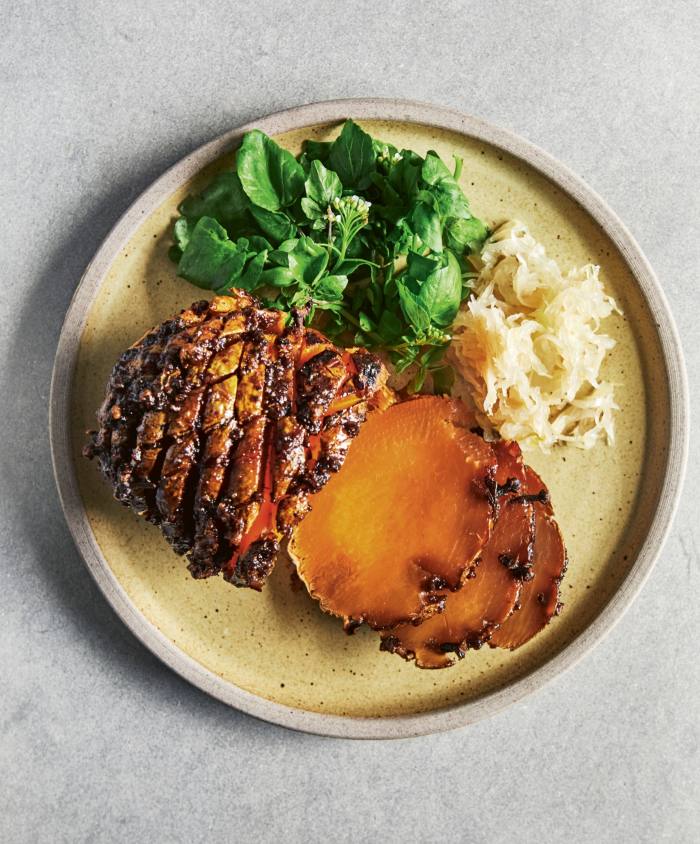
In anticipation of Boxing Day, when I always roast a ham, I also tried a recipe from Tom Hunt’s book Eating for Pleasure, People & Planet. “A swede pretending to be a ham” required studding a swede with cloves, roasting it for an hour and finishing with a mustard/sugar glaze. It wasn’t exactly ham but it did showcase many of the same flavours and was surprising tasty with sauerkraut in a bun.

Tom Hunt’s Vegan ham

Tom Hunt’s Vegan ham © Jenny Zarins

For steak I don’t think any plant-based fillet lives up to the promise of a good T-bone. As for “facon”, I have tried a few varieties and come to the conclusion that, in a BLT with lots of mayonnaise, I can just about settle for This Isn’t Bacon. But why settle? I managed to get my hands on a cutting-edge version from Atlast (a spinoff of New York biotech company Ecovative) that is made from mycelium fibres (the filament-roots of mushrooms). The rashers looked like mummified banana skins, but they sizzled beautifully in the pan, crisped up nicely and had a lovely brittle snap. They tasted like bacon, too. Uncannily so. The product is currently only available in Honest Weight Food Co-op in Albany, upstate New York. But there are plans to widen distribution next year: one more reason, I suppose, for wanting 2020 to be over and 2021 to hurry along.

https://www.ft.com/content/8f370ebb-3aa0-40ce-b4fd-e30e98e76e9d

Sunday, November 15, 2020

Vegan On A Budget: 5 Easy Tips To Save Money During Covid-19

From greenqueen.com.hk

COVID-19 has brought unprecedented changes to our lifestyle, moreover, it has enabled us to rethink ways through which we can make our lives healthier and more cherishing. According to a recent report from Nestle, the sales of plant based alternatives increased 40% compared to other categories. The pandemic made people realize the hazardous outcomes of  animal based food products and now they are more aware of the benefits of living a vegan lifestyle. 

While the latest research shows rising demand for plant-based food across the world, there are still some challenges and widespread myths about veganism, which prevents a large section of the society from shifting towards a complete plant-based diet. The most common misconception is that vegan food is not budget friendly for you, especially after COVID-19, when most of the individuals and families are facing budget constraints due to less earning. 

Fortunately, this fact is far from reality, and even it is more likely that you save a good chunk of money if you pay close attention to these amazing tips to eat vegan on a budget during corona.

1) Eat seasonal fruits and vegetables     

Have you ever noticed that strawberries are way too expensive in winters? While apples cost less in the same season. Well, you can save a reasonable amount of money too every week, if you take a seasonal vegan diet, the difference in prices of a seasonal and non seasonal fruit can be as much as by 50%, but apart from this there are so many other benefits of eating seasonal fruits and vegetables. 

These are not only cheaper but also, more fresh and nutritious because as soon as the vegetables are picked from the fields in which they are grown, they begin to lose their nutrient content. 

Moreover, when you eat seasonally, you favour a sustainable food chain which is in alignment with plants’ natural life cycle. Therefore, the habit of eating seasonal fruits also helps in reducing carbon footprint and it is the easiest way of becoming environment friendly within your budget. 

2) Consider online vegan stores

When you visit a supermarket to buy vegan food items, you often find yourself getting discouraged by the limited and overpriced vegan options. To deal with this, you can consider online vegan stores and some dedicated vegan grocery places, where you will find all kinds of plant-based diet options along with discounts and reasonable pricing.

Online vegan stores and zero waste stores also enable you to compare between different vegan food articles and you can choose the ones, which suit your health and pocket best.

3) Grow your own food

During the COVID-19. It is one of the best practices for vegans to save money, stay healthy and stay safe. Living on a plant-based diet gives you tons of advantages, and one of these is that If you have some space in your backyard or balcony, you can easily grow your own organic vegetables at home without any prior agriculture knowledge. 

All you need is soil, seeds and some useful tips for managing your home garden, and within a couple of months, you would be saving both money and time that you can spend on other vegan friendly stuff and activities. 

Apart from growing, you can also consider making your own vegan cupcakes, breads and other recipes at home with simple easy to available ingredients.

4) Purchase pantry staples in bulk

Vegan staples such as lentils, beans, oats, rice, etc. can be purchased in large quantities as these food items can be stored in your kitchen easily, and you will be saved from the trouble of going grocery shop again and again. 

When you buy vegan goods in bulk, you are likely to get good offers on your purchase and thus, you are saving money, fuel and time altogether. 

5) Avoid unwanted & un-needed supplements

Awareness of your diet plays a significant impact on your pocket, especially when you’re a part of the thriving vegan culture. There are many companies and brands, who spread false information and claims to sell their vegan products.

For example, there is a common myth that vegans need to intake numerous additional protein and vitamin based supplements to maintain a balanced diet and stay healthy, but the truth is, only Vitamin B12 is required as an additional supplement for vegans. 

Being Vegan is Budget-Friendly, Eco-Friendly and Life-Friendly

When you become a vegan, you follow a lifestyle that promotes sustainable living, animal welfare and carbon footprint reduction. Moreover, you are already saved from the risk of various health issues that cost huge sums of money and your precious time of life. 

All these factors along with efforts to increase your understanding of vegan diet, can bring a lot of positive change towards keeping the planet healthy and wealthy. 

https://www.greenqueen.com.hk/vegan-on-a-budget-5-easy-tips-to-save-money-during-covid-19/

Saturday, November 14, 2020

130-Year-Old British Bakery Launches Vegan Violife Cheesy Bake at 160 Locations in the UK

From vegnews.com

British bakery Cooplands recently partnered with vegan brand Violife to launch a vegan Cheeze and Vegetable Bake. The new bake combines Violife Epic Mature Cheddar cheese with vegetables and a creamy sauce in Cooplands’ flaky pastry. It was created to meet the increasing demand for vegan options in parts of England, including the North East and Yorkshire.  

“We are excited to partner with Violife to create a new plant-based cheeze bake using their great-tasting cheese replacement product,” Belinda Youngs, CEO at Cooplands, said. “For people who are either vegan or just looking to eat less meat in their diet or trying to do their bit for the environment, it is a tasty option.”

130-Year-Old British Bakery Launches Vegan Violife Cheesy Bake at 160 Locations in the UK


The new Cheeze and Vegetable Bake is available at more than 160 Cooplands locations in Yorkshire, Lincolnshire, and the North East of England. It joins the bakery’s existing plant-based line-up, which includes a vegan sausage roll and steak bake.

https://vegnews.com/2020/11/130-year-old-british-bakery-launches-vegan-violife-cheesy-bake-at-160-locations-in-the-uk

How to get protein as a vegan from 6 plant-based foods including sources of complete proteins

From msn.com

How to get protein as a vegan requires a little more effort than if you're vegetarian or eat meat, but it's not impossible.
  • Of the five main food groups, vegans will get most of their protein from the protein foods category which includes nuts, seeds, soy, and legumes.
  • Read on to learn about the vegan-friendly foods that are considered complete proteins.
  • This article was reviewed by Samantha Cassetty, MS, RD, nutrition and wellness expert with a private practice based in New York City.

  • One of the main concerns vegans may have is how to get their protein when they aren't consuming what many consider to be the traditional sources of protein.

    In addition to avoiding meat, vegans take their diet a step further than vegetarians because they cut out all animal byproducts including protein-rich foods like eggs, Greek yogurt, and certain brands of dry-roasted peanuts that contain gelatin, which is made from animal collagen.

    Despite these numerous dietary restrictions, "as long as the diet includes a variety of protein-rich plant foods, consuming adequate protein is not a problem for vegans," says Samantha Heller, MS, senior clinical nutritionist at NYU Langone Health.

    How much protein you should get each day largely depends on your age and activity level. Check out this handy calculator from the FDA to find out how much protein you should be getting each day. For an average healthy, active adult it should be between 50 to 70 grams of protein, or about 0.4 to 0.9 grams of protein per pound of body weight.

    There are five main food groups: fruits, vegetables, grains, protein foods like pulses (beans and legumes), nuts and seeds, and dairy. Most of a vegan's protein will come from – you guessed it – the protein foods category, but grains also provide some protein to a lesser degree. Below is a breakdown of protein-rich foods in each of those three categories. 

    Protein foods

    Legumes

    • Chickpeas: 1 cup cooked contains 14.5 grams of protein
    • Lentils: 1 cup cooked contains 17.2 grams of protein
    • Beans (black, pinto, kidney, lima): 1 cups of black beans contains 8.9 grams of protein
    • Peas: 1 cup contains 15.1 grams of protein
    • Peanuts: 1 serving size (28 grams) contains 7 grams of protein

    Soy

    • Soy milk: 1 cup contains 6.3 grams of protein
    • *Tempeh: 1 cup contains 33.7 grams of protein
    • *Tofu: 3.5 ounces (100 grams) contains 10.1 grams of protein
    • *Edamame: 1 cup contains 16 grams of protein

    Nuts and nut butters

    • Almonds: 1 cup of dry roasted contains 29 grams of protein, or two tablespoons of almond butter gets you 6.7 grams of protein
    • Cashews: 1 cup of dry roasted contains 21 grams of protein, or two tablespoons of cashew butter gets you 3.9 grams of protein
    • Pistachios: 1 cup of dry roasted contains 26 grams of protein, or two tablespoons of pistachio butter gets you 6 grams of protein
    • Walnuts: 1 ounce (28 grams) of dry roasted contains 4 grams of protein, or two tablespoons of walnut butter gets you about 5 grams of protein

    Seeds

    • Sunflower seeds: 3.5 ounces (100 grams) contains 11.67 grams of protein
    • Flax seeds: 1 cup contains 30.7 grams of protein 
    • *Chia seeds: 3.5 ounces (100 grams) contains 15.4 grams of protein
    • *Hemp seeds: 3.5 ounces (100 grams) contains 30 grams of protein

    Vegetables

    • Spinach: 3.5 ounces (100 grams) contains about 2.35 grams of protein
    • Broccoli: 3.5 ounces (100 grams) contains about 2.7 grams of protein
    • Kale: 3.5 ounces (100 grams) contains about 3.54 grams of protein
    • Green beans: 3.5 ounces (100 grams) contains about 2.35 grams of protein

    Grains 

    • Whole wheat bread: Once slice contains about 6 grams of protein
    • Whole wheat pasta: 1 cup contains about 12 grams of protein
    • *Quinoa: 1 cup contains about 8 grams of protein
    • Old fashioned oats: 1/2 cup raw oats contains 10 grams of protein 

    *These are foods considered a complete protein. Read on to learn more.

    A complete protein source is one that contains all nine essential amino acids. We need each of these nine amino acids for a healthy diet — hence why they're called "essential" amino acids.

    Many animal products and byproducts, like steak and eggs, are complete proteins, which is one of the main differences between many vegan and non-vegan diets. However, you can still get all nine essential amino acids either by eating plant-based complete proteins, like the ones included in the list above or by eating a balanced diet of incomplete proteins from the various sources listed. It may just take a little more effort.

    If you're not feeling your best and are concerned that you aren't getting enough protein as a vegan, consider working with a registered dietitian who can identify any gaps in your diet and make sure you're meeting your nutrient needs. 

    https://www.msn.com/en-us/health/nutrition/how-to-get-protein-as-a-vegan-from-6-plant-based-foods-including-sources-of-complete-proteins/ar-BB1aZBfb?li=BBnb7Kz


    NEXT! Announces Expansion Of ‘The World’s Most Realistic’ Vegan Bacon

    From plantbasednews.org

    'We have worked really hard to ensure NEXT! Bacon is as juicy and realistic as possible'

    World's most realistic vegan bacon
    NEXT! says its product is the world's most realistic vegan bacon
    Credit: Supplied

    Australian plant-based meat giant NEXT! has unveiled expansion plans for its self-proclaimed ‘tastiest and most realistic’ vegan bacon style strips.

    The brand claims its plant-based bacon is a ‘world’s first’ and free from cholesterol.

    ‘It crackles like real bacon’

    Biren Doshi, founder of NEXT! claimed it is imperative that meat-free bacon be as juicy and tasty as the real thing.

    In a statement to Plant Based News, he said: “We have worked really hard to ensure NEXT! Bacon is as juicy and realistic as possible.

    “There is none of the dryness associated with some plant-based bacon.

    “It also crackles like real bacon in the pan – that sound, along with the mouth-watering aroma of bacon are two of the greatest pleasures when cooking and eating bacon.

    “It was crucial that we got those details right.”

    Moreover, Doshi claimed the bacon is quicker to cook than the real thing – requiring just three to five minutes of cooking and a splash of oil.

    Vegan bacon

    NEXT! bacon products are now available in Countdown stores across New Zealand.

    This comes as other plant-based bacon alternatives have increased in popularity.

    Last month, meat alternative brand THIS announced it had sold 4.5 million portions of its vegan bacon in 2020.

    In addition, THIS also announced the launch of its products in hundreds of Asda stores in the UK.

    https://plantbasednews.org/lifestyle/food/worlds-most-realistic-vegan-bacon-debuts/

    Vegans have insatiable sex appetite and romp twice as much as meat eaters, survey finds

    From mirror.co.uk

    EXCLUSIVE: A whopping 84% of vegans are satisfied with their sex lives - compared to a mere 59% of meat eaters, with the majority romping four times a week, compared with two for meat eaters

    Vegans have an insatiable appetite for sex and get their oats four times a week.

    It means they have twice as many romps as those who prefer rumps… steak, that is.

    Researchers found 84 per cent of vegans are satisfied with their sex lives – compared to a mere 59 per cent of meat eaters.

    Famous vegans include Sir Paul McCartney and Ellie Goulding, for whom music is also the food of love.

    Actors Thandie Newton, Benedict Cumberbatch and Zac Efron make a play for vegan food so they should be happy too – while tennis superstar sisters Venus and Serena Williams may also be having a smashing time.

    Strict vegans eat a plant-based diet, with tofu a favourite. Meat, fish and animal-based dairy are shunned.

    Fifty-seven per cent report having sex four times a week. In meat eaters, just half make love twice every seven days.

    Some 92 per cent of vegans describe their love lives as “great” and 58 per cent are so full of beans they always have energy for sex. With meat eaters the figures were 79 and 35 per cent respectively.

    Vegans are more adventurous too, the survey found.

    Two-thirds are prepared to experiment in the bedroom, yet more than half of meat eaters admit they are chicken when it comes to throwing off the shackles.

    And meat eaters are just a little bit shellfish too.

    Just 35 per cent describe themselves as “givers”, compared to 58 per cent of vegans.

    Dating website IllicitEncounters.com quizzed 500 vegans and 500 meat eaters.

    Spokeswoman Jessica Leoni said: “Vegans are masters of seduction it would appear. Our statistics don’t lie and vegans eat foods known for their aphrodisiac qualities such as ginseng and aniseed.

    “But I’ve never heard of a rack of barbecue ribs or a lamb shank turn anyone on.”

    https://www.mirror.co.uk/news/uk-news/vegans-insatiable-sex-appetite-romp-23010568